Press & reviewer kit · v1
A rosacea tracker that respects current dermatology consensus.
Skinframe is the photo-first rosacea tracker for iPhone, built around the ROSCO 2017 phenotype framework instead of the abandoned subtype model every other app still ships. PSA-derived per-feature severity. Ocular-symptom tracking. Skin-tone-branched onboarding that foregrounds sensory phenotype on Fitzpatrick IV-VI per the published literature. Made by SailQuery LLC, an independent iOS studio. Free reviewer access is available on request.
Why we built it
The category is using a model dermatology already retired.
Every rosacea-named consumer app on the App Store still uses the four-subtype model (erythematotelangiectatic, papulopustular, phymatous, ocular). The international ROSCO consensus retired that model in 2017 and replaced it with a phenotype-based framework: patients have features, not subtypes, and the features change over time. The literature moved on. The apps didn't.
We built Skinframe around the phenotype framework. Per-feature severity rated independently, not collapsed into a composite IGA score. Ocular involvement tracked as a first-class phenotype (50-72% of cutaneous-rosacea patients have it, per published literature, and zero consumer apps surface it). Skin-tone-branched onboarding that recognizes Fitzpatrick IV-VI presents as sensory phenotype (burning, stinging) rather than visible redness, per Adamson and Smith.
Photos stay in a sandboxed app folder on-device. Severity and trigger metadata syncs through the user's private CloudKit container under their Apple ID. We don't operate user-facing servers and can't read user CloudKit. The dermatologist-handoff PDF generates locally and lays out the methodology so a clinical reader can judge the evidence in 30 seconds.
Pick your angle
Four story angles, dermatology evidence attached.
Each angle is a starting frame, not a finished pitch. Use what fits your beat. Citable sources sit one section down.
01 · The model dermatology retired
Why no consumer rosacea tracker uses the current consensus
The international ROSCO 2017 consensus replaced the four-subtype model with a phenotype framework. Every rosacea-named iOS app still ships the retired model. Skinframe is built around the consensus the literature moved to nine years ago.
Evidence: Tan J et al., "Standardized grading of rosacea: an update from the global ROSCO consensus panel" (ROSCO 2017). Multi-competitor schema audit (Rosacea Diary, Thea, Bearable, Daylio) confirms persistent subtype usage.
02 · The 50-72% of patients with ocular involvement
The most-undertracked rosacea phenotype
Ocular rosacea (dryness, burning, grit, blepharitis) affects 50-72% of cutaneous-rosacea patients per the literature. Every other rosacea app treats it as an afterthought or omits it entirely. Skinframe surfaces it as a tracked phenotype, not a checkbox.
Evidence: Vieira ACC, Mannis MJ. "Ocular rosacea: a review." Arq Bras Oftalmol. 2013. NRS-CSR consensus diagnostic criteria for ocular rosacea (2018 update).
03 · Skin-tone bias in tracking apps
Why visible-redness-only UX fails Fitzpatrick IV-VI
Rosacea on darker skin presents as sensory phenotype, burning and stinging, often without the visible erythema that defines diagnosis on lighter skin. AI face-scan apps inherit the Adamson and Smith / Daneshjou skin-tone-bias problem. Skinframe's onboarding branches on Fitzpatrick type to foreground sensory phenotype where the visual cue isn't reliable.
Evidence: Adamson AS, Smith A, "Machine Learning and Health Care Disparities in Dermatology" (JAMA Dermatology 2018). Daneshjou et al., "Disparities in dermatology AI performance on a diverse, curated clinical image set" (Sci Adv 2022).
04 · No corpus of faces
An anti-AI-positioning stance from a builder studio
The "AI face scan" rosacea apps require uploading your face to a third-party server. Skinframe doesn't. Photos stay on-device in a sandboxed folder. Metadata syncs through your private CloudKit container. We literally don't have a corpus of users' faces, and we never will. For a category increasingly defined by AI dermatology theater, the absence is the position.
Evidence: Skinframe codebase (CloudKit private database, no server-side image storage). Two operations-only third-party SDKs in the binary (TelemetryDeck for usage, Sentry for crashes), both under a strict no-PHI allowlist.
Evidence the app rests on
Cite freely. Sources below.
Skinframe's positioning is anchored in peer-reviewed dermatology consensus, skin-tone-equity literature, and the on-device engineering posture.
Phenotype consensus
"The international ROSCO consensus retired the four-subtype model in 2017 in favor of phenotype-based assessment. Patients have features, not subtypes."
Ocular prevalence
"Ocular involvement (dryness, burning, blepharitis) affects between 50 and 72 percent of cutaneous-rosacea patients."
Skin-tone bias
"Dermatology AI models trained on lighter-skin datasets underperform on Fitzpatrick IV-VI patients. The bias is structural, not incidental."
Engineering posture
"Photos stay on-device in a sandboxed folder. Metadata syncs through the user's private CloudKit container. Skinframe does not have a corpus of users' faces and never will."
What it actually looks like
Three screens that carry the wedge.
Renders from the iOS build. Free to use in editorial coverage with credit. Higher-resolution device-framed versions are in the asset bundle below.
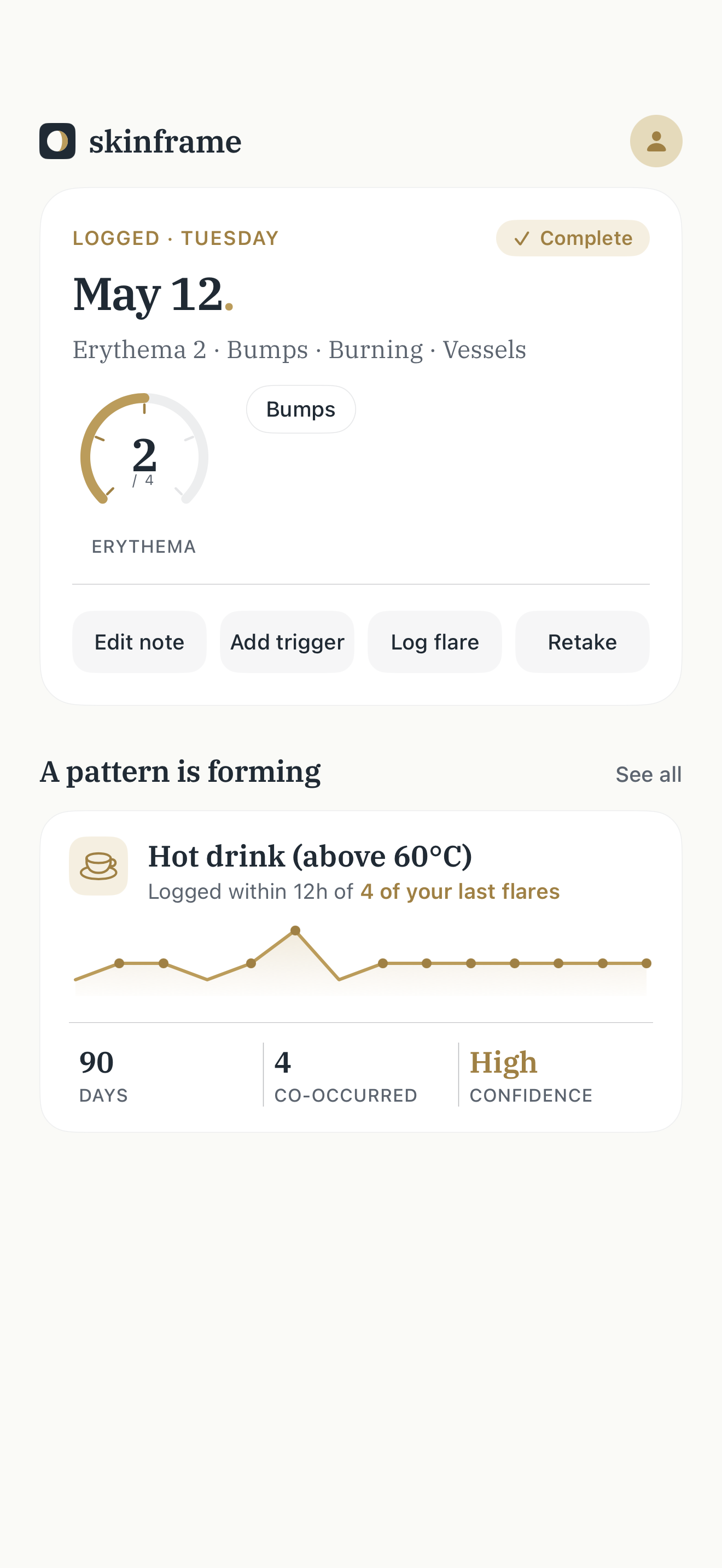
01 · Ten-second daily check-in
Today
Selfie, per-feature severity, one trigger tag. The whole thing fits in the time a flare-up still lets you think.
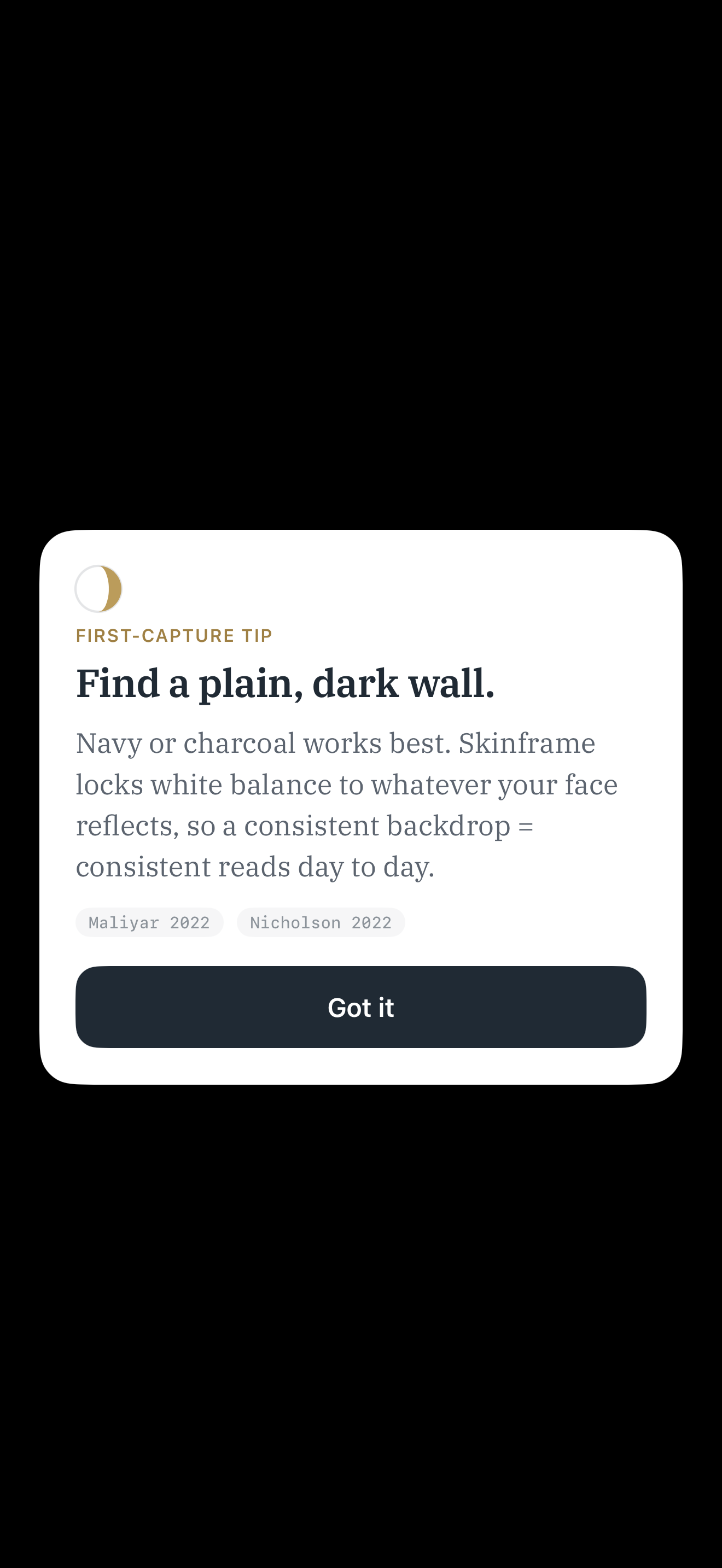
02 · White-balance-locked capture
Photo
Week-1 and week-6 selfies use the same exposure and white balance. Real differences, not phone-camera artifacts.
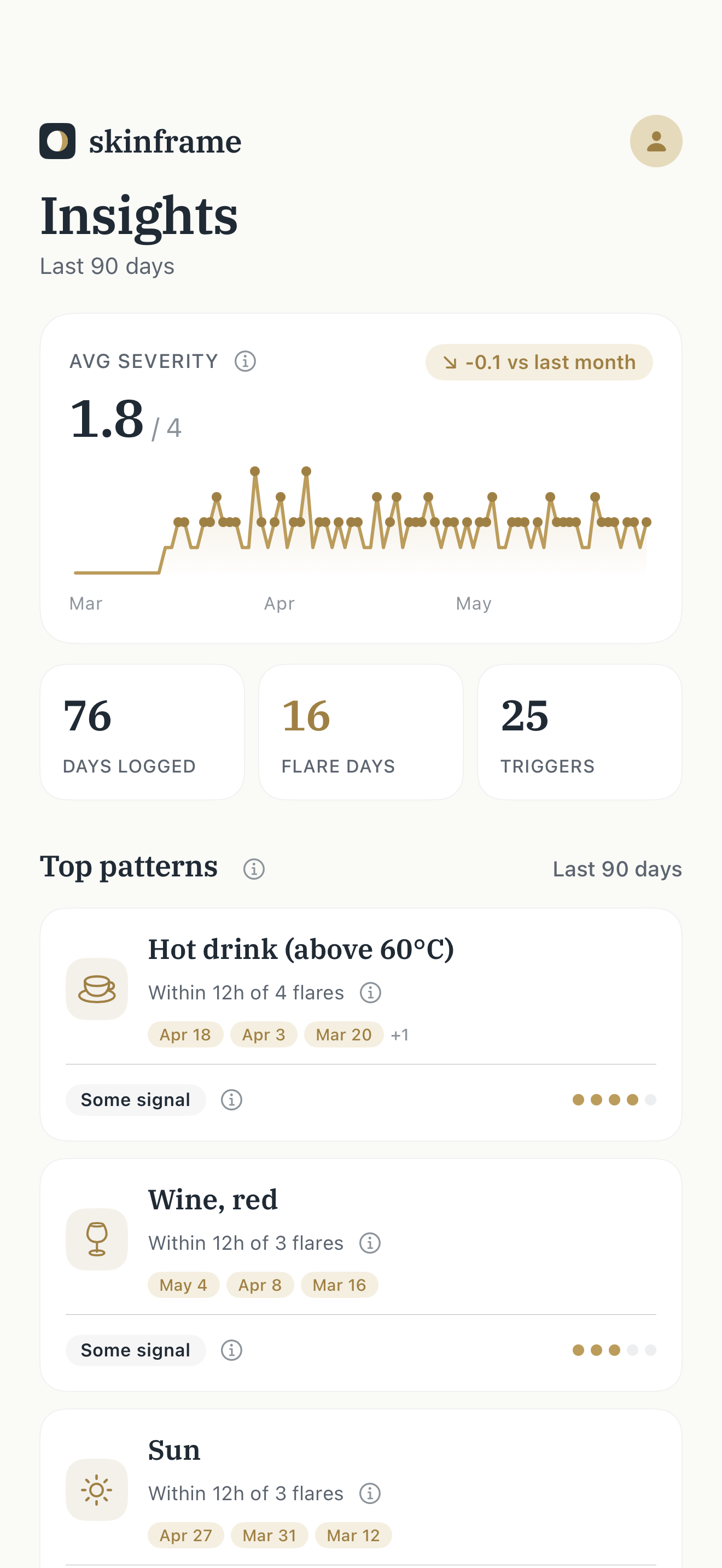
03 · Lag-aware patterns
Patterns
12 to 72 hour lag windows tuned to physiology. Three matching events required before any pattern surfaces. Co-occurrence not causation, on every insight.
The company
skinframe.
A company of builders · SailQuery LLC
"We literally do not have a corpus of users' faces. We never will. That's not a marketing line. That's the engineering posture."
The narrative.
Skinframe is built by a small company of builders inside SailQuery LLC, an independent iOS studio that ships privacy-first apps for human niches the consumer-software industry overlooks. Rosacea is the kind of niche we mean: 16 million Americans, almost no software written for them, and a category occupied by AI face-scan apps that monetize the face you upload.
We took the opposite position. Photos stay on your device. Metadata stays in your private CloudKit container. We don't run servers that touch user images, by design. The dermatologist PDF is generated locally on the phone. The schema follows ROSCO 2017 because the literature already moved there. Skin-tone-branched onboarding exists because Adamson and Smith and Daneshjou are right about what AI dermatology gets wrong.
SailQuery LLC also ships Postdrome (migraine tracking), Platepusher (strength training), Met (networking), and SailQuery (cruise loyalty). Full portfolio context at sailqueryllc.com.
Reviewer kit
Everything you need to write or film this in under an hour.
60-second pitch · paste-ready
Skinframe is the photo-first rosacea tracker for iPhone built around the ROSCO 2017 phenotype framework instead of the four-subtype model the dermatology literature retired. Per-feature severity, ocular-symptom tracking, skin-tone-branched onboarding for Fitzpatrick IV-VI, white-balance-locked photo capture, lag-aware trigger correlation with a co-occurrence-not-causation footnote on every insight. Photos stay on-device in a sandboxed folder, metadata syncs through the user's private CloudKit container. 14-day free trial, then $29.99 one-time lifetime or $4.99/month auto-renewing. Read-only and CSV export remain available after the trial without any purchase. Built by a small company of builders at SailQuery LLC.
Reviewer access
Free Lifetime, on us.
Email press@sailquery.com and we send a one-tap redemption link from App Store Connect. Unlocks Skinframe Lifetime free, forever, on your Apple ID. Per-recipient, one-time use, no auto-renew, no charge ever.
Request a code →Five things to try in ten minutes
- Run the onboarding and pick a Fitzpatrick range past IV. Watch the schema branch into sensory phenotype (burning, stinging) instead of visible redness.
- Take the daily check-in selfie. Notice the white-balance-locked framing UI; the photo is comparable to next week's by design.
- Open Patterns. Wait until at least three matching events exist before any pattern surfaces (that's the literature-grounded floor, not a UI delay).
- Generate the derm-handoff PDF. It's a single page, journal-paper-formatted, designed to be skimmed in 30 seconds by a clinician with a 12-minute visit.
- Open Settings, turn off iCloud sync. The app keeps working local-only. Then export your data as JSON + photo bundle. Free, no paywall.
Brand assets
Use these in editorial coverage with credit.
Logos, wordmark, app icon, and product screenshots are available under a non-exclusive press use license. Don't modify the marks or use them to imply endorsement.
1E2A35
FAFAF7
C19A4F
F4F1EA
The placemat
A printable one-pager, designed for the press inbox.
The same content as this page, condensed to one US Letter portrait page with real screens. Designed to skim, pin, or forward to an editor. We send the PDF and your one-tap reviewer code together.
Reach us. Reply within a day.
Interview requests, advance review copies, embargo coordination, clinical inquiries, or anything not covered above. Monitored by the Skinframe team directly. Twenty-minute Zoom or async Q&A available on request, usually within fourteen days.