Every rosacea diary gets abandoned on the day that matters most.
Paper booklets, printable PDFs, and tracking apps all fail at the same moment: the flare day, when logging takes effort nobody has left.
The page stays blank on the night it matters
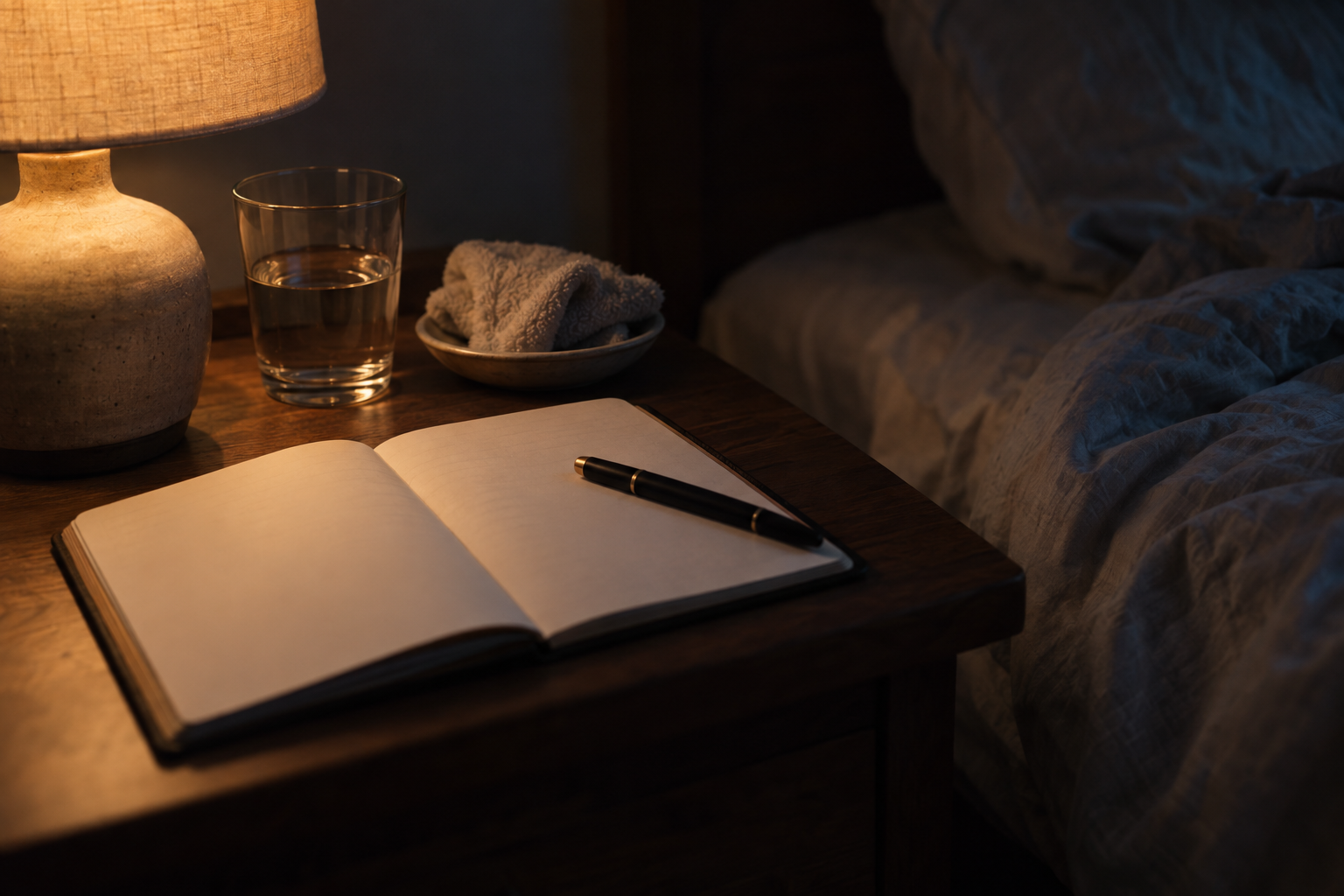
The flare started around lunch. By nine at night the cheeks still burn, the skin feels tight and hot, and the rosacea diary a dermatologist asked for is sitting on the nightstand with today's page empty.
Filling it in means reconstructing the day. Breakfast, how hot the coffee was, whether the office was warm, what went on the skin this morning, how stressful the afternoon got. Then rating the redness. Then maybe photographing a face nobody wants to look at right now.
So the page stays blank. Tomorrow it's two days behind, and by the weekend the diary is back in a drawer.
That empty page was the most important entry in the whole book.
Good-day design
Every rosacea diary format we can trace back through the category was built around a good day. Paper, PDF, app: each one assumes the person holding it has time, a steady mood, and the willingness to write, categorize, and photograph.
Flare days take all three away.
We call this good-day design, and it explains why the diary keeps getting reinvented without ever sticking. A trigger diary exists to answer one question: what happened before the flare? The only entries that can answer it are the flare-day entries. And those are exactly the entries a good-day design makes hardest to write, because it asks for the most effort at the moment effort is gone.
A trigger diary is only as useful as its worst day's entry.
Why "just build the habit" misreads the problem
The standard advice treats a lapsed diary as a willpower problem. Set a reminder. Keep the booklet by the bed. Log at the same time every night. That advice quietly assumes lapses land at random, a busy Tuesday here, a forgotten Sunday there, and that more discipline fills them in.
But the gaps that matter aren't random. They gather around flares, because the flare is the thing making logging hard: the skin hurts, the mood drops, and staring into a mirror long enough to rate redness is the last thing anyone wants to do.
A diary with holes in those places isn't a slightly worse diary. It's missing the data it was built to collect.
The willpower framing also puts the failure on the patient. So people switch formats instead of questioning the design. Paper didn't work, so try the PDF. Then an app. Each one breaks on the same night, for the same reason.
Fifteen years of reinventing the same diary
The rosacea diary has a longer history than most patients realize. The National Rosacea Society has distributed a paper rosacea diary booklet for years, and patients still request it. Creators have repackaged the same idea as a downloadable PDF, including Lex Gillies' rosacea diary offered as a lead magnet Lex Gillies published a free downloadable rosacea diary PDF on the Rosacea Club Substack ([source](https://rosaceaclub.substack.com/p/rosacea-diary)). A run of dedicated rosacea-tracking apps has followed Market research turned up only one dedicated rosacea tracking/diary app on the App Store (a rosacea-named app focused on skincare-routine and medication logging); a second rosacea-named listing is a pure informational/news app, not a tracker, leaving the rosacea-specific tracking category effectively undefended.. And on r/Rosacea, patients still ask how to keep the diary their dermatologist assigned as homework, with no settled answer The founding signal for the app was a Reddit thread (r/TheGirlSurvivalGuide, post 1syvpn1, ~27 upvotes/23 comments) where the poster explained that their dermatologist wanted them to track rosacea patterns before starting treatment, but the derm's suggested symptom-diary apps were text-only and couldn't capture visual skin changes, leaving no good tool for photographing and pattern-matching flares against triggers.. The span from booklet to that thread runs decades The repo's own evidence trail spans about 28 years: the earliest patient survey data it cites is a National Rosacea Society patient survey from 1998, and the most recent real-world evidence is a Reddit thread surfaced in a 2026 competitive/demand scan showing patients still struggling with the same tracking problem today..
The trigger data explains why the flare-day entry is so demanding. The NRS patient survey on triggers ranked sun exposure, emotional stress, and hot weather near the top, with wind, heavy exercise, alcohol, and hot baths also common National Rosacea Society survey of over 1,000 patients ranked top triggers: sun exposure (81%), emotional stress (79%), hot weather (75%), wind (57%), heavy exercise (56%) ([source](https://dermnetnz.org/topics/rosacea/whats-triggering-my-rosacea)). Most of those happen hours before the skin reacts. So a flare-day entry isn't a quick note about now. It's a reconstruction of the whole preceding day, the hardest kind of writing to do while flaring.
Format
What each entry asks for
What a flare day takes away
Where it tends to break
Paper booklet
Handwritten notes on food, drink, weather, products, stress, plus a severity rating
Time, a steady mood, the will to write it all out
Blank page, then backfilled from memory or not at all
Printable PDF diary
The same fields, printed and filled in by hand
All of the above, plus having printed it in the first place
Stops at the first rough week
Form-based tracking app
Tapping through categories, rating symptoms, sometimes a photo
Patience for a multi-screen form; willingness to look at your face
Skipped check-in, then reminders get muted
Dermatologist-assigned homework (any format)
Whatever the clinic handed over, kept until the next visit
Everything above, now with a deadline
The appointment arrives with the flares missing
Format lineage traced from the NRS booklet, a creator-published PDF diary, dedicated rosacea apps, and an open r/Rosacea request. Failure points are our design analysis of what each format demands, not measured adherence rates.
What a two-week diary actually records
Picture a two-week diary assigned before a follow-up appointment. This is an illustration, not a case.
Days one through eight go fine. The skin is calm, and the entries are thorough: coffee, a morning run, the new moisturizer, a cool week.
On the evening of day eight there's a long hot bath and a glass of wine. Both show up on common trigger lists. Day nine is a bad flare. No entry.
Day ten gets a scrawled line: bad flare, still hot. Days eleven through fourteen are complete again, because the skin has settled and logging feels possible.
At the appointment, the diary holds thirteen careful records of calm days and one gap where the only flare should be. The dermatologist asks what happened the night before it started. The answer comes from memory, which is the exact thing the diary was supposed to replace.
Design for the worst day first
If good-day design is the problem, a prettier booklet or a nicer app won't fix it. The flare-day entry has to be the one the format is built around, and everything else bends to fit it. As a set of requirements, that looks like this.
The flare entry is one action. Doable one-handed, in bed, without typing.
Capture now, explain later. Stamp the time of the flare tonight; add context tomorrow, when you're up to it, with prompts that jog memory about the previous evening.
Let good days carry the load. Record the routine baseline (usual products, usual drinks, usual exercise) when you feel fine, so a flare entry only has to note what was different.
Photos are optional on a bad night, and consistent when taken: same light, same angle, so they're comparable later.
Record how it feels, not just how it looks. Burning, stinging, and tightness belong in the log. On darker skin tones (Fitzpatrick IV to VI, the darker end of the standard skin-type scale), redness can be hard to see or photograph, so the sensory side of a flare carries more of the record In Fitzpatrick skin types IV to VI, rosacea's central facial erythema is masked, unlike the textbook diagnosis relying on visible erythema. ([source](https://www.aestheticsunlocked.co.uk/blog/rosacea-skin-of-colour-fitzpatrick-clinical-diagnosis)).
And no penalty for gaps. Nothing that counts missed days or scolds.
Where Skinframe starts
We built Skinframe starting from that flare-day entry, because it's the one every earlier format was least likely to capture. The worst night should take the least effort: a quick log you can make half-asleep, with the details filled in when you're able Skinframe's flare quick-log is a single-tap capture separate from the daily anchor selfie: tapping "Log a flare event" takes one photo and saves it immediately with no forced trigger or severity entry, so an acute flare can be recorded in the moment without slowing the user down. The severity-at-the-moment and what-triggered-it context are deliberately deferred, filled in afterward from the day's detail view via "Add severity" / "Add trigger," rather than blocking the capture itself.. Photos stay on your phone Skinframe stores every photo on-device in its local data store and, if the user has iCloud enabled, syncs it only to that user's own private iCloud database; there is no SailQuery-operated server that photos pass through or are stored on.. Sensory symptoms sit alongside visible ones. And there's no counter keeping score of the days you skipped.
We're careful about what that means. A better diary doesn't treat rosacea, and nobody has run a rosacea-specific trial on tracking apps.
What we'd tell anyone with a half-finished diary: bring it anyway. A patchy record with the flare days in it is more useful to a dermatologist than a complete one without them. Talk to your dermatologist about what they most want logged, and make that the part that survives a bad night.
What the evidence does and doesn't say
There's no published rosacea-specific RCT showing a tracking app improves outcomes. Evidence in adjacent dermatology conditions (atopic dermatitis, psoriasis) shows patient-reported tracking improves visit outcomes No rosacea-specific clinical trial yet shows that tracking-app use improves dermatology visit outcomes, so Skinframe's research base leans on the closest adjacent-condition evidence: a systematic review/meta-analysis of mobile self-management apps in atopic dermatitis (over 1,000 patients) found clinically meaningful improvement in eczema severity and quality-of-life scores, and broader dermatology literature frames patient-reported outcome tracking as a 'vital sign' that improves patient-clinician communication and visit efficiency.. Skinframe applies the same approach to rosacea. This article's argument is about diary design and abandonment, not treatment.
Try Skinframe on iPhone. Log the next flare in one tap, and fill in the rest tomorrow.
Skinframe comes from a small team of builders who spent a long time with the rosacea literature and the diary formats that came before. It's built around the entry every earlier format lost, the flare-day log, with photos kept on your phone, sensory symptoms tracked alongside visible ones, and nothing that punishes a missed day.