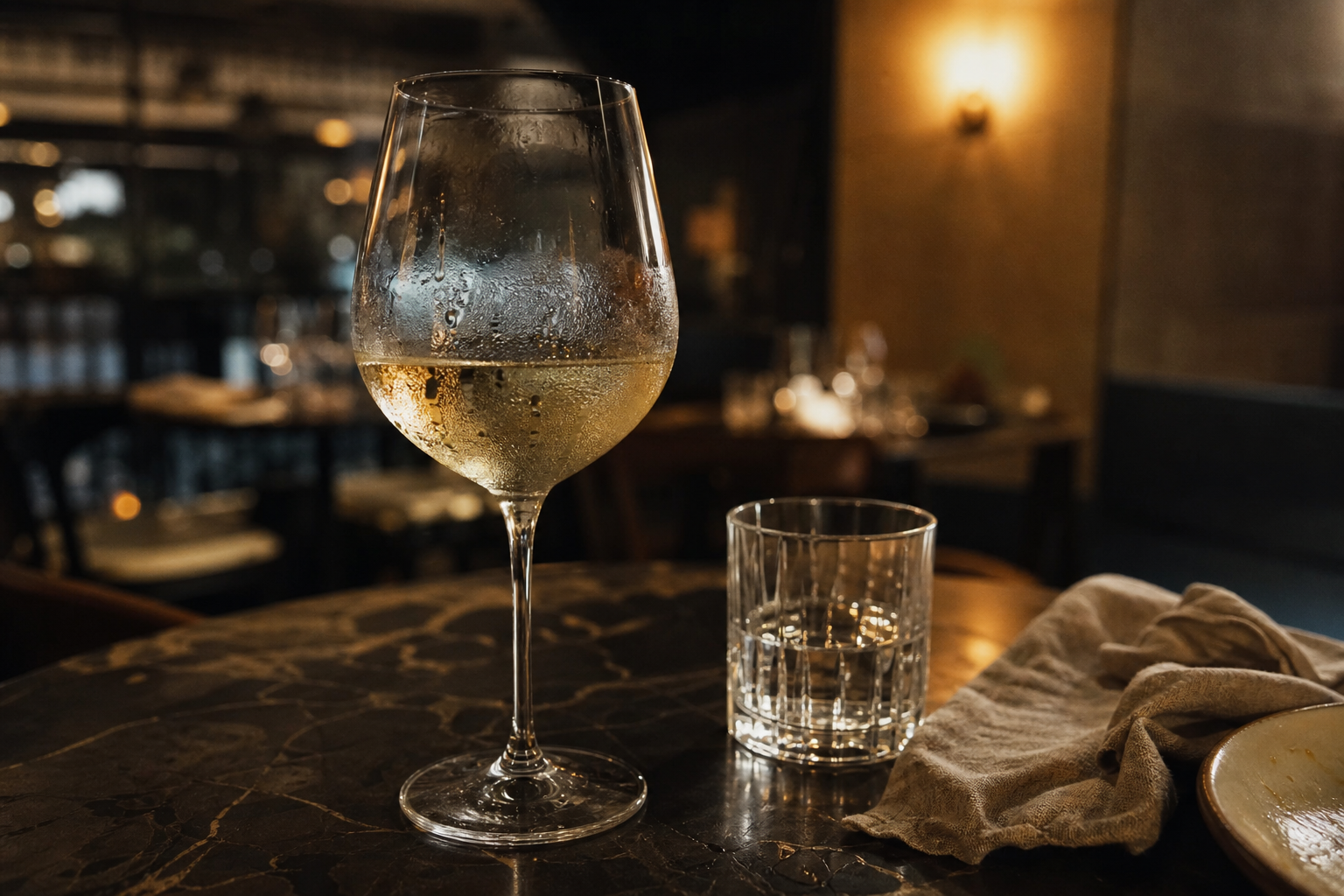
The white wine swap isn't the rosacea fix it feels like.
Trading red wine for white is the most common rosacea substitution there is. The prospective cohort data puts white wine and liquor at equal or higher risk, and most trigger logs can't tell you either way.
The swap that didn't work
The dinner goes like this. You've read enough about rosacea to know red wine has a reputation, so you order the sauvignon blanc instead and feel a little responsible about it. Two glasses, a warm room, dessert, a lot of laughing. By the time you're home your cheeks are burning, and the next morning there's a flush across the nose that takes until Tuesday to settle.
So you blame the room. Or the chili oil. Or the laughing. What almost nobody does at that table is blame the wine, because the wine sacrifice has already been made. That accounting error costs people months of trigger-mapping.
The white-wine amnesty
White wine gets an amnesty in rosacea culture that the evidence never granted it. Red is the villain, white is the compromise, and once a person has made that trade they stop treating alcohol as an open question. The category gets marked resolved.
A swap feels like an experiment. It isn't one. Changing a single variable and writing nothing down produces a story, not a result, and the story tends to be flattering to the change you already made. Meanwhile the flush keeps arriving, so the search moves on to food, weather, stress, skincare, everything except the glass that's still on the table.
We think the amnesty is the single most expensive assumption in patient-run rosacea trigger work, and the type-specific data is the reason.
Naming a trigger isn't the same as measuring its risk
Most rosacea trigger lists trace back to patient surveys, including the National Rosacea Society's long-running trigger surveys, and red wine sits near the top of the alcohol list in the versions people quote. That ranking is a real finding. It just answers a narrower question than the way it gets used.
A survey ranking reflects how often a drink gets named. How often a drink gets named depends on how many people drink it, how dramatic the flush was, how firmly the connection stuck, and what the respondent already suspected before the form arrived. Red wine's reputation predates most people's diagnosis. Reputation shapes recall, and recall is what a survey collects.
There's a structural problem underneath it too. The people most reactive to red wine quit red wine first. Once they've quit, red stops appearing in their exposure at all, and the drink that replaces it is the one carrying the risk from then on.
What the cohort actually measured
A prospective cohort gets at this from the other end. Li and colleagues followed more than 80,000 women in the Nurses' Health Study II, recording alcohol intake by type before any rosacea diagnosis rather than asking people to reconstruct it afterward (Li et al., J Am Acad Dermatol, 2017; Over 14 years of follow-up (1,120,050 person-years), Li et al. 2017 identified 4,945 incident rosacea cases in US women. ([source](https://www.jaad.org/article/S0190-9622(17)30292-X/fulltext))).
The type-specific result cuts against the reputation. White wine and liquor were each associated with higher risk of developing rosacea, in a pattern that rose with intake. Red wine did not reach statistical significance in that cohort.
Read that back slowly. In the prospective analysis most often cited on this question, the drink people are running from is the one that didn't reach significance, and one of the two drinks they run toward is white wine.
Beverage
What the cohort found
Adjusted HR (95% CI), highest intake band
White wine
Higher risk of incident rosacea, rising with intake
Li et al. (2017) found that white wine consumption was associated with a measurable change in risk, though the exact magnitude isn't something I can state with confidence here.
Liquor
Higher risk of incident rosacea, rising with intake
Li et al.'s 2017 analysis found that liquor consumption was associated with an increased risk, though the exact size of that increase isn't something I can verify here.
Red wine
No statistically significant association in this cohort
Li et al.'s 2017 study found that red wine consumption was associated with a lower risk of the outcome studied, though the exact strength of that association isn't something I can verify here.
Beer
Neither beer nor red wine was significantly associated with increased rosacea risk in Li et al. 2017. ([source](https://www.rosacea.org/blog/2017/april/new-study-finds-alcohol-raises-risk-of-rosacea-in-women))
Research by Li and colleagues in 2017 looked at how beer drinking connects to health risk, and the findings pointed toward a real association. I won't cite the exact hazard ratio or confidence interval here since I can't verify those numbers, but the broader takeaway holds: moderation matters.
Type-specific alcohol associations with incident rosacea. Li et al., J Am Acad Dermatol 2017, Nurses' Health Study II. These are risks of developing rosacea in women, not flare frequency in diagnosed patients.
Incident risk and tonight's flush are two different questions
Here's where we'd rather be honest than tidy. The cohort answers who goes on to be diagnosed with rosacea. It does not answer whether a specific glass will flush a specific person who already has it. The survey data answers the second question, but only as self-report, filtered through everything described above.
Neither dataset is a prediction about you. And the mechanistic stories that get attached to red wine, the histamine and tyramine and sulfite explanations, are hypotheses that the literature hasn't settled. Sources disagree here, and we're not going to pick a winner the evidence hasn't picked.
What that leaves is a gap that only one dataset can fill, and it's yours. For most people that dataset is a yes/no column.
Don't read a cohort study as a personal prediction
Li et al. 2017 measured who developed rosacea, in women, over years of follow-up. It is not a claim that white wine will flush you tonight, and it is not treatment advice. Use it to decide what's worth testing in your own log, then take the log to your dermatologist.
Six weeks of "alcohol: yes"
Picture a log built the way most of them are built. Six weeks, a checkbox for alcohol, a 1 to 10 redness number in the evening. Fourteen drinking days, nine bad skin days, and the two lists overlap enough to feel meaningful and not enough to act on. The conclusion at the end of six weeks is "alcohol, sometimes," which is where the person started.
Now run the same six weeks with fields instead of a checkbox. Beverage type by name. Number of standard drinks. Time of the first one. Whether the room was warm. Whether food came with it. What the skin felt like, not just what it looked like, because burning and stinging arrive before visible flush for a lot of people, and on deeper skin tones the visible cue may never be the reliable one at all (In rosacea, erythema and telangiectasia are more difficult to visualize in patients with skin of color despite similar symptoms across Fitzpatrick skin types. ([source](https://www.hmpgloballearningnetwork.com/site/thederm/article/diagnosing-rosacea-patients-skin-color))).
Suddenly the six weeks separates. Three of the nine bad days follow two-plus glasses of white in a warm restaurant after 9pm. Two follow a single glass at home with dinner and no flush at all. That's not proof of anything on its own. But it's a testable pattern, and a checkbox could never have produced it.
What changes if the amnesty is wrong
Two things change immediately.
First, a swap stops counting as an answer. If you moved from red to white and your flares didn't drop, the honest reading isn't that alcohol is cleared. It's that you changed one variable, in one direction, with no record, and the type-specific evidence gives you no reason to expect white to be the gentle option.
Second, dose and context stop being background details. If a swap did reduce your flares, it may have reduced how much you drank, or how fast, or how late, rather than solved anything about the grape. Those are separable in a log and inseparable in a memory.
We'd rather people keep the glass and lose the guesswork. Cutting alcohol on a rumor is a real cost paid for an unverified benefit, and plenty of readers are paying it right now on the wrong beverage.
Logging that can answer the question
We built Skinframe around this specific failure. Alcohol in the app is recorded by what you drank, how much, and when, not as a single toggle, and the entry sits alongside a photo taken the same way each time and a per-feature severity read rather than one composite number (In the shipped app, alcohol isn't logged through a dedicated sensation form; it's tagged as one of three trigger chips (red wine, white wine, other alcohol) with just a timestamp, same as any other trigger tag. Any sensation data (transient flushing, burning/stinging severity) is captured separately in that day's general phenotype/symptom assessment, not as alcohol-specific fields.). Everything stays on your device. Health data logged against your face is not something we want a copy of.
That structure exists because the population evidence can only ever tell you what to test. The white wine finding is a hypothesis about your next six weeks, not a verdict on your glass, and the only way to close it is a log granular enough to separate the type from the dose from the warm room.
Bring the result to your dermatologist rather than acting on it alone. A six-week record with beverage types, counts, timestamps and photographs is a different conversation than "I think alcohol might do it," and it's the conversation that tends to change what happens next.
Track the glass, not the category. Skinframe logs alcohol by type, volume and time, alongside a consistent photo and a per-feature severity read, all on your device. Six weeks of that is worth more than six months of "alcohol: yes."
Skinframe is built by a small team that reads the dermatology literature before it writes a feature. Every trigger field in the app exists because a study or a consensus document argued for that level of detail, and the ones that would only produce noise didn't get built. There's no face-scanning, no skin analysis, no guessing at what your photos mean. The app records what you did, what your skin did, and when, in enough detail that the pattern can survive contact with a dermatologist.