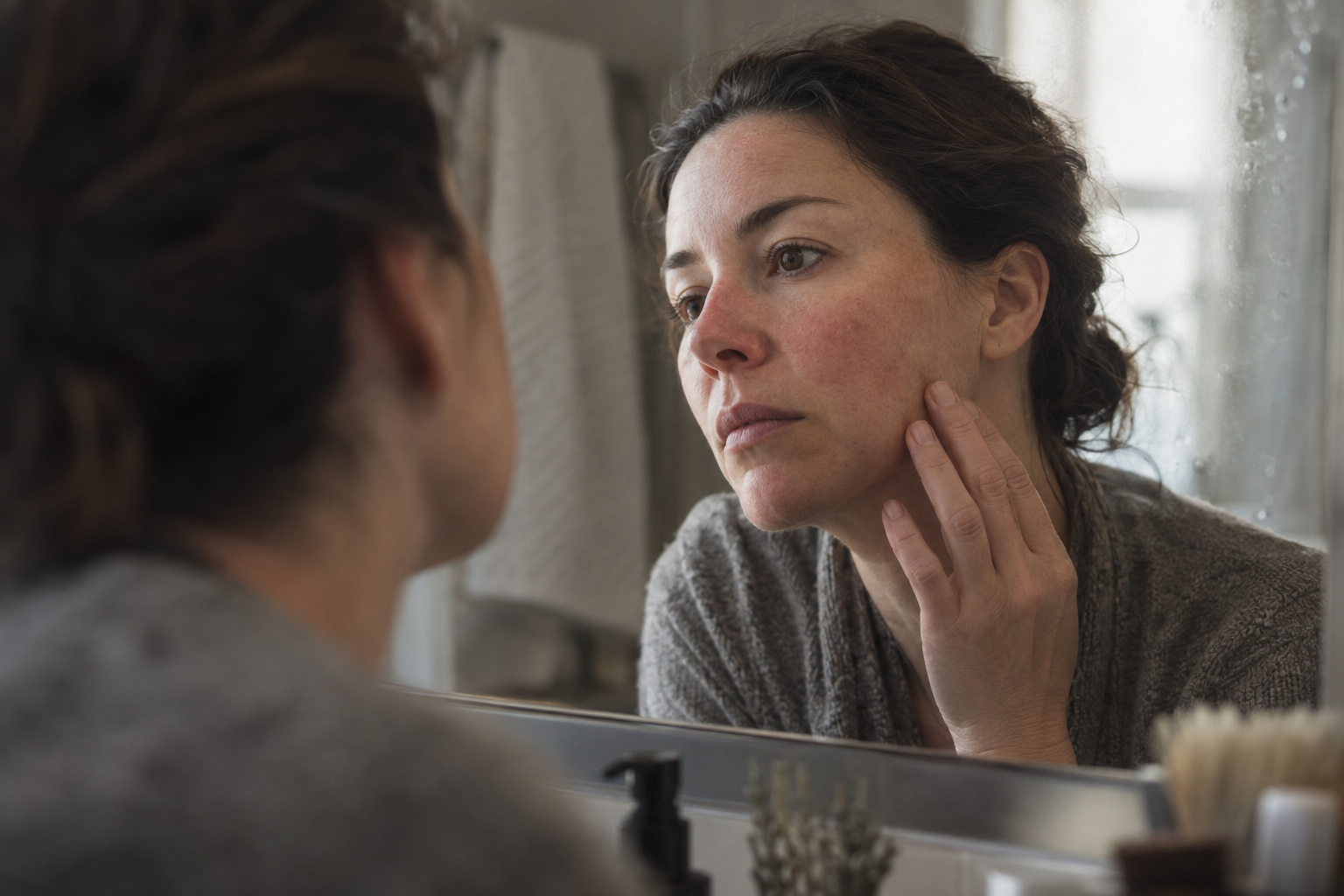
Your rosacea photos and your trigger log live in different places.
Rosacea trackers log either what your skin looked like or what you were exposed to. Your dermatologist needs both on the same day, in the same entry.
Eleven minutes before the appointment
The dermatologist's waiting room is where most rosacea trigger diaries fall apart. You scroll back through your camera roll looking for the flare from two Thursdays ago. It's there, a close-up of your left cheek, wedged between a grocery list screenshot and a photo of a parking sign. The photo shows how bad it got. It doesn't say what you'd done that day.
The other half of the story lives somewhere else. A notes app, maybe, or a paper booklet from the clinic, or a spreadsheet with columns for food, heat and stress. That log says what you ate on the Wednesday. It can't show what your skin looked like on the Thursday.
So the question your dermatologist actually asks (what did the flare look like, and what came right before it?) gets answered from memory. In a waiting room. With the clock running.
The Split Record
We call it the Split Record, and it's the default state of rosacea trigger tracking right now. Every method we reviewed falls on one side of a line. Photo tools capture appearance with no structured place for exposure. Diaries, checkbox apps, paper booklets and spreadsheets capture exposure with no photo attached.
We looked across six live methods: photo-first skin apps, an app built on automated skin scans, dedicated rosacea diary apps, a patient-society paper booklet, and a spreadsheet template shared through a newsletter. None of them stamps a photo and a trigger note onto the same entry. Skinframe's daily tracking is built around the six independent phenotype features named by the ROSCO consensus panel (persistent facial redness, transient flushing, papules/pustules, visible vessels, eye-related symptoms, and burning/stinging) rather than the old four-subtype model, so each feature's definition should be checked against the current ROSCO classification guidance as of the article's publish date.
So the evidence exists. It just exists in two places, and the only place they meet is inside the patient's head.
A flare photo without a note is a picture. A note without a photo is a guess.
Two features in one app still isn't one entry
Ask how the category thinks about this and you get a checklist. Photos: yes or no. Trigger log: yes or no. An app that ticks both boxes looks finished.
But a photo tab and a trigger tab in the same app is still the Split Record, just with one icon on your home screen. If the photo from the 14th sits in a gallery and the note from the 13th sits in a list, someone has to line them up by hand. That someone is you, usually the night before the visit.
The pairing is the unit of evidence, not a feature on the list. An entry that holds the image, the exposure and the timestamp together is something a clinician can read in seconds. Two separate records are homework.
Capture audit across six live trigger-tracking methods, from our category review. Skinframe tracks six rosacea phenotype features independently rather than one composite score, persistent redness, transient flushing, bumps (papules), visible vessels (telangiectasia), burning/stinging, and eye irritation, following the ROSCO 2017/2019 phenotype-based consensus framework, with each feature rated on a patient-self-assessment severity scale.
What a flare entry has to hold
The trigger categories most diaries ask about come from patient-reported data. The National Rosacea Society's patient survey The trigger evidence Skinframe's app research draws on comes from the National Rosacea Society's 2002 Triggers Survey of 1,066 rosacea patients, which found sun exposure the top-reported flare trigger (81%), followed by emotional stress (79%) and hot weather (75%). put sun exposure, emotional stress and hot weather near the top, with alcohol, spicy food, hot baths and skincare products further down. That's the backbone of the heat, product, food, stress and weather structure most trackers borrow. It tells you what patients believe sets them off. It can't tell you what sets you off.
The appearance side changed in 2017. The global ROSacea COnsensus panel (ROSCO; Tan et al., British Journal of Dermatology 2017) moved dermatology away from subtype buckets toward phenotypes: individual features like flushing, persistent redness, bumps and pustules, visible blood vessels and eye involvement, each assessed on its own. A photo is how you show which feature flared.
And some evidence never reaches the camera. Burning, stinging and gritty eyes are sensory symptoms, felt rather than seen. On darker skin (Fitzpatrick IV to VI, the deeper end of the standard skin-tone scale) redness can be hard to see in a photo, so the note may carry most of the signal. Adamson & Smith (JAMA Dermatology 2018) warned that dermatology image algorithms trained mostly on light skin would underperform on dark skin, and Daneshjou et al. (Science Advances 2022) measured that drop on a diverse image set. A photo-only record inherits the blind spot. A text-only record misses what the camera does catch.
Trigger lists are a starting point
Published trigger lists come from what patients report. They're categories worth watching, not proof that any one exposure causes your flares. A pattern in your own record, reviewed with your dermatologist, is the only thing that speaks to that.
A two-week diary, walked through
Take a made-up but ordinary two weeks. On day 3 you switch sunscreens and go to a hot yoga class. On day 4 your cheeks flare, with burning that lasts into the evening. On day 9 you have red wine at dinner on a warm night. Day 10 is fine.
In the Split Record, the day-4 photo lands in the camera roll with no context. The diary for day 3 says "new sunscreen, yoga." The diary for day 9 says "wine, warm." Nothing records that day 10 was calm, because nobody photographs a calm face. At the visit you're working from one flare photo and a list of guesses.
Now pair them. Day 3 gets a quick baseline photo plus the note. Day 4 gets the flare photo, burning marked, and "nothing new today." Day 9 gets a photo and a note, and so does day 10, showing that nothing happened.
Same two weeks, same person. But the record now shows a flare the day after two exposures, a calm day after a third, and what each looked like. It doesn't prove the sunscreen did it. It gives your dermatologist something concrete to test.
What changes if the pairing is the point
A few things follow. Calm days need photos too, because a flare only means something against a baseline. The photo needs to be taken the same way each time, same light and same distance, or the comparison turns into noise. Lag matters: a flare the morning after is still the previous day's story. And what you bring to the visit should be a timeline, one row per day, image next to note.
You can get partway there with what's already on your phone. Take the photo, then write the trigger note in that photo's caption, date included. It's clunky. It still beats rebuilding two weeks from memory in a waiting room.
We're watching two open questions next: whether phone photos can be made consistent enough for subtle redness changes to register day to day, and how eye symptoms, which almost never get photographed, should sit alongside the skin.
Where Skinframe fits
We built Skinframe around one entry: a photo and a trigger note saved together under a single timestamp, with fields for heat, products, food, stress and weather, plus the sensory symptoms a camera can't see. Each self-exported log row records the date and entry type (assessment, photo capture, trigger, or quality-of-life check-in), plus the relevant fields for that row: redness, bump count, visible-vessel count, and burning/stinging severity for daily assessments, a flushing flag and eye-symptom notes, the trigger category and any custom label, whether a photo was a baseline or flare-event shot with its inline severity, and a free-text note field. There's no automated face scan, for the reasons Adamson & Smith and Daneshjou laid out. The photo is evidence that you and your dermatologist read together.
We won't claim a tracking app improves rosacea outcomes, because no rosacea-specific trial has tested that. Evidence in adjacent conditions, atopic dermatitis and psoriasis, shows patient-reported tracking can improve visit outcomes No rosacea-specific study has shown that patient tracking improves dermatologist visit outcomes, so Skinframe grounds its claims in the closest available evidence: research on mobile self-tracking in related skin conditions like atopic dermatitis and psoriasis, where patient-reported outcome tracking has been shown to meaningfully improve symptom scores and visit quality. The app's marketing frames this honestly as evidence from adjacent dermatology conditions rather than a rosacea-specific clinical claim., and Skinframe applies the same approach to rosacea.
Two weeks of paired entries won't diagnose anything. They'll make your next appointment less about guessing. Talk to your dermatologist about what to track and for how long.
Start your first paired entry: one photo, one note, one timestamp.
Skinframe saves the flare photo and the trigger note as one timestamped entry, so the record you bring to your dermatologist already lines up appearance with exposure. No automated face scan, per the skin-tone equity concerns raised by Adamson & Smith 2018 and Daneshjou 2022.