Your rosacea diary and the wine studies are timing two different clocks.
Trigger lists merge flare evidence with onset-risk evidence into one rule. Here's what each study measured, and what your diary can and can't tell you.
The swap that felt like progress
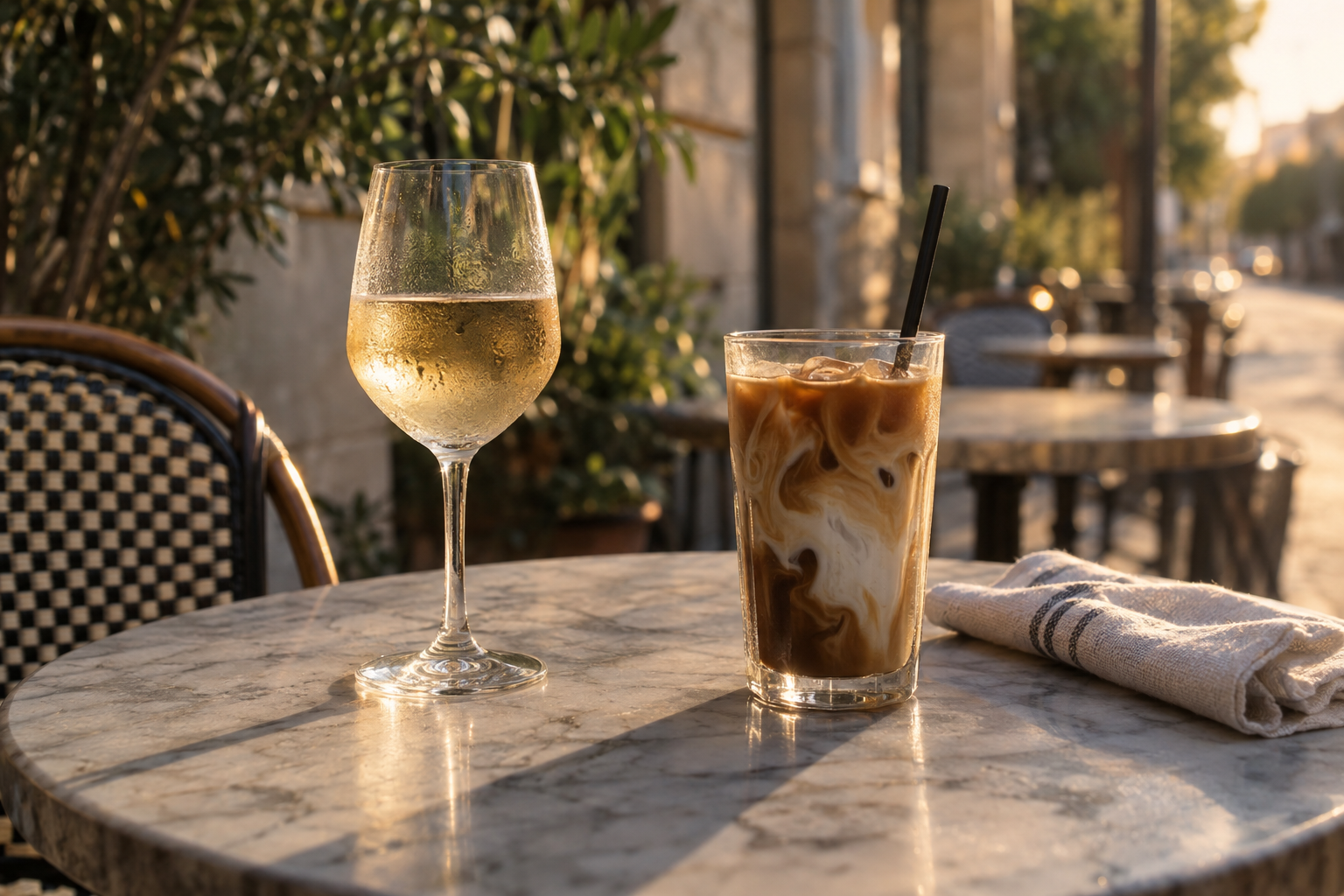
Red wine went first. Every trigger list says so, and the National Rosacea Society's own survey backs up the instinct. So white wine took its place at dinner, the morning coffee went over ice, and the diary started to look better.
Only half of that swap has solid evidence behind it. The other half leans on a study that asked a different question, about who develops rosacea over many years, and that study points the opposite way from what most people assume.
That gap is what this piece is about. You won't get another trigger list here. What you'll get is a closer look at what each study actually measured, so the entries in your diary mean what you think they mean.
The two-clock problem
Rosacea evidence runs on two clocks, and most trigger advice reads them as if they were one.
The flare clock ticks in minutes. You drink something, and your face flushes, burns or stings within the hour, then it fades. Lab challenge studies run on this clock. So does your diary.
The onset clock ticks in years. It asks whether a habit kept up over a decade changes the odds that someone gets diagnosed with rosacea at all. Large cohort studies, which follow thousands of people forward in time, run on this clock. They never see a single flare.
"Coffee and wine are triggers" joins a flare-clock claim to an onset-clock claim and throws away the label. Without the label, people use a finding about one clock to make decisions about the other. That's how white wine ends up feeling safe, and how hot coffee's problem gets pinned on its caffeine.
Why the trigger list got built from memory
Most rosacea trigger lists trace back to self-report surveys. The NRS has asked people with rosacea about their triggers for years, and those surveys are useful. They show what patients notice and what they remember.
In the NRS's 2010 alcohol survey, red wine was named as a trigger far more often than white wine. Those results are real. They measure perception.
A survey can't pull the drink apart from the evening around it. Red wine can come with a warm restaurant, a rich or spicy meal and a long night. Hot coffee always comes hot. When someone ticks "red wine" or "coffee," they're compressing a whole scene into one word.
The answer also comes without a timescale. "My face flushed twenty minutes later" and "I think drinking made my rosacea worse over the years" go into the same tally.
72%
of NRS 2010 alcohol-survey respondents named red wine as a triggerNational Rosacea Society 2010
49%
of the same survey's respondents named white wineNational Rosacea Society 2010
A survey answer has no clock attached.
What the key studies actually measured
Wilkin's 1981 study in the Journal of Investigative Dermatology is the main evidence on the flare clock. People with the flushing-and-persistent-redness presentation (back then it was called the erythematotelangiectatic subtype, a label dermatology has since moved away from) drank coffee hot and drank it cooled, and caffeine was tested on its own. The hot liquid provoked flushing. Caffeine alone didn't. What drove the flush was heat in the mouth.
Both Li papers measure the onset clock. Each draws on the Nurses' Health Study II, a long-running cohort of US women who are registered nurses, and each asks who went on to receive a rosacea diagnosis.
Li et al. 2017, in the Journal of the American Academy of Dermatology, found that higher alcohol intake went with a higher risk of developing rosacea. White wine and liquor carried that association more clearly than red did.
Li et al. 2018, in JAMA Dermatology, found that women who drank more caffeinated coffee had a lower risk of developing rosacea. Caffeine from coffee, but not from other sources like tea, soda and chocolate, was associated with lower risk. Decaffeinated coffee was not linked to lower incidence. ([source](https://jamanetwork.com/journals/jamadermatol/articlepdf/10.1001/jamadermatol.2018.3301))
So on red versus white, the survey and the cohort seem to disagree. They're answering different questions on different clocks, though, so they don't actually contradict each other.
Source
Design
Clock
What it found
NRS alcohol survey, 2010
Self-report survey
Neither (perception)
72% named red wine, 49% named white wine as a trigger
Wilkin 1981, J Invest Dermatol
Controlled challenge, flushing-type rosacea
Flare (minutes)
Hot liquid provoked flushing; caffeine alone didn't
Li et al. 2017, JAAD
Prospective cohort, Nurses' Health Study II
Onset (years)
More alcohol, higher rosacea risk; clearest for white wine and liquor
Li et al. 2018, JAMA Dermatology
Prospective cohort, Nurses' Health Study II
Onset (years)
More caffeinated coffee, lower rosacea risk
Four sources behind the 'coffee and wine are triggers' rule, sorted by the question each one answers.
A cohort finding isn't a flare forecast
Li 2017 doesn't show that a glass of white wine will flush your face tonight. Wilkin 1981 says nothing about who develops rosacea. Neither study tells someone who's already diagnosed what to drink. That's a conversation for your dermatologist.
One diary, read on both clocks
Picture a month of logs. In weeks one and two, there's red wine with dinner three nights a week and hot coffee every morning. In weeks three and four, the wine is white and the coffee goes over ice. Logged flares drop.
The diary does support one conclusion: the iced coffee change fits Wilkin. Heat is a plausible flare driver, and taking it away fits with fewer flushes.
It can't support the idea that white wine is the safe wine. Two weeks of calmer skin is flare-clock data, and it's tangled. Did dinner change? Was the room cooler? Was the white served cold while the red sat at room temperature? The diary can't answer, because nobody wrote those things down. And no month of logs, however tidy, says anything about the onset clock, which is the one where Li 2017 placed white wine.
One more gap matters for readers with darker skin (Fitzpatrick types IV to VI, on the scale dermatologists use to describe how skin responds to sun). Flushing can be hard to see, and a diary that only records visible redness will miss flares. Burning, stinging and a sense of heat count as flare data too. Image-based tools have the same blind spot. Adamson & Smith (JAMA Dermatology 2018) and Daneshjou et al. (Science Advances 2022) both flagged it for automated skin analysis.
Read your log by clock
Log temperature as its own entry. "Coffee" really means two things, the drink and the heat. Write both down and the diary can tell them apart.
Log the scene around the drink: what you ate, where you were, how warm the room felt. Then, when wine looks guilty, you can check whether it was the wine or the evening.
Keep onset-clock studies in the background. If you already have rosacea, Li 2017 and Li 2018 describe population risk among US women. They don't say how a particular drink will behave on your face on a particular night.
Bring a dated record to your dermatologist. Flare-clock patterns are something a clinician can work with, and personal triggers vary enough that the list in your head may not match the one in your log.
Where Skinframe fits
We built Skinframe for the flare clock, because that's the one a person can actually measure. Each log entry can carry the drink, how hot it was and what was going on around it, next to a dated photo, and all of it stays on your phone Skinframe's log has a 'hot drink' trigger tag that captures beverage temperature (a hot drink rather than which beverage), and each daily entry also takes an optional free-text note for context. Photos and logs are stored on the user's device, with an optional sync to their own private iCloud. Skinframe doesn't keep them on its own servers, and patterns are computed on the device.. After a few weeks, you have a record a dermatologist can read, which beats a memory.
We won't promise it finds your triggers. No rosacea-specific trial has tested tracking apps. In adjacent conditions like atopic dermatitis and psoriasis, evidence shows patient-reported tracking improves visit outcomes, and Skinframe applies the same approach to rosacea.
What we're tracking next
Two gaps stand out. The Li cohorts were made up of US women who are registered nurses, so it's an open question how far the alcohol and coffee findings apply to men and to other populations.
The study we'd most like to read is a controlled challenge in diagnosed rosacea that compares red and white wine flushing directly, a wine version of Wilkin's coffee test. If one comes out, we'll write it up.
For now, the iced coffee swap has a mechanism behind it. The white wine swap has a survey behind it. Raise that with your dermatologist before you treat it as settled.
Log the drink, the heat and the photo in one place, then bring the record to your dermatologist. Try Skinframe free for 14 days on iPhone.
Skinframe is a rosacea tracker for the flare clock. You log what you drank, how hot it was and the scene around it, next to dated photos that stay on your phone. No rosacea-specific trial has tested tracking apps. In adjacent conditions (atopic dermatitis, psoriasis), evidence shows patient-reported tracking improves visit outcomes, and Skinframe applies that approach to rosacea.