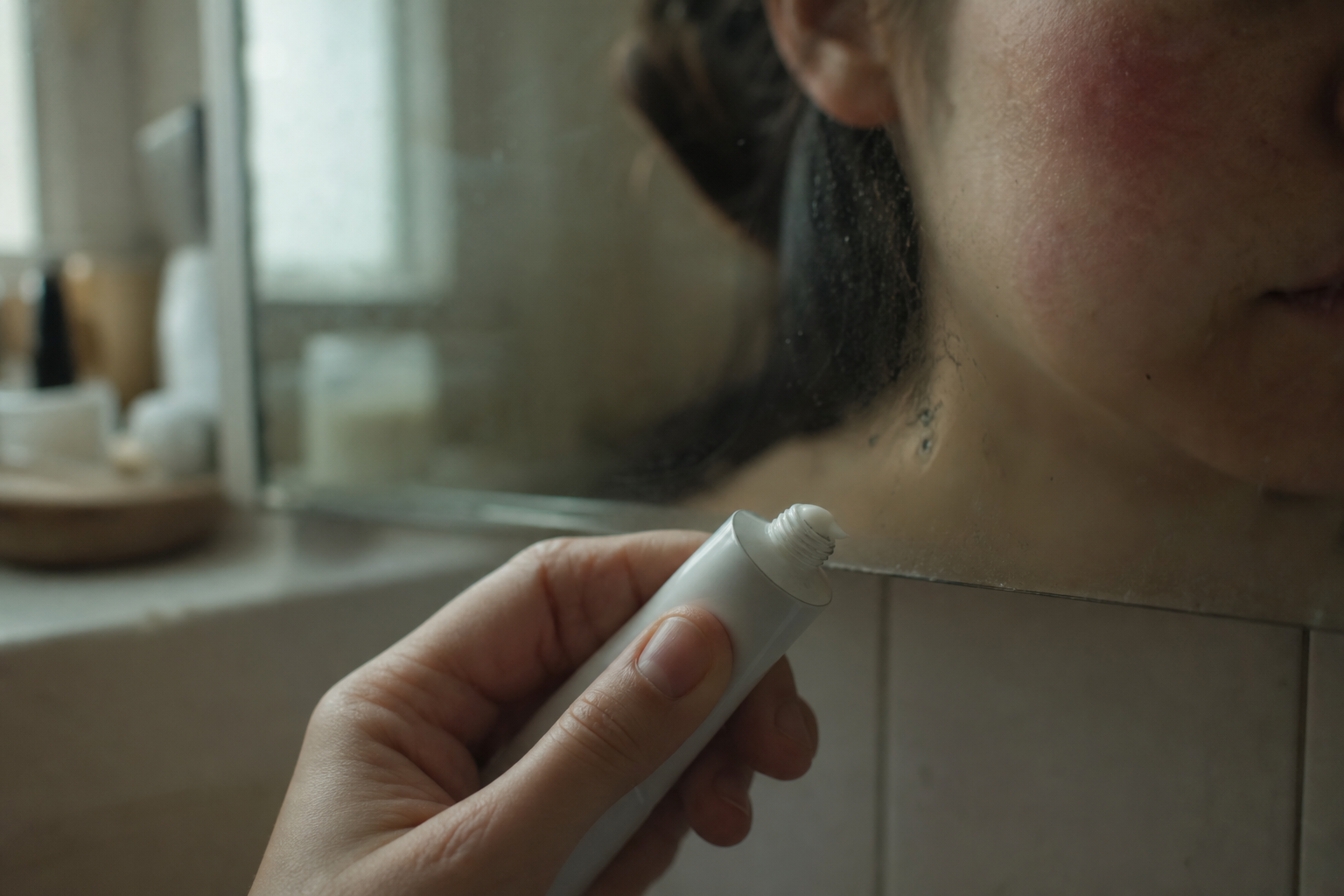
Cortisone on your face delays your rosacea diagnosis
Steroid creams like hydrocortisone flatten facial redness fast, but they quietly corrupt the baseline a dermatologist needs to read your rosacea correctly.
The cream that fixes the wrong problem
The redness fades within the hour. A fingertip of drugstore hydrocortisone, worked into two flushed cheeks the night before a dermatology appointment, and by morning the face in the mirror looks almost calm. That calm is the trouble. The person who walks into the exam room looks better than their skin has looked in weeks, and the dermatologist across the desk has no way to see the flaring that came before. The cream did its job. It just did it to the wrong audience, quieting the exact evidence the appointment exists to gather.
The confounded baseline
A rosacea diagnosis is a reading of a baseline. How red the skin runs on an ordinary day, how often it flares, what the flushing looks like when nothing is holding it down. Topical corticosteroids, the anti-inflammatory creams that run from over-the-counter hydrocortisone up to prescription-strength formulas, quietly rewrite that reading. We call what they leave behind the confounded baseline: a face chemically calmed to the point where neither the patient nor the clinician can tell how severe the underlying condition actually is. The steroid does three things at once, and all three distort the record. It suppresses redness in the moment. It sets up a rebound when it stops. And used long enough on facial skin, it can seed a separate problem that looks like rosacea and gets treated as rosacea, when it was the cream all along.
The face in the exam chair looks better than the skin actually is.
Why 'it calms the redness' is the wrong signal
The intuition is reasonable and completely misleading. Steroid creams reduce facial redness, so they feel like they are treating the problem. What they are mostly doing is narrowing the small blood vessels near the skin's surface, which makes the surface read as less pink, and dampening inflammation across the board. That is cosmetic suppression, not correction. Rosacea is still doing whatever it was going to do underneath. Facial skin is also thin and absorbs topical steroids readily, which is why dermatologists are cautious about steroids on the face to begin with. The redness that lifts overnight is the least informative version of the skin. A clinician needs to see the skin misbehaving, and the cream's entire function is to make sure it does not.
What the cream does that brimonidine does not
Two things unfold on different clocks. Short term, the vasoconstriction and anti-inflammatory effect make the skin look better. On withdrawal, the vessels rebound and the background redness can return worse than before, a flare that is really the cream leaving rather than the disease advancing. Chronically, facial steroid use can produce steroid-induced rosacea, a rosacea-like dermatitis that dermatology treats as its own entity Adverse effects of topical glucocorticosteroids include rosacea among the most frequent, per a JAAD review. ([source](https://www.jaad.org/article/S0190-9622(05)00255-0/abstract)). This is worth separating cleanly from brimonidine, the prescription gel some patients use for redness. Brimonidine also narrows facial vessels and has its own documented rebound, but that rebound is a same-day pharmacologic wear-off, not a distinct disease the way steroid-induced rosacea is. Confusing the two leads people to expect the wrong timeline for their skin to settle.
Question
Topical corticosteroid
Brimonidine gel (for contrast)
What it is
Anti-inflammatory cream, OTC hydrocortisone up to prescription strength
Prescription alpha-agonist gel that narrows facial vessels
When redness returns
As rebound over days after stopping
As a same-day wear-off as the dose fades
Long-term risk
Steroid-induced rosacea, a distinct rosacea-like dermatitis
Worsening or rebound redness, but not a separate disease entity
Effect on the baseline
Corrupts it for days to weeks
Confuses a single day, not the underlying picture
The pattern a dermatologist has to discount
Picture the common sequence. Someone reaches for 1% hydrocortisone twice a day for three weeks because it takes the edge off the flushing. Two days before the appointment they stop, having read somewhere that you are not meant to use it long-term, and the skin rebounds hard. The dermatologist now sees an angry, inflamed face and hears a verbal history: it comes and goes, I used a little cream, I think it's been a few weeks. None of that is measurable. The clinician has to mentally subtract an unknown amount of steroid effect from an unknown baseline, working from a memory that is doing its honest best and still failing. The diagnosis gets slower, or the rebound flare gets misread as the true severity, or the steroid-driven component never gets named at all. The information that would have made the visit decisive evaporated in the bathroom weeks earlier.
Do not stop a facial steroid cold turkey
Abruptly quitting a steroid cream you have used for a while can trigger a rebound flare that itself distorts what your dermatologist sees. If you have been applying one, tell them before you change anything and let them guide how to taper.
What an interpretable record looks like
The version a dermatologist can actually read is a sequence, not a summary. Dated photos taken in consistent light, with the steroid marked where it belongs: started here, this dose, this often, stopped here. That turns 'I used a little cream' into a before, during, and after the clinician can see for themselves, including the rebound as a rebound instead of a mystery flare. This is the gap we built Skinframe to close. A photo log that lives on the device and lets you timestamp application, dose, and the discontinuation date gives your next visit a spine of evidence instead of a recollection the doctor has to discount. Evidence from adjacent dermatology conditions like atopic dermatitis and psoriasis suggests patient-reported tracking improves what happens in the visit A 2024 systematic review and meta-analysis of 1,038 patients with atopic dermatitis found that mobile self-management apps produced a clinically meaningful improvement in POEM scores (mean −1.57), with DLQI improving alongside; a 2022 JAAD review further found that patient-reported outcome measures used as a 'vital sign' increase efficiency and improve the clinician-patient relationship. No rosacea-specific RCT exists yet, but this adjacent dermatology evidence supports the principle that structured self-tracking improves derm visit outcomes., and we are applying that same approach to rosacea. Whether cortisone belongs anywhere near your face is a decision only your dermatologist can make. Bring them a record they can trust, and let them make it.
Start a timestamped skin log that keeps your before, during, and after in one place, so your next dermatologist visit opens with evidence.
We read the dermatology literature before we ship a claim, and we do not ship skin-AI. Skinframe keeps your photo log on your device, timestamps what you applied and when you stopped, and hands your dermatologist a sequence to read instead of a history they have to discount.