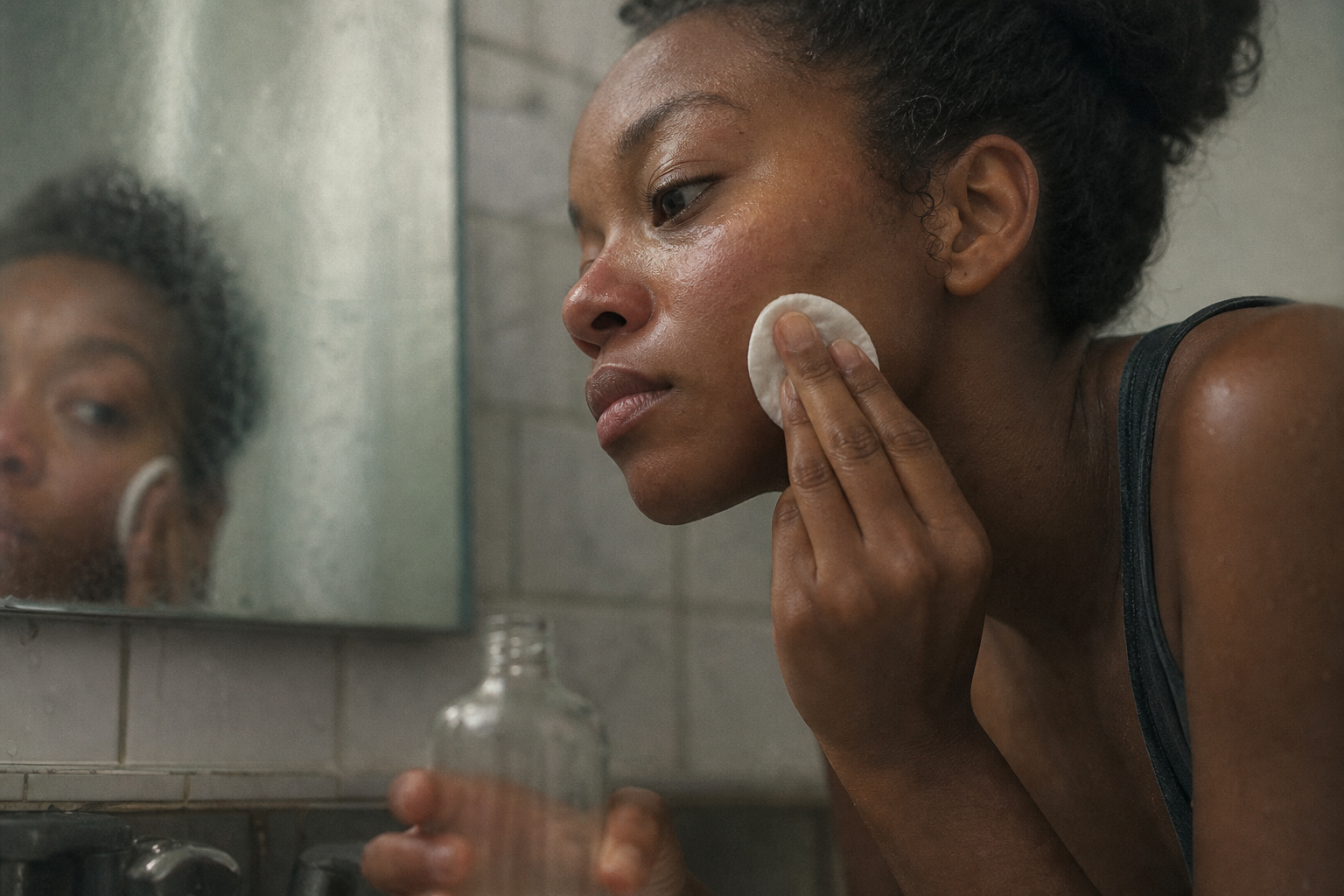
You're avoiding wine. Your toner has more alcohol than beer.
Rosacea advice spends its energy on what you drink. The alcohol with a plausible route to the nerve endings in your face is sitting in the bottle by the sink.
The flush that shows up at 7:40 a.m.
Six weeks off red wine. No whiskey, no spicy food, no hot coffee before noon. And the flush still arrives most mornings inside the same ten-minute window.
That timing tracks the routine, not the weather. The toner goes on at 7:35. A cotton round, two passes across both cheeks, and a product whose second ingredient is alcohol denat. sits on facial skin that already runs a leaky barrier.
The food log has forty entries by now. The bathroom shelf has none. The diary asked what you drank. It never asked what you poured onto your face ninety seconds after the shower.
Call it the ingestion bias
Rosacea trigger tracking is organized around things that enter the body through the mouth. Wine, coffee, chili, cinnamaldehyde, hot soup. Those are easy to name, easy to count, and easy to pull for two weeks to see what happens.
Topical exposure gets one checkbox. Two if the form is generous: "skin-care products" and "cosmetics." No field for which product. No field for what's in it. No field for how many times a day it touched the face, or whether it was rinsed off or left on.
So patients run careful elimination protocols on the exposure they can taste, while applying twice daily a volatile solvent with a documented action on the same sensory channels the flush runs through. Both columns are measuring alcohol. Only one of them is being counted.
"Alcohol" on a label is two unrelated families
"Avoid alcohol in your skincare" is well-meant and half-wrong, because the word covers two chemically unrelated groups that sit on the same ingredient list.
Denatured alcohols (alcohol denat., SD alcohol 40, ethanol, isopropyl alcohol) are small volatile solvents. They dissolve lipids, flash off in seconds, thin a formula, and make an essence feel weightless on application.
Fatty alcohols (cetyl, stearyl, cetearyl, behenyl) are long-chain waxy solids. They thicken creams, hold emulsions together, and act as emollients. Structurally they're closer to the lipids in your own stratum corneum, the outermost barrier layer, than to anything in a gin bottle.
US and EU labeling rules put every ingredient above roughly one percent in descending order of concentration. Alcohol denat. in the second or third slot isn't a trace. Beer runs about 5% ABV. CIR safety assessment tested formulas with 12% and 29% SD Alcohol 40-B, including a gel and spray liquid ([source](https://pubmed.ncbi.nlm.nih.gov/18569160/))
The swap that circulates in rosacea forums deletes both families at once. That removes the emollients and keeps the solvents, which is the wrong half of the shelf.
On the label (INCI)
What it is
Behavior on rosacea-prone skin
Alcohol denat., SD alcohol 40
Denatured ethanol, volatile solvent
Lipid-solvent, evaporative, the class this article is about
Alcohol (unqualified), Ethanol
Ethanol
Same class as above; position on the list indicates concentration
Isopropyl alcohol
Volatile solvent
Same class; more often in astringents and wipes
Benzyl alcohol
Aromatic preservative, not a drying solvent
Different chemistry; a contact allergen for some, not a barrier solvent
Cetyl / Stearyl alcohol
Long-chain fatty alcohol, emollient
Thickener and emollient, not drying
Cetearyl alcohol
Cetyl + stearyl blend, emulsifier
Emollient and emulsion stabilizer; occasional contact sensitizer
Behenyl alcohol
Long-chain fatty alcohol
Emollient, functionally inert for flushing
The two families that share a word. Reading INCI position matters as much as reading the name.
What the literature supports, and where it stops
Three lines in the rosacea literature converge on topical ethanol, and none of them require a drink.
Ethanol acts on TRPV1, the heat-and-capsaicin receptor sitting on sensory nerve endings. Trevisani et al. (Nature Neuroscience, 2002) showed ethanol both excites nociceptors through TRPV1 and lowers the receptor's heat-activation threshold, so stimuli that previously sat below the line start to register. Sulk et al. (Journal of Investigative Dermatology, 2012) found TRP channel expression altered in rosacea skin, with the pattern varying by presentation. And rosacea skin starts compromised: Dirschka et al. (British Journal of Dermatology, 2004) documented impaired epithelial barrier function in papulopustular rosacea, while the Yamasaki and Gallo work on cathelicidin LL-37 and kallikrein 5 (Nature Medicine, 2007) tied barrier and protease activity to the inflammatory cascade itself.
Now the honest part. None of that is a controlled trial of topical ethanol in rosacea patients, and the hand-hygiene literature pushes back. Kampf and Kramer (Clinical Microbiology Reviews, 2004) summarize repeated findings that alcohol-based hand rubs irritate skin less than detergent handwashing. Ethanol on skin isn't automatically destructive.
The rosacea question is narrower than the hand question: repeated leave-on exposure, on facial skin, over a barrier that already leaks, above nerves that are already sensitized. We think that difference is real. We also think anyone stating its size with confidence is out ahead of the evidence.
52%
of rosacea patients name alcohol consumption as a triggerNational Rosacea Society patient survey
41%
name certain skin-care products as a trigger, a category almost no diary breaks down furtherNational Rosacea Society patient survey
1
line item the entire topical-product category gets on the standard trigger checklist
What it looks like in a log
Walk a hypothetical log forward, because the shape will be familiar even if the details aren't yours.
Weeks one through six: wine gone, spicy food gone, coffee iced. Flush days hold steady at four or five per week. The food column is immaculate and useless.
Week seven, the reader adds a product column: name, time, rinse-off or leave-on, and the first five ingredients. Two entries a day instead of one, because the exfoliating toner goes on every morning and again on alternate evenings.
By week ten the pattern separates. Flush intensity clusters on the double-application days. The rest-day mornings still flush, but lower, and the stinging that used to be filed as "just sensitive skin" turns out to be a timestamped event rather than a permanent condition.
That isn't proof, and it shouldn't be treated as proof. A single-arm home test can't separate the ethanol from the fragrance riding along in the same bottle, from the mechanical friction of the cotton round, or from a week of dry indoor heat. What it does is turn a vague suspicion into a documented, dated pattern you can hand to a dermatologist who can then design a real removal test.
If the exposure you can't taste is the one that counts
Two things change if the topical column carries real weight.
Elimination diets get smaller and more targeted. Cutting every named dietary trigger at once is a blunt instrument that costs months and social life and often resolves nothing, because the twice-daily exposure was never in the experiment.
And product auditing becomes an ingredient-position question, not a brand or price question. "Is this formulated for sensitive skin" is a marketing claim. "Is a denatured alcohol in the top five, and is it leave-on" is a checkable fact printed on the box.
There's a third effect worth stating plainly. Barrier repair has been treatment-adjacent advice in dermatology for years, and it's usually delivered as a vibe: be gentle, use a bland moisturizer. An exposure log turns it into something with a before and after.
Don't blanket-ban the word "alcohol"
Cutting every ingredient with "alcohol" in the name removes cetyl, stearyl, cetearyl and behenyl alcohol, which are emollients and emulsifiers that help hold a barrier together. Readers who do this often end up with a thinner, more reactive routine and keep the volatile solvents anyway. Read the position on the list, not the word.
A log with a field for what you applied
This is the constraint we built Skinframe around. A rosacea diary that records meals, weather, sleep and stress but has nowhere to put the product you applied twice today is measuring one side of a two-sided exposure, and it will keep returning clean food columns while the pattern sits in the bathroom.
So products log alongside everything else, with the product name and its ingredients attached to a timestamp, and photos stored on the device rather than shipped to a server, because the visible record and the exposure record only mean something in the same timeline. Severity records per feature (flushing, papules, stinging, eye symptoms) instead of collapsing into one composite number, since "flushing 2, papules 0, stinging 3" is a sentence a dermatologist can act on and "6.4 out of 10" isn't.
Evidence in adjacent dermatology conditions, atopic dermatitis and psoriasis, shows patient-reported tracking improves what comes out of a visit. We're applying that same approach to rosacea. No rosacea-specific trial of tracking-app efficacy exists yet, and we won't pretend otherwise.
What we're watching next
Two open threads. First, whether anyone runs a proper controlled topical-ethanol challenge in rosacea patients, because the mechanistic case is strong and the direct evidence is still missing. Second, the fragrance overlap: denatured alcohol and fragrance compounds co-occur constantly in the same formulas, which makes them almost impossible to separate in a home test. We've written separately about why the label doesn't help you there. The article lives at /articles/fragrance-free-rosacea-labeling-gap and explains that a 'fragrance-free' label in the US only guarantees the absence of one named ingredient, while essential oils and masking agents containing known rosacea-triggering compounds (like linalool and limonene) can still slip through, which undermines fragrance-based trigger tracking.
None of this is a diagnosis or a treatment plan. If your flushing pattern is changing, if you're getting grittiness, burning or recurrent styes in the eyes, which can signal ocular involvement, or if your skin isn't settling on your current routine, take the log to a dermatologist and let them design the removal test. The point of tracking is to make that appointment worth more, not to replace it.
Log both sides of the exposure. Food, weather and stress in one column, products and ingredients in the other, with dated photos on your device, in about thirty seconds a day. Bring the pattern to your next dermatology appointment instead of a hunch.
Skinframe was built by reading the rosacea literature first and the app-store category second. Severity records per visible feature rather than as one blended score, photos and logs stay on your device, and the exposure log has a field for the product and its ingredients, not just the meal. It's the same standard we hold the citations in this article to.