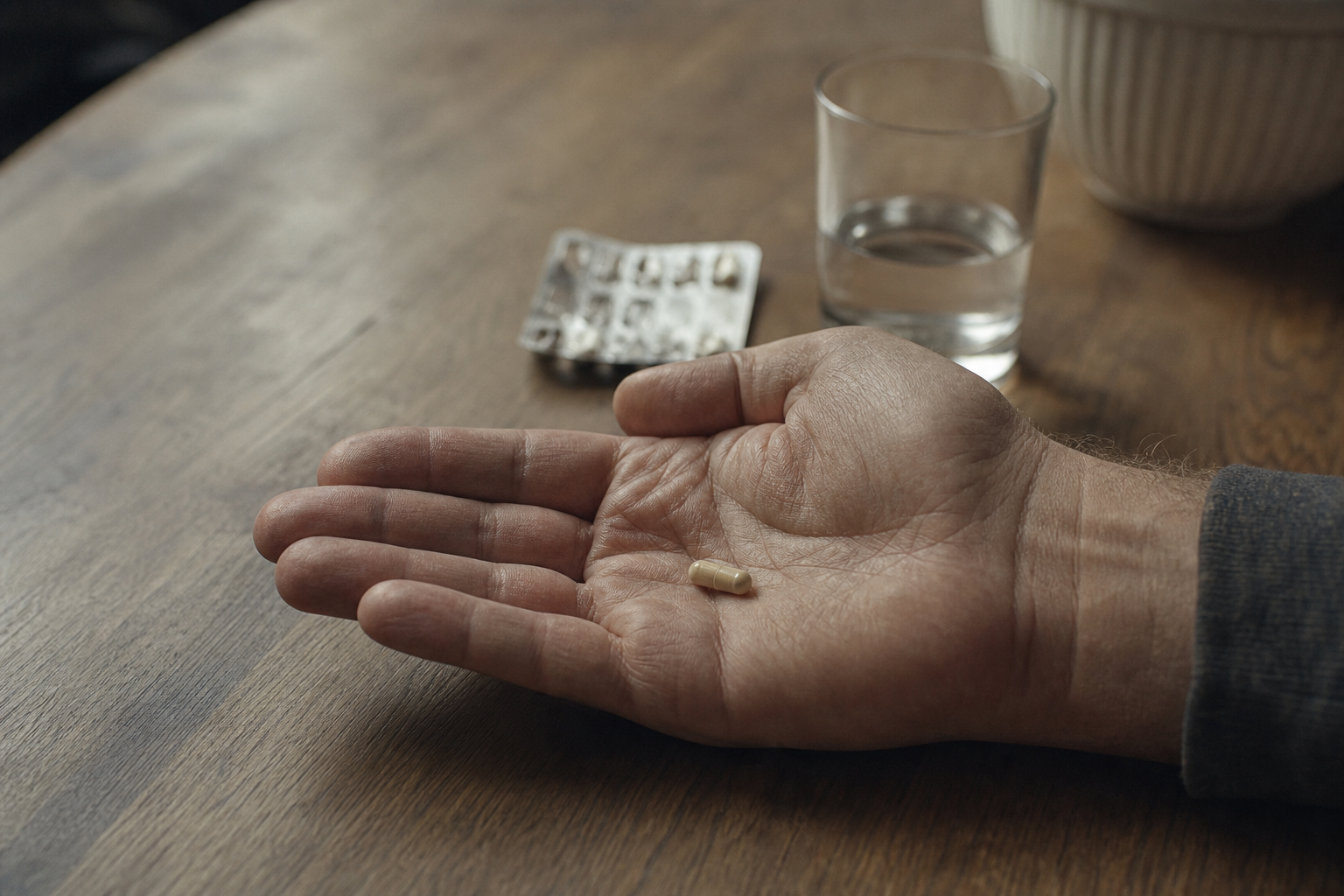
The 40 mg rosacea pill is an anti-inflammatory wearing an antibiotic's name.
The 40 mg modified-release doxycycline used for rosacea works by damping the skin's inflammatory machinery, not by killing bacteria. That changes what resistance means and when you stop.
Week five, when the bottle stops getting opened
Week five is usually when the bottle stops getting opened. The papules along the cheeks have flattened, the burning after a hot shower has quieted, and the pharmacy label says doxycycline, which everyone knows is an antibiotic. So the reasonable thing happens. The pills stop, there's a vague guilt about not finishing the course, and somewhere around midnight there are three forum threads open about antibiotic resistance.
Three weeks later the papules are back, and the working theory becomes "the antibiotic stopped working."
It didn't. In most of these cases the pill was never running an antimicrobial program in the first place.
The dose is the mechanism
Doxycycline has two careers, and the dose decides which one it shows up for. At 100 mg once or twice daily it does the tetracycline thing: binds the bacterial 30S ribosome and shuts down protein synthesis. At 40 mg in a modified-release capsule (30 mg that releases immediately, 10 mg that releases later), steady-state blood levels sit below the concentration needed to pressure bacteria. What's left is the molecule's other job, which is suppressing the inflammatory machinery in the skin itself.
That other job is the entire basis of the rosacea indication. The 40 mg modified-release formulation was approved in the United States in 2006 for the inflammatory lesions of rosacea in adults, and it remains the oral drug carrying that specific indication. Anti-inflammatory dose is the accurate name for it, because that's what the label is actually buying.
Two intuitions, both borrowed from infection medicine
Patients arrive holding two beliefs about antibiotics. Both are correct for strep throat and both misfire here.
The first is finish the course. That rule exists because a partially treated infection leaves surviving organisms behind to regroup. There is no infection in rosacea, so there is no course in that sense. Anti-inflammatory dose doxycycline is suppressive therapy for a chronic inflammatory condition, and it works while it's being taken. Papules returning after stopping is not treatment failure, it's a chronic condition doing what chronic conditions do.
The second is fear the resistance. Reading "months of antibiotics" and picturing a stewardship problem is a sane reaction, and it deserves the actual figures rather than the figures from a full-dose regimen. Plenty of clinicians outside dermatology carry the same mental model too, which is how a patient hears "you're on a long antibiotic" from one office and "this isn't really an antibiotic dose" from another in the same month.
Nothing on the pharmacy label tells you that 40 mg and 100 mg are doing two different jobs.
What the literature actually supports
The mechanism case is not new. Yamasaki et al. 2007 (Nature Medicine) showed that rosacea skin carries elevated kallikrein-5, a protease that cuts the antimicrobial peptide cathelicidin into fragments that drive inflammation. Tetracyclines inhibit matrix metalloproteinases (the enzymes involved in that processing cascade), blunt neutrophil recruitment, and reduce reactive oxygen species, and those effects hold at concentrations well below what pressures bacteria.
The clinical case rests on the phase 3 program in Del Rosso et al. 2007 (JAAD): two identical 16-week randomized placebo-controlled trials of 40 mg modified-release doxycycline that found significant reductions in inflammatory lesion counts against placebo (The two Del Rosso 2007 phase 3 trials involved a combined total of 537 rosacea patients, with 269 receiving doxycycline 40 mg. ([source](https://www.dermatologytimes.com/ipubs/managing-papulopustular-rosacea/US-ORC-2100001_ORACEA_inbook%20article_2_16_21%20FINAL.pdf))). Del Rosso et al. 2008 (J Drugs Dermatol) then compared the 40 mg anti-inflammatory dose against 100 mg and found comparable lesion outcomes with fewer gastrointestinal adverse events.
On the flora question, the reassurance is real but bounded. Skidmore et al. 2003 (Archives of Dermatology) followed sub-antimicrobial dose doxycycline in acne for six months and found no detectable shift in skin flora and no emergence of resistant organisms, and the periodontal literature reports the same across nine-month courses. Those are months of surveillance in specific populations, not a general clearance for indefinite use, and the honest version of this claim keeps that qualifier attached.
40 mg modified-release (anti-inflammatory dose)
100 mg (antimicrobial dose)
Daily amount
40 mg once daily: 30 mg immediate-release plus 10 mg delayed-release
Inhibition of bacterial protein synthesis at the 30S ribosome
Steady-state plasma level vs the antimicrobial threshold
Below
Above
US indication for rosacea
Yes, inflammatory lesions of rosacea in adults (2006)
No, prescribed off-label
Flora and resistance findings in published studies
No detectable flora shift or resistant-organism emergence over 6 to 9 months
Selective pressure applies; standard antibiotic stewardship applies
Head-to-head on inflammatory lesions
Comparable efficacy with fewer gastrointestinal adverse events
Comparable efficacy with more gastrointestinal adverse events
Sources: Del Rosso et al. 2007 (JAAD) phase 3 program; Del Rosso et al. 2008 (J Drugs Dermatol) dose comparison; Skidmore et al. 2003 (Arch Dermatol) and the periodontal sub-antimicrobial dosing trials for flora findings; Yamasaki et al. 2007 (Nature Medicine) for the kallikrein-5 and cathelicidin mechanism. Anti-inflammatory dose doxycycline's most common adverse events were nasopharyngitis (4.8%), diarrhea (4.4%), and headache (4.4%) ([source](https://pubmed.ncbi.nlm.nih.gov/17367893/))
Sub-antimicrobial does not mean risk-free
The flora studies ran for months, not years, and they were run in acne and periodontitis populations rather than long-term rosacea maintenance. Doxycycline at any dose still carries photosensitivity, gastrointestinal effects, and pill-esophagitis risk. None of this is a reason to adjust a dose on your own. It's a reason to ask which dose you're on and why.
What this looks like in a real logbook
Picture the log a dermatologist actually receives at the four-month follow-up. One column, one checkbox, four months of "took medication."
That log cannot answer a single question the visit turns on. It doesn't show that the first three weeks were 100 mg twice daily from an urgent care visit, then a switch to 40 mg modified-release. It doesn't show the azelaic acid that started in week six, which is a real candidate for the improvement everyone is crediting to the pill. It doesn't show the eleven-day gap in April when the prescription ran out. And it doesn't show that lesion counts were flat while the burning and stinging dropped by half, which is its own signal.
The endpoint problem compounds it. "Looks less red" is a weak measure for anyone, and it's weakest on brown and black skin, where erythema reads faintly or not at all in a phone photo. Papule and pustule counts and sensory symptoms (burning, stinging, dryness) carry more of the signal there, and those are the things a checkbox log throws away.
The question that replaces "how long am I on this?"
If the dose is the mechanism, the visit conversation changes shape. "How long am I on the antibiotic" is the wrong question, because it assumes an endpoint that a suppressive therapy doesn't have.
Better questions: which dose am I on, and is it the anti-inflammatory one or the antimicrobial one? What are we measuring to decide it's working, lesion counts or flushing or the burning? What's the maintenance plan when the oral stops, and does a topical carry it? What should I expect in the three weeks after I stop, so I don't read a normal return as failure?
Those are answerable questions, and they're answerable in about ninety seconds if the patient walks in with a record that distinguishes one regimen from another.
Why a tracker should ask which dose
Most symptom trackers model medication as one bit of information: taken, or not taken. That's a design decision borrowed from pillboxes and infection courses, and it flattens dose, formulation, start date, and stop date into a checkmark. For a condition where 40 mg and 100 mg of the same molecule are doing different work, the checkmark is the part of the log that fails first.
We built Skinframe's medication log around the regimen instead: which drug, which dose, which formulation, when it started and when it stopped, sitting on the same timeline as per-feature photos, lesion counts, and sensory symptoms like burning and stinging. Everything stays on the device. The output is a record that shows a dermatologist what was actually taken and what actually changed, in the order it happened.
None of that is a substitute for the person prescribing. If you're unsure which dose you're on, whether to continue, or what to do about a return of symptoms after stopping, talk to your dermatologist and bring the timeline with you.
Log the dose, not just the day. Get Skinframe and bring your dermatologist a timeline they can read in ninety seconds.
There's no rosacea-specific randomized trial showing that tracking apps improve outcomes, and we won't claim one. What exists is adjacent: in atopic dermatitis and psoriasis, structured patient-reported records improve what happens in the visit. Skinframe applies that approach to rosacea, with per-feature photos, sensory symptoms, and a medication log that records the actual regimen rather than a checkbox, stored on your device.