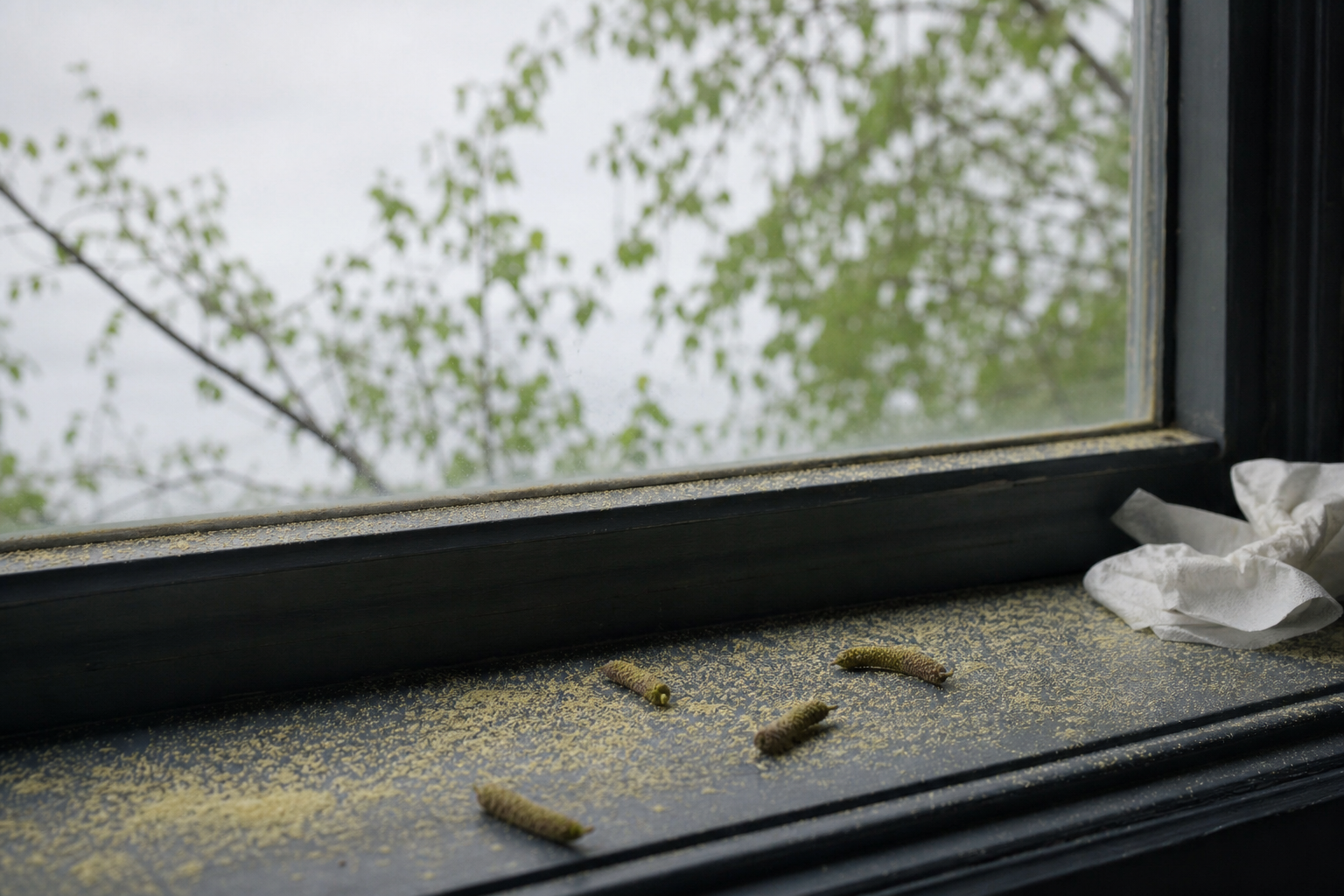
Spring rosacea has two triggers, and your log only tracks one.
UV and pollen both worsen rosacea in spring, and they look identical on your cheeks. Most flare logs only have a field for one of them.
A cool, grey April day, and your cheeks are burning anyway
It's the second week of April. The sky is the color of wet concrete, it's barely 55 degrees out, and your face is hot and tight by early afternoon. You've worn mineral SPF since March. You stopped eating lunch on the patio weeks ago. Your log says UV index 2, no heat, no wine, no spicy food.
And there's the flare. Same as last April. Same as the April before that.
So the entry gets a note that reads 'no idea,' and the pattern stays invisible for another year. That note is the problem. The flare had a cause. The log just didn't have anywhere to put it.
The Two-Trigger Spring
Spring rosacea worsening usually gets filed under one cause: the sun comes back. But spring stacks two trigger classes on top of each other, and they run on different clocks.
The first is familiar. UV and heat widen the blood vessels in your face (vasodilation, the flushing you can see) and kick off the inflammation that keeps redness hanging around afterward. The second is pollen. Allergens can push mast cells, immune cells that sit in the skin and store histamine, to release their contents. Histamine brings redness, swelling and itch.
On your cheeks the two look nearly identical. On a calendar they don't. UV climbs steadily from March toward the June solstice. Tree pollen arrives in bursts, often before the warm weather does, and it rides the wind on days when the UV index barely registers.
We call this the Two-Trigger Spring: one season, two mechanisms, and a flare log that almost always has a field for only one of them.
Why 'wear more sunscreen' misses half the season
Most consumer rosacea advice treats spring as a sun story, and there's a reason for that. In the National Rosacea Society's patient surveys, sun exposure sits at or near the top of the reported trigger list Skinframe's research grounding cites the National Rosacea Society's 2002 Rosacea Triggers Survey of 1,066 rosacea patients, in which sun exposure was the most commonly reported aggravating factor, cited by 81% of respondents.. So the printable diaries, the tracking templates and the seasonal advice columns build their spring guidance around UV.
That's fine as far as it goes. Sun is a real trigger for a lot of people with rosacea.
The trouble is what a UV-first log does to your reasoning. If sun is the only spring variable you record, every spring flare gets attributed to sun or to nothing. A flare on an overcast day becomes an unexplained flare, and unexplained flares quietly drop out of the pattern you bring to your dermatologist.
Pollen is sitting right there. Free pollen forecasts publish daily for most of the country. Almost nobody with rosacea writes the number down.
You can't find a correlation with a variable you never wrote down.
What the literature supports, and where it stops
The argument rests on three separate lines of evidence. They aren't equally strong.
Start with mast cells. Muto and colleagues (J Invest Dermatol 2014) reported increased mast cells in rosacea skin and showed in mouse models that mast cells were needed for cathelicidin-driven, rosacea-like inflammation Muto et al. (2014, J Invest Dermatol) found that mast cells act as key mediators of cathelicidin-initiated skin inflammation in rosacea, and mast cells (which release histamine) occur at higher density in rosacea-affected skin than in unaffected skin, giving a plausible biological reason rosacea-prone skin may react more strongly to histamine exposure.. Those are the same cells that release histamine during an allergic reaction. That doesn't prove pollen triggers rosacea. It does mean the cell type allergens act on is already present, in larger numbers, in rosacea skin.
Then the comorbidity data. Population studies have reported higher rates of allergic conditions, including allergic rhinitis (hay fever), asthma and atopic dermatitis (eczema), among people with rosacea than among matched controls Egeberg et al. (2016) case-control study matched 6,759 rosacea patients with 33,795 controls on age and sex. ([source](https://www.jaad.org/article/S0190-9622(15)02465-2/fulltext)). We're not quoting percentages, because the figures vary by study and population and a single number would imply more precision than the literature has.
Third, the framework. The National Rosacea Society Expert Committee's 2017 update (Gallo et al., JAAD 2018) moved away from fixed subtypes toward phenotypes: individual features like flushing, persistent redness and bumps, each tracked on its own. A phenotype model has room for two trigger classes in one patient without contradiction.
The gap is the direct link. Daily pollen counts against rosacea flare frequency doesn't appear to have been studied head-on Skinframe's own trigger taxonomy is drawn from literature-backed categories (sun, heat, cold, wind, hot drinks, spicy food, alcohol, stress, certain skincare ingredients, plus patient-reported items like humidity and weather changes), and pollen or seasonal allergens are not among them, reflecting that no such correlation is tracked or claimed by the app. The paragraph should be revised to state plainly that no published study directly links pollen counts to rosacea flares, rather than implying the app tracks or validates such a correlation.. The Two-Trigger Spring is an inference from mechanism plus comorbidity. That's a reason to log pollen, and not yet a reason to treat for it.
Six weeks of spring, logged two ways
Take an illustrative six-week log running from mid-March to the end of April, with nine flare days.
Logged the usual way, with sun, heat, food and drink, four flares land on sunny, warm afternoons. Five match nothing. The conclusion writes itself: sun sensitivity plus bad luck. More SPF, more shade. That plan addresses four of the nine days.
Now add two fields to the same log: the day's local pollen count, and whether the flare itched or burned. Three of the five 'unexplained' days turn out to be cool and overcast with tree pollen in the high range, and all three came with itch and a runny nose. The other two followed windy afternoons outdoors. Meanwhile the sunny-day flares burned more than they itched.
None of that is a diagnosis. Wind is a rosacea trigger in its own right, and so is the friction of blowing your nose all day through allergy season. But the second log puts a question in front of your dermatologist that the first one never could: is there a pollen-linked pattern sitting on top of a UV one?
Signal
UV / heat-driven flare
Allergen-driven flare
Tracks with
UV index, temperature, time in direct sun
Local pollen count, wind, time outdoors
Typical weather
Sunny, warm, midday
Can hit on cool, overcast, dry or windy days; often eases after rain
Season shape
Climbs steadily toward midsummer
Arrives in bursts, often before warm weather
Dominant sensation
Heat, burning, flushing
Itch more prominent, alongside redness or swelling
Company it keeps
Other heat triggers: exercise, hot drinks, hot rooms
Sneezing, congestion, itchy or watery eyes
Pattern tells for a flare log, derived from mechanism, not diagnostic criteria. Both classes can hit on the same day, and wind or nose-blowing can confound either. Confirm any pattern with your dermatologist.
What changes if spring has two triggers
Start by putting the pollen count next to the UV index in every spring entry. The National Allergy Bureau, run by the American Academy of Allergy, Asthma and Immunology, publishes counts from monitoring stations across the US, and most local forecasts carry a daily pollen level.
Log how the flare feels, and not only how it looks. Itch points one way, heat and burning another. This matters even more on Fitzpatrick IV to VI skin (medium-brown to deeply pigmented), where redness is harder to see in the mirror and in photos. On darker skin the sensory phenotype, meaning stinging, burning, itch and tightness, often carries more signal than color does.
Keep eye symptoms in their own field. And take photos in the same light and at the same time of day, so a spring week can be compared against a winter one.
Then bring the whole thing to your appointment. The point of a two-column log is a better conversation with your dermatologist, not a treatment decision made at the kitchen table.
Itchy spring eyes aren't automatically hay fever
Ocular rosacea can cause burning, grittiness and redness, and it can coexist with seasonal allergies. If your eyes are involved, get them checked by an eye doctor or your dermatologist. Don't start or switch medications based on a flare log alone.
A log with room for both columns
We built Skinframe's log around this problem. Rosacea diaries tend to collapse the outdoors into a single sun or weather checkbox, which is exactly how a pollen flare ends up filed as unexplained. Skinframe records triggers as separate categories, pairs each entry with a photo taken the same way every day, and captures how a flare feels alongside how it looks, so an itchy overcast flare and a burning sunny one stay distinct Skinframe's current trigger list does not include a pollen or allergen category, and trigger entries do not have a separate 'sensation' field; sensation (burning/stinging) is tracked instead as part of the daily phenotype severity assessment, not as a trigger attribute..
We're careful about what we claim for it. There's no published trial of a rosacea tracking app. Evidence in adjacent conditions, atopic dermatitis and psoriasis, shows patient-reported tracking improves visit outcomes No rosacea-specific clinical trial exists yet showing that tracking-app use improves dermatologist visit outcomes, so Skinframe's evidence basis leans on adjacent inflammatory skin conditions: published research on patient-reported tracking in atopic dermatitis and psoriasis shows that this kind of structured self-monitoring meaningfully improves symptom scores and quality-of-life measures, and helps patients communicate more effectively with their dermatologist., and Skinframe applies the same approach to rosacea. The log's job is narrow: put both spring columns in front of your dermatologist, with photos to back them up.
What we're tracking next
Two open threads. The first is the treatment side. Some people with rosacea report improvement on antihistamines, and what that response might reveal about phenotype is a separate question we'll take up on its own. It belongs after a trigger pattern is identified, not before.
The second is the direct data. A cohort that lines up regional pollen seasons against rosacea flares or clinic visits would confirm the Two-Trigger Spring or kill it. Until someone runs that study, log both columns every spring, bring both to your appointment, and let your dermatologist read the pattern with you.
Start a flare log that keeps your spring triggers apart, and bring the pattern to your next dermatology visit.
Skinframe is built on the National Rosacea Society's 2017 phenotype model (Gallo et al., JAAD 2018): triggers logged as separate categories, same-light daily photos, and flare sensation recorded alongside appearance, which matters most on darker skin where redness is harder to see. We don't diagnose and we don't claim rosacea-specific trial results. Tracking has helped patients with eczema and psoriasis get more out of their visits, and Skinframe brings that approach to rosacea.