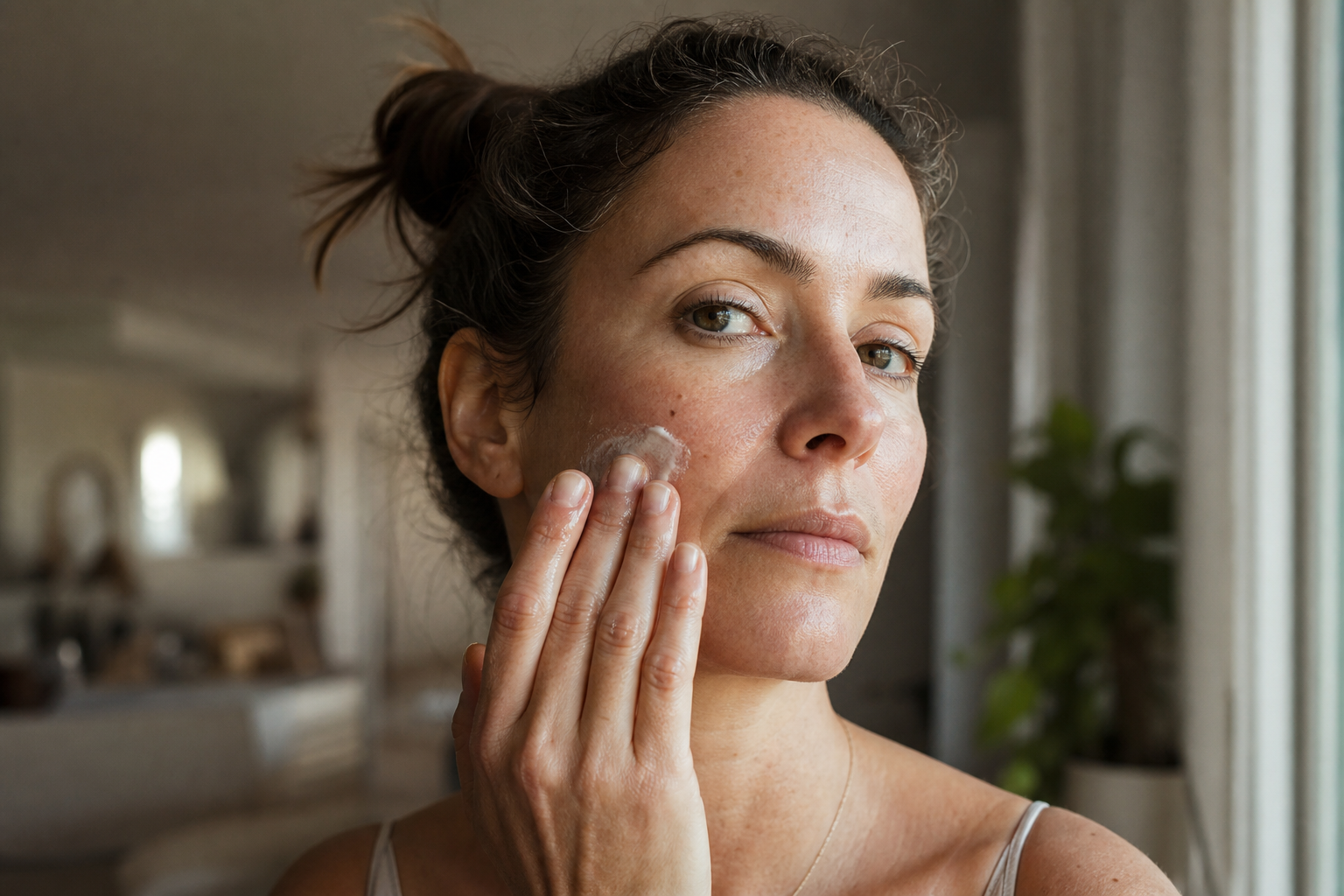
For rosacea, the SPF number is the least useful thing on the bottle.
Two people with identical SPF 50 compliance can flare in opposite directions. The number on the bottle can't tell them apart. The vehicle chemistry can.
Same number, opposite skin
Two people put on the same SPF 50 every morning for a month. One watches her cheeks settle. The other flushes harder by noon and blames the sun for winning. Same broad-spectrum claim, same number stamped on the front, opposite outcomes on the face.
The variable that split them was never the SPF value. That number measures one thing: how much UV the film blocks in a lab. It says nothing about what the film is made of, and for reactive skin the ingredients are the whole story. When people search for the best sunscreen for rosacea, the answer they get back is a number. The answer their skin is reacting to is chemistry.
The vehicle is the variable, not the value
Here is the read we keep coming back to: for rosacea skin, sunscreen is a vehicle problem wearing a number's clothes. "Wear SPF daily" is universally correct advice. It is also universally incomplete, because it stops at the number and the number is the least informative thing on the label.
What actually determines tolerance sits lower in the ingredient list. The UV-filter class (chemical versus mineral), the fragrance, the alcohol base, the emollient system. Rosacea skin runs a heightened sensory phenotype, meaning it registers stinging, burning, and warmth from products that a neutral face would shrug off. So the same SPF 50 can read as protection to one barrier and as an irritant to another.
Sunscreen is a vehicle problem wearing a number's clothes.
Why "just wear SPF 30+" isn't the whole instruction
The standard guidance is not wrong. Rosacea patients need daily broad-spectrum protection, and dermatology societies say so plainly. The gap is that the headline instruction was written to solve UV exposure, not product tolerance, so it treats every SPF 30 as interchangeable.
For most skin, they roughly are. For rosacea skin, the interchangeability breaks. A person who dutifully reapplies a fragranced, alcohol-forward chemical formula every two hours can be more inflamed at the end of the day than someone who used less of a bare mineral one. Compliance went up. So did the flushing. When the advice only tracks the number, that outcome looks like a paradox instead of what it is: a formula mismatch.
What the evidence actually shows
Two threads in the literature matter here. The first is absorption. In an FDA-run maximal-use trial, common chemical UV filters crossed the skin into the bloodstream at plasma levels above the agency's own systemic-testing threshold after routine application (Matta et al., JAMA 2020). Systemic absorption is not the same as a proven rosacea trigger, and we won't claim it is. But it settles the old assumption that a chemical filter simply sits on top of the skin.
The second thread is irritation from the vehicle rather than the filter itself. Fragrance is a leading contact irritant and dermatology guidance for sensitive and rosacea-prone skin routinely flags it, alongside high-alcohol bases that can sting a compromised barrier (The AAD recommends rosacea patients use a gentle, fragrance-free sunscreen and choose mineral sunscreens with zinc oxide or titanium dioxide. ([source](https://www.aad.org/public/diseases/rosacea/triggers/tips))). Whether chemical filters also drive flushing through a vasoreactive route independent of UV is a thinner, less settled area of the literature, and we flag it as open rather than assert it.
0.5 ng/mL
FDA plasma threshold above which a UV filter requires systemic safety testingMatta et al., JAMA 2020
All 6 sunscreen active ingredients tested in Matta 2020 resulted in plasma concentrations above 0.5 ng/mL. ([source](https://jamanetwork.com/journals/jama/fullarticle/2759002))
chemical filters that crossed that threshold under maximal-use conditionsMatta et al., JAMA 2020
What to scrutinize
What it is
Why it matters for rosacea skin
Chemical UV filters (avobenzone, oxybenzone, octocrylene)
Organic molecules that absorb UV and shed it as heat
Documented systemic absorption (Matta 2020); heat conversion and stinging land harder on a reactive barrier
Fragrance / parfum
Added scent compounds, often unlisted individually
A leading contact irritant flagged in sensitive-skin guidance; no UV benefit
Alcohol denat. (high in the list)
Volatile solvent used for a fast, light finish
Can strip barrier lipids and sting compromised skin
Mineral filters (zinc oxide, titanium dioxide)
Inorganic filters that sit on the surface
Generally better tolerated; the tradeoff is white cast, worse on deeper skin tones
Ingredient categories to scrutinize, not brands. Category literacy over a shopping list.
How to tell a sun flare from a formula flare
Say your cheeks flared on a bright Saturday. The obvious culprit is the sun, so you buy a higher SPF and change nothing else. That is the trap: you swapped the number and kept the chemistry, so a formula trigger stays invisible and you blame the weather again next week.
The single-variable method separates the two. Change one product at a time, and only one, across a defined logging window of several days. Keep sun exposure, hot drinks, alcohol, and skincare steady while you test. When a flare hits, photograph the same area in the same light within about ten minutes of onset, before the redness peaks and settles. Run one week on your current chemical formula, one week on a bare mineral one, everything else held constant. If the redness tracks the product rather than the sunny days, the vehicle was the variable. If it tracks sun exposure regardless of formula, it wasn't the sunscreen. You cannot reason your way to that answer. You have to isolate it.
The mineral tradeoff isn't the same for every skin tone
"Just switch to mineral" is where a lot of rosacea advice lands, and for tolerance it is often the right instinct. It is also written as if every reader has the same complexion. Zinc oxide and titanium dioxide sit on the surface and scatter light, which is exactly why they leave a white or grey cast, and that cast falls hardest on Fitzpatrick IV to VI skin.
This connects to a wider blind spot. Rosacea is already underdiagnosed on darker skin because the diagnostic image bank skews pale, and the same skew shows up in dermatology tooling: deployed skin-analysis models perform measurably worse on dark skin (Adamson & Smith, JAMA Dermatology 2018), and image datasets underrepresent it (Daneshjou et al., 2022). A tolerance recommendation that ignores the cast tradeoff quietly asks deeper-skinned patients to choose between comfort and looking ashen. The honest version names the tradeoff instead of pretending it doesn't exist.
The mineral fix has an equity tradeoff
Mineral filters are usually gentler on rosacea skin, but the white cast worsens on deeper complexions. Advice that says "just use mineral" without naming that tradeoff isn't neutral, it just wasn't written for Fitzpatrick IV to VI skin.
Where the logging comes in
None of this works from memory. By the time a flare fades, most people cannot reconstruct which morning they switched formulas, how hot the afternoon was, or whether they had a glass of wine the night before. The variables blur, and the sunscreen either takes the blame or dodges it, usually incorrectly.
That is the problem we built Skinframe around. A timestamped photo taken within minutes of onset, tagged to the one product you changed that window, turns a vague suspicion into a comparison you can actually read, and one you can hand to a dermatologist instead of describing from memory. There is no rosacea-specific trial proving a tracking app changes outcomes, and we won't pretend otherwise. What exists is adjacent evidence: in conditions like atopic dermatitis and psoriasis, structured patient-reported tracking is associated with better-informed visits, and the same logging logic carries to isolating a sunscreen trigger. Photo as evidence, one variable at a time, kept on your own device.
What we're still watching
Two open questions sit under this piece. First, the vasoreactivity route: whether chemical filters can drive facial flushing through a mechanism separate from UV protection, or whether the reactions patients report are better explained by absorption, heat, fragrance, and alcohol together. The literature isn't settled, and we would rather say so than overstate a mechanism.
Second, formulation is moving. Newer filter chemistries and cosmetically elegant mineral formulas are narrowing the white-cast gap, which could change the tolerance-versus-cast tradeoff for darker skin over the next few years. We'll update as the evidence lands. If your skin is flaring and you can't isolate why, that isn't a research question, it's a clinical one: talk to your dermatologist, and bring your logged photos with you.
Skinframe is coming to iPhone. Join the waitlist to isolate your own triggers, one logged variable at a time, from day one.
No rosacea-specific trial has tested whether a tracking app changes treatment outcomes, and we won't claim one. What the literature does support is adjacent: in atopic dermatitis and psoriasis, structured patient-reported tracking is associated with better-informed dermatology visits. Skinframe applies the same isolate-one-variable, photograph-the-evidence approach to rosacea, on-device.