Sleep debt is a rosacea trigger. Almost no one logs it.
Trigger lists name heat, wine, and sun. They skip the eight hours where circulating inflammation and barrier repair actually reset your skin's flushing threshold.
The flush that arrives before the coffee
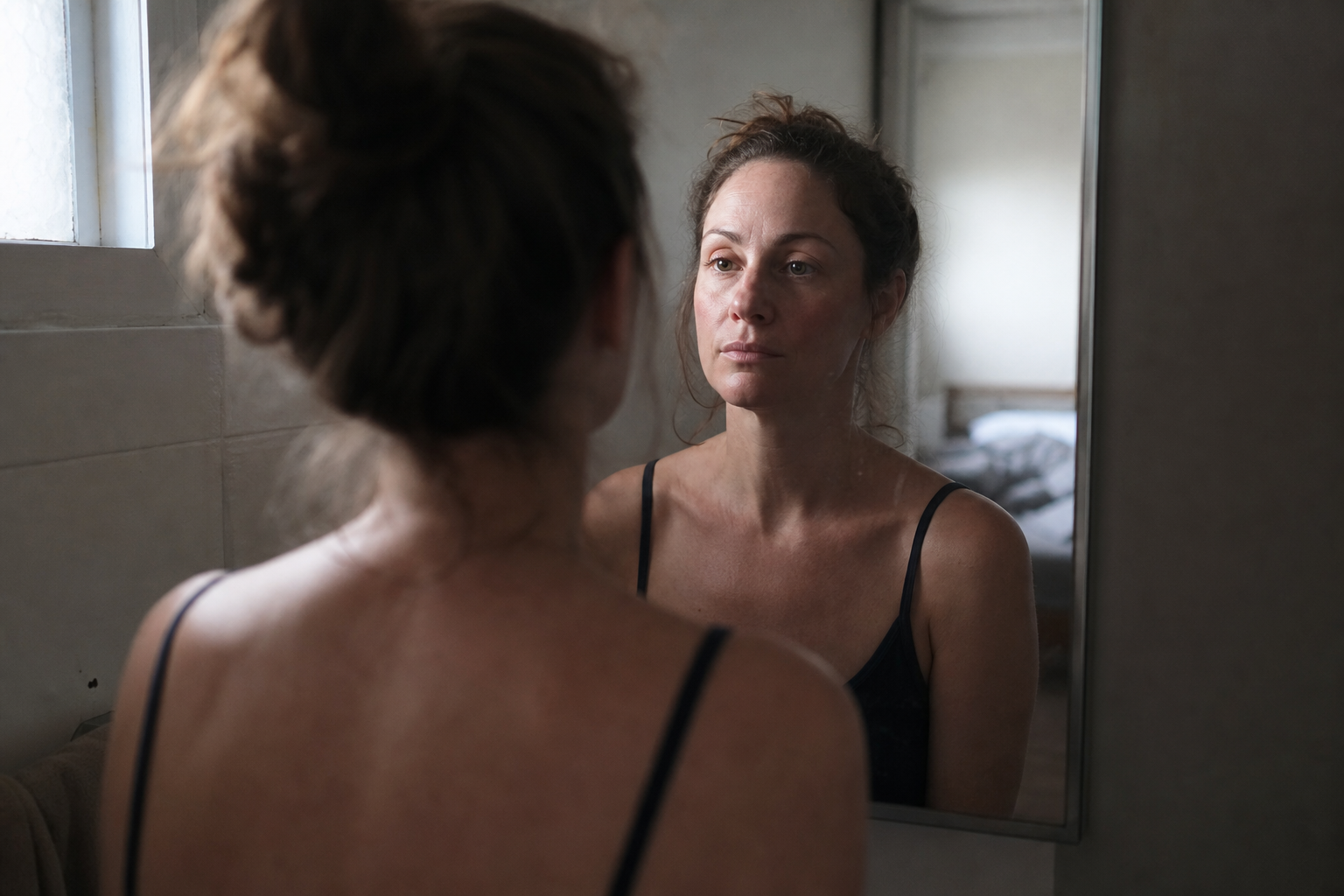
The redness shows up before you have done anything to your face. Five hours of sleep, or six broken into pieces, and by the time you reach the bathroom mirror the cheeks are already warm and pink, reacting to a cleanser that was fine on Tuesday.
Nothing about your triggers changed overnight. Your skin's threshold did. The wine, the sun, the hot shower are all still where they were on the list. What moved was how little it now takes to tip your face into a flush, and the thing that moved it happened while you were asleep and not writing anything down.
The morning-after gap
Here is the claim we want to defend: sleep duration and sleep quality are mechanistically real rosacea variables, and they are almost completely absent from published trigger lists and from the defaults in most tracking apps.
Call it the morning-after gap. Trigger taxonomies are built around things you encounter while awake and can point at: a food, a drink, weather, a product, an emotion. Sleep is the one variable that operates in the gap between last night's log and this morning's flare. It never gets an entry, so when the flare arrives it gets blamed on whatever you can see, which is usually the wrong thing.
Why trigger lists have a blind spot here
The standard rosacea trigger list has a recognizable shape. The National Rosacea Society's patient surveys put sun exposure, emotional stress, hot weather, wind, heavy exercise, alcohol, spicy food, and hot drinks at the top, and nearly every consumer logging app inherits that same menu of tappable triggers. It is a good list. It is also a list of daytime encounters.
That inheritance is the blind spot. A trigger you log by tapping an icon has to be something you noticed happening. Sleep loss is not an event you witness; it is an accumulated deficit that changes your baseline before you are even awake to react to anything. So it falls through. The taxonomy is not wrong about wine and sun. It is just structurally incapable of catching a variable that never presents as a moment.
What actually happens overnight
The overnight mechanism is two-part, and both parts point the same direction: a lower flushing threshold by morning.
First, inflammation. Sleep loss raises circulating pro-inflammatory signaling. Irwin, Olmstead & Carroll's 2016 meta-analysis in Biological Psychiatry found short sleep duration and sleep disturbance associated with elevated C-reactive protein and interleukin-6 (IL-6), and experimental sleep restriction elevates tumor necrosis factor-alpha (TNF-alpha) as well. Rosacea is a neurovascular and inflammatory condition to begin with (Yamasaki et al. 2007 documented elevated cathelicidin LL-37 and kallikrein-5 in rosacea skin), so adding systemic inflammatory load on top of that lowers the bar for flushing. Sleep restriction also elevates next-evening cortisol (Leproult et al. 1997), which feeds the same loop.
Second, barrier repair. The skin barrier does much of its recovery work at night, and disrupting deep, slow-wave sleep interrupts that window. Oyetakin-White et al. 2015 found poor sleepers showed slower recovery of barrier function after a provoked disruption. A less-recovered barrier is a more reactive one, which is why the same cleanser stings on a bad-sleep morning and not on a good one.
The barrier-repair window, defined
Your skin barrier (the outermost layer that holds water in and irritants out) runs on a daily rhythm and does much of its repair during deep, slow-wave sleep. Cut that sleep short and the repair is left unfinished, so the barrier is measurably more reactive the next morning. That is separate from feeling tired: it is a physical head start toward a flush.
Sleep loss is not an event you witness. It is an accumulated deficit that changes your baseline before you are awake to react to anything.
How the gap misleads a real log
Picture a Sunday night that goes badly: a late deadline, four hours of broken sleep, cortisol up, barrier repair cut short. Monday morning the cheeks flare hard. You open your log and look for a cause, and the only new thing you can see is the moisturizer you started over the weekend. So the moisturizer gets tagged as a trigger and gets thrown out.
The moisturizer was a bystander. The real driver was the deficit no field asked about. Now it compounds, because the flare itself makes the next night worse: burning and stinging fragment sleep architecture, which shortens deep sleep again, which lowers the threshold further. That bidirectional loop (bad night to reactive skin to worse night) is exactly the kind of pattern a trigger log exists to surface, and it is invisible to a log that has no sleep row.
What changes if you actually log it
If sleep is a genuine variable, then a trigger log that omits it is not neutral. It produces confident, wrong answers, blaming the visible bystanders (a new product, yesterday's one glass of wine) while the real driver goes unrecorded month after month. Elimination diets get longer, skincare shelves get emptier, and the pattern that would explain a third of the bad mornings never shows up because no column holds it.
The fix is unglamorous: give sleep a row. This is where the design of a tracking tool stops being cosmetic. We built Skinframe to capture the variables the literature actually supports, which meant the log had to ask about the night, not just the day. Concretely, three fields are enough to make the argument testable against your own face: sleep duration (roughly how many hours), subjective quality (rested, broken, or poor), and next-morning flare severity scored per visible feature. Log those beside the usual triggers and the correlation either shows up over a few weeks or it does not, which is the whole point of tracking instead of guessing.
Field to log
What to capture
Why it matters
Sleep duration
Rough hours slept
Short duration is what the cytokine and cortisol findings track against
Subjective quality
Rested / broken / poor
Fragmented deep sleep is what interrupts the barrier-repair window
Next-morning severity
Per visible feature, not one composite score
A per-feature score is what lets a sleep correlation surface instead of averaging out
The three fields that make sleep testable as a personal trigger.
What we are watching next
The open question is the loop, not the single night. Any given bad night lowering tomorrow's threshold is well supported. What is harder to see, and more useful, is the compounding version: a run of short nights during a stressful stretch stacking into a week of reactive skin, where each flare shortens the next night's deep sleep. That pattern only becomes visible with weeks of paired sleep-and-flare data logged the same way each day, which almost nobody has, because almost nobody logs the sleep half at all. Closing that gap is the point. If any of this describes your bad mornings, the honest next move is still the same one: bring the pattern, not a self-diagnosis, to your dermatologist, and let the log do the arguing.
Skinframe is coming to iPhone. Join the waitlist to log the night, not just the day, from launch.
We built Skinframe around what the dermatology literature actually supports, which is why the log asks about your sleep and scores flares per visible feature instead of collapsing everything into one number. The reader here has rosacea and has probably already thrown out a moisturizer that was innocent; the tool exists to stop that from happening on a hunch.