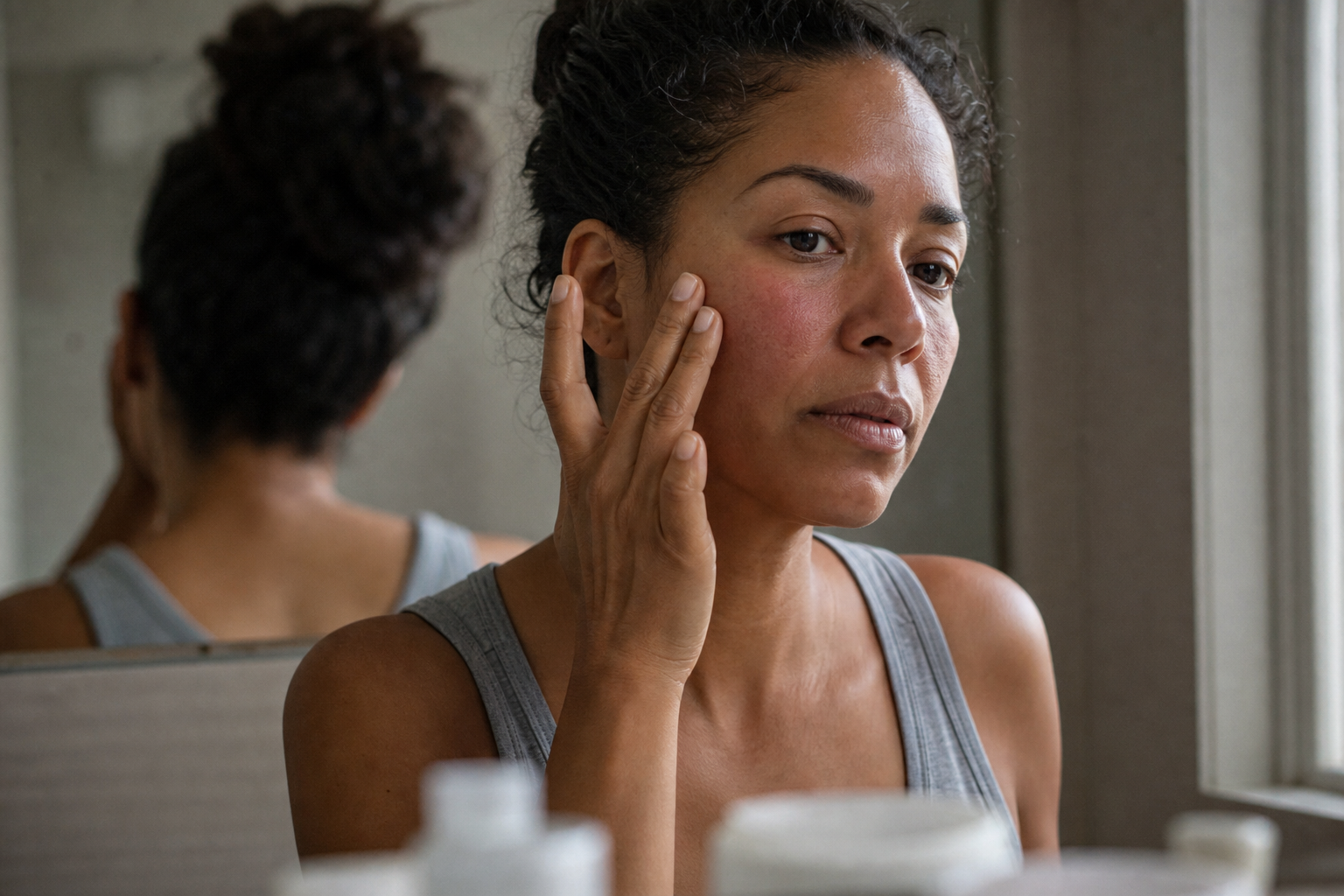
Sensitive skin is a marketing label; rosacea is a diagnosis.
"Sensitive skin" has no medical code and no treatment pathway. Rosacea has both. Here's why the difference can quietly cost years in the wrong aisle.
The shelf that was labeled for you
The shelf is labeled for you. "Sensitive skin," in soft type, runs down the cleanser, the moisturizer, the mineral sunscreen you switched to after the last one left your cheeks hot. You have rotated through this aisle for years. Fragrance-free, then barrier-repair, then the one a forum swore by. Some weeks your face is calm. Some weeks it flushes at a warm room, a glass of red, a walk in July, and settles into a low burn across the nose and cheeks that no cream seems to touch. Nobody has ever put a name to it, because the aisle you have been shopping in does not have one.
A label with no chart
Here is what the packaging will not tell you: "sensitive skin" is a category built to sell products, not a condition a clinician can diagnose. Call it the label with no chart. It has no code a dermatologist can enter, no agreed clinical definition, and no treatment that follows from it. Rosacea, the inflammatory skin disease those same symptoms can describe, has all three. The gap between the two is where years disappear, because a person managing a label has no reason to book the appointment that would reframe it.
You can manage "sensitive skin" for a decade and never once be evaluated for the disease those symptoms describe.
Who actually named it
"Sensitive skin" entered the vocabulary through cosmetics marketing, and it stuck because it is useful to almost everyone. Population surveys consistently find that a majority of adults describe their skin as sensitive Globally, ~60–70% of women and 50–60% of men self-report some degree of sensitive skin (Farage, 2019). ([source](https://pmc.ncbi.nlm.nih.gov/articles/PMC6533878/)). A term half the market claims is a marketing win and a clinical dead end at the same time. It gathers sunburn-prone skin, contact allergy, eczema, over-exfoliation, and early rosacea under one reassuring umbrella. The umbrella sells cleanser. It does not sort the person whose flushing is episodic and centered on the face from the person whose skin simply reacts to a harsh surfactant. Those two people need different things. The aisle treats them as one.
Where each word lives in the record
Look for "sensitive skin" in the places medicine keeps its definitions and it is not there. The U.S. Food and Drug Administration, which governs how cosmetic and drug claims can be made, has no regulatory definition for the term There is no federal standard or definition for 'for sensitive skin' claims on cosmetic products. ([source](https://www.fda.gov/cosmetics/cosmetic-ingredients/allergens-cosmetics)). The International Classification of Diseases, the coding system every diagnosis in your chart runs through, has no entry for it. Rosacea has a place in that system and, since 2017, a phenotype-based set of diagnostic criteria from the global ROSCO panel (Tan et al. 2017) that centers on persistent centrofacial redness rather than the older subtype model. Phenotype just means the visible and felt features a clinician can observe, not a category you self-select. One of these is a thing your record can hold. The other is a thing your shelf can sell.
Criterion
"Sensitive skin"
Rosacea
ICD diagnostic code
None
Yes (rosacea, L71)
FDA regulatory definition
None
Recognized; FDA-approved treatments exist
Standardized diagnostic criteria
None
2017 ROSCO phenotype criteria (Tan et al. 2017)
Treatment pathway
Over-the-counter cosmetics only
Prescription topicals, oral medication, laser
Where each term does and does not appear in the medical record. Rosacea codes to ICD-10 category L71.
The same year, logged instead of shopped
Picture the same year documented rather than shopped. A structured daily entry does not ask which cream you tried. It asks what your skin did and what surrounded it. Over eight weeks a pattern surfaces that no product rotation would: the redness is not constant, it arrives in episodes. The episodes cluster around heat, a hot shower, a warm restaurant, direct sun, sometimes a drink. The redness sits on the central face, nose and cheeks, not the jaw or hairline. Twice there were small raised bumps, papules, that came and went. None of that is a diagnosis, and a log cannot make one. But it is exactly the information a dermatologist uses to separate reactive skin from inflammatory disease, and exactly the information a "sensitive skin" routine is built to never collect.
A log documents; it does not diagnose
A structured record surfaces a pattern. It cannot tell you what you have. Only a clinician can distinguish reactive skin from rosacea, and the log exists to make that visit more useful, not to replace it.
The cost of never sorting
If the label does the sorting, the sorting does not happen. Published estimates of how long rosacea goes unrecognized run to years, and part of that delay is structural. Someone confident they have "sensitive skin" has no reason to escalate. So the two conditions hiding under the label, one you can only soothe and one you can actually treat, get the same response for years: another cream, another aisle. The label is not neutral. It is the thing standing between a reactive-skin routine and a question a dermatologist could actually answer.
Why this matters more on darker skin
This gap widens, it does not close, on darker skin. Rosacea's redness is harder to see on Fitzpatrick IV to VI skin, so the burning, stinging, and dryness, what dermatology calls the sensory phenotype, may be the clearest signal a person has that something is inflammatory rather than merely reactive. The automated skin-scan tools now sold as a shortcut make this worse: Adamson & Smith (JAMA Dermatology, 2018) documented that deployed dermatology algorithms perform measurably worse on dark skin, and Daneshjou et al. (2022) showed how thin the training data for those tones remains. We built Skinframe as a plain structured log for that reason. It records flushing, distribution, sensory symptoms, and photos over time, on your device, not in a cloud. It is not a verdict. It is a record you can hand to someone qualified to read it.
Keep the cleanser. Ask the question.
So keep the fragrance-free cleanser if it helps. But if your "sensitive skin" flushes in episodes, centers on your nose and cheeks, or throws the occasional bump, that is a pattern worth documenting and worth showing a professional. You deserve a clinical answer. The label on the shelf was never going to be one. Talk to your dermatologist, and bring the evidence.
Skinframe is a private, on-device rosacea tracker built for exactly this: documenting the pattern a skincare routine can't. It's coming to iPhone. Join the waitlist and start logging before your next appointment.
There is no published rosacea-specific trial proving a tracking app changes outcomes, and we will not pretend there is. What the adjacent dermatology evidence shows is that patient-reported tracking improves what happens in the exam room. We built Skinframe to bring that same structured record to rosacea, on your device, so the pattern reaches your dermatologist intact.