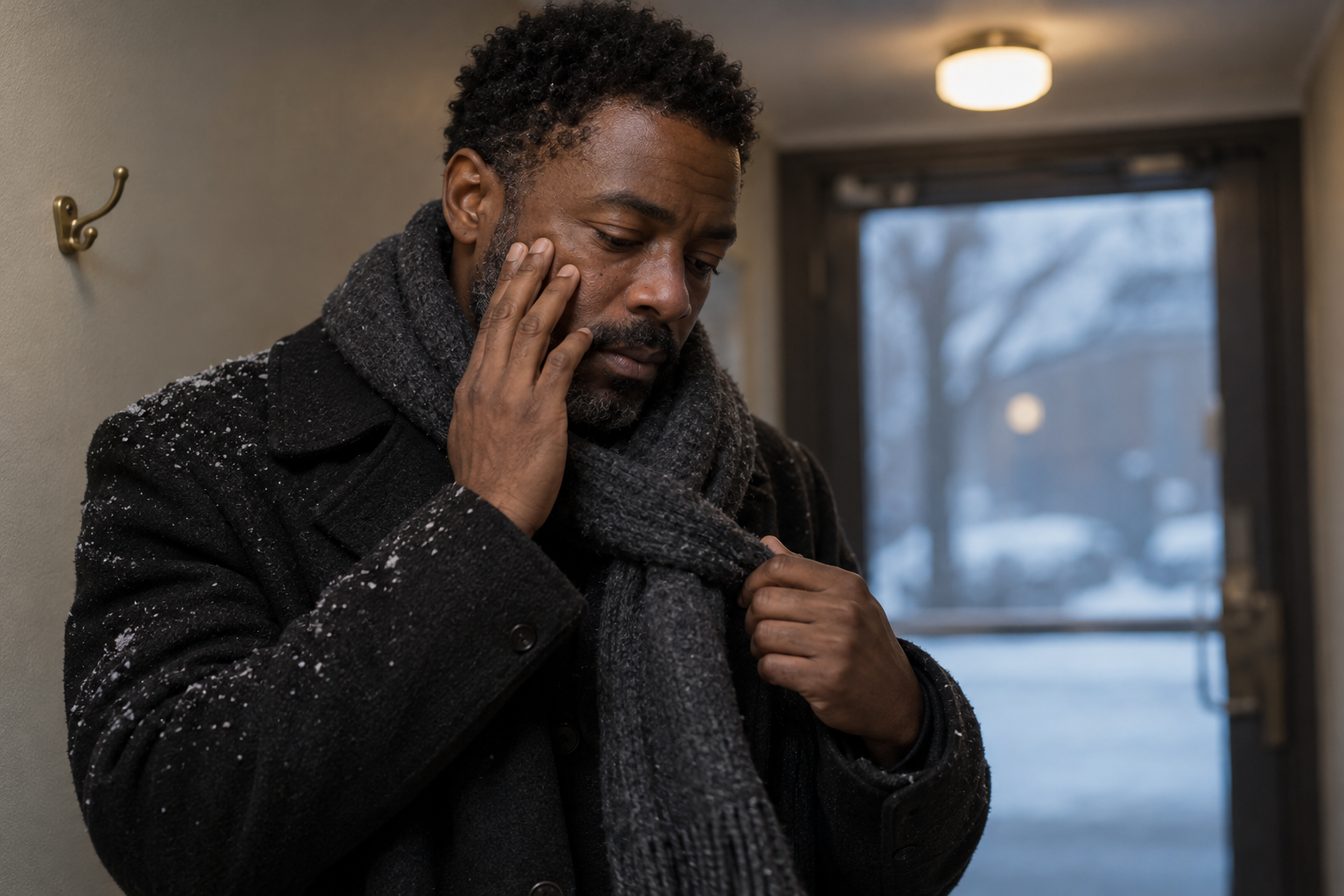
Rosacea without redness is real: warmth, stinging, and a dusky shift.
On brown and Black skin, rosacea often shows up as heat, sting, and swelling before anyone sees pink. Here's what that looks like and how to log it.
Can you have rosacea without redness?
Yes. On brown and Black skin, rosacea often shows up first as something you feel: persistent warmth, burning, stinging, or swelling across the cheeks and nose, with a dusky or brownish shift in color instead of the pink most photos teach you to look for. The National Rosacea Society's patient guide Rosacea Looks Different in Skin of Color (NRS 2023) and the review by Maliyar et al. (2022) both describe this pattern.
The inflammation can still be there. It's just harder to see against more melanin, so the sensations end up carrying the signal.
That's why the question gets typed into search bars so often. If every reference image shows a flushed, pink face, and yours looks the same color it always does while it feels like you've been standing over a stove, it's fair to wonder whether rosacea is even on the table. It can be. Whether it's what you have is a call for a dermatologist, and the rest of this piece is about making that appointment more useful.
Where the redness goes on brown and Black skin
On lighter skin, redness is the visible sign of blood vessels widening near the surface. On deeper skin tones the same change reads differently. Depending on the person and the light, it can look dusky or a shade darker brown, or barely register on camera at all. NRS 2023 and Maliyar et al. 2022 both describe these color shifts as a reason rosacea gets missed.
So the visible half of the picture gets quieter. The felt half doesn't. Warmth that hangs on after you come in from the cold, a sting when your usual moisturizer goes on, puffiness across the cheeks the morning after a trigger. The sensory side is where both sources direct attention for darker skin.
There's a practical problem too. A feature that's hard to see is also hard to remember in an exam room, and a short appointment on a calm-skin day can show a dermatologist almost nothing.
We cover the wider diagnostic gap, flushing that doesn't look red, and photo resolution on darker skin in separate pieces The three articles live on skinframe.app at /articles/rosacea-on-every-skin-tone (skin-tone underdiagnosis), /articles/rosacea-photo-log-darker-skin-tones (flushing that reads dusky purple or brown rather than red on deeper skin), and /articles/rosacea-pih-resolution-darker-skin (telling post-inflammatory pigment apart from an active flare on darker skin).. This one stays on the question you typed and what to write down.
What the 2017 criteria count: what you see and what you feel
Dermatologists classify rosacea today using the National Rosacea Society Expert Committee's 2017 update (Gallo et al., Journal of the American Academy of Dermatology, 2018). It replaced the old subtypes with phenotypes, meaning individual features that get recorded one at a time. Burning, stinging, and swelling are on that list by name.
But there's a catch to know before you read the table. Those sensations are classed as secondary features. They support a rosacea diagnosis and they're worth reporting, yet on their own they don't make one. The diagnostic features are persistent redness in the center of the face and phymatous changes (thickening of the skin, most often on the nose).
That's the honest reason sensation alone can't settle the question at home. It's also why documenting the felt side carefully matters so much: on deeper skin, it may be the most consistent evidence you have between visits.
Feature group
Features named in the 2017 update
Mostly seen or felt?
Diagnostic (one is enough)
Persistent centrofacial erythema (redness in the center of the face); phymatous changes (skin thickening)
Seen, though the redness can be hard to see on deeper skin
Major (two or more support a diagnosis)
Flushing; papules and pustules; telangiectasia (visible small vessels); ocular manifestations
Seen, plus felt: the heat of a flush, gritty or burning eyes
Source: Gallo et al., J Am Acad Dermatol 2018, the NRS Expert Committee's 2017 update. Paraphrased for readability. Your dermatologist applies these criteria; this isn't a self-check.
Do I have rosacea, or is my skin just irritated?
You can't answer that one from your bathroom, and neither can we. Plenty of things make skin burn or sting: a new product, a harsh cleanser, wind, contact dermatitis, and other inflammatory conditions that can look similar on darker skin. Sorting those apart is the dermatologist's job.
What you can do is collect the details that make the sorting faster. A few patterns matter because the criteria hinge on them.
Does the warmth sit in the center of your face (cheeks, nose, chin, forehead) or somewhere else? Does it come in episodes and settle, or does it stay? Does it follow the same things each time, like heat, hot drinks, alcohol, sun, exercise, or stress? And do your eyes get gritty or burn at the same moments your cheeks do?
Four questions. You don't need to answer them today. You need a week or two of notes that answer them for you.
Documentation, not diagnosis
A log helps your dermatologist see a pattern. It can't tell you that you have rosacea, and a calm week doesn't rule it out. If any of the red flags at the end of this piece apply to you, don't wait for the log to fill up.
A sensation log you can bring to your appointment
Keep it short enough that you'll actually fill it in on a bad day. Six fields, three of them rated 0 to 3, and you're done in about a minute.
Pair it with photos taken the same way every time. Then bring both: the photos for what changed in color, the log for what the camera couldn't catch.
Field
What to record
Why it helps the visit
Date and time
When it started and roughly how long it lasted
Separates episodes that come and go from warmth that persists
Warmth (0 to 3)
0 none, 1 noticeable, 2 distracting, 3 hot to the touch
The felt version of flushing, which may not show on camera
Sting or burn (0 to 3)
Rate it, and note whether a product had just gone on
Burning and stinging are named secondary features
Swelling (0 to 3)
Puffiness across cheeks, nose, or around the eyes
Edema is easy to miss once it settles
Where
Cheeks, nose, chin, forehead, eyes, elsewhere
Location in the center of the face matters to the criteria
What came before
Heat, hot drink, alcohol, sun, exercise, stress, new product, nothing obvious
Turns single bad days into a pattern
A template, not a scoring system. Ratings are your own and only mean something compared with your other entries.
Photo setup that holds up across days
Same spot, same daylight source in front of you, flash off, same time of day when you can manage it. Shoot before skincare or makeup goes on: face straight on, then each cheek. Hold a plain white or gray card at the edge of the frame so color shifts can be judged against something that didn't change. Skip beauty filters and portrait modes that smooth skin.
Where Skinframe fits
We built Skinframe around per-feature tracking because that's how the 2017 criteria work. Warmth, sting, and swelling get their own entries, logged next to the photo from the same moment, so the felt and seen sides of a flare sit together when you scroll back before an appointment.
What we don't do is run automated analysis on your face. Image-based dermatology tools have a documented skin-tone problem. Adamson & Smith (JAMA Dermatology, 2018) warned that the images these systems learn from skew toward lighter skin, and Daneshjou et al. (Science Advances, 2022) found that dermatology algorithms performed worse on darker skin tones when tested on a diverse image set.
For a condition whose clues on deeper skin are partly invisible to begin with, a camera-generated score is the wrong tool. Your notes and your dermatologist's eyes are the right ones.
When to see someone sooner
Book a dermatologist visit whatever your log looks like if the sensations are new and persistent, spreading beyond your face, or not following any pattern you can find.
Some symptoms shouldn't wait for a routine appointment at all. Eye pain, sensitivity to light, or blurred vision need prompt care from an eye doctor, because rosacea can involve the eyes. Sudden swelling of the lips, tongue, or throat, or any trouble breathing, means calling emergency services. And a facial rash that comes with joint pain, fever, or feeling unwell all over needs a clinician to look at it, since other conditions can mimic rosacea on the face.
For everything else: keep logging, bring the log, and talk to your dermatologist. That conversation is where the question you searched gets its real answer.
Start your sensation log in Skinframe. Record warmth, sting, and swelling next to the photo from the same moment, then bring the whole record to your next dermatology visit.
Skinframe tracks rosacea one feature at a time, the way the NRS 2017 update classifies it, with warmth, sting, and swelling logged as their own entries beside dated photos. Evidence in adjacent dermatology conditions (atopic dermatitis, psoriasis) shows patient-reported tracking improves visit outcomes; Skinframe applies the same approach to rosacea. No automated face scoring, and nothing that tries to diagnose you.