Why the same glass of wine flares you on Saturday but not Tuesday, and why single-trigger elimination logs give false answers about half the time.
The Saturday glass of wine
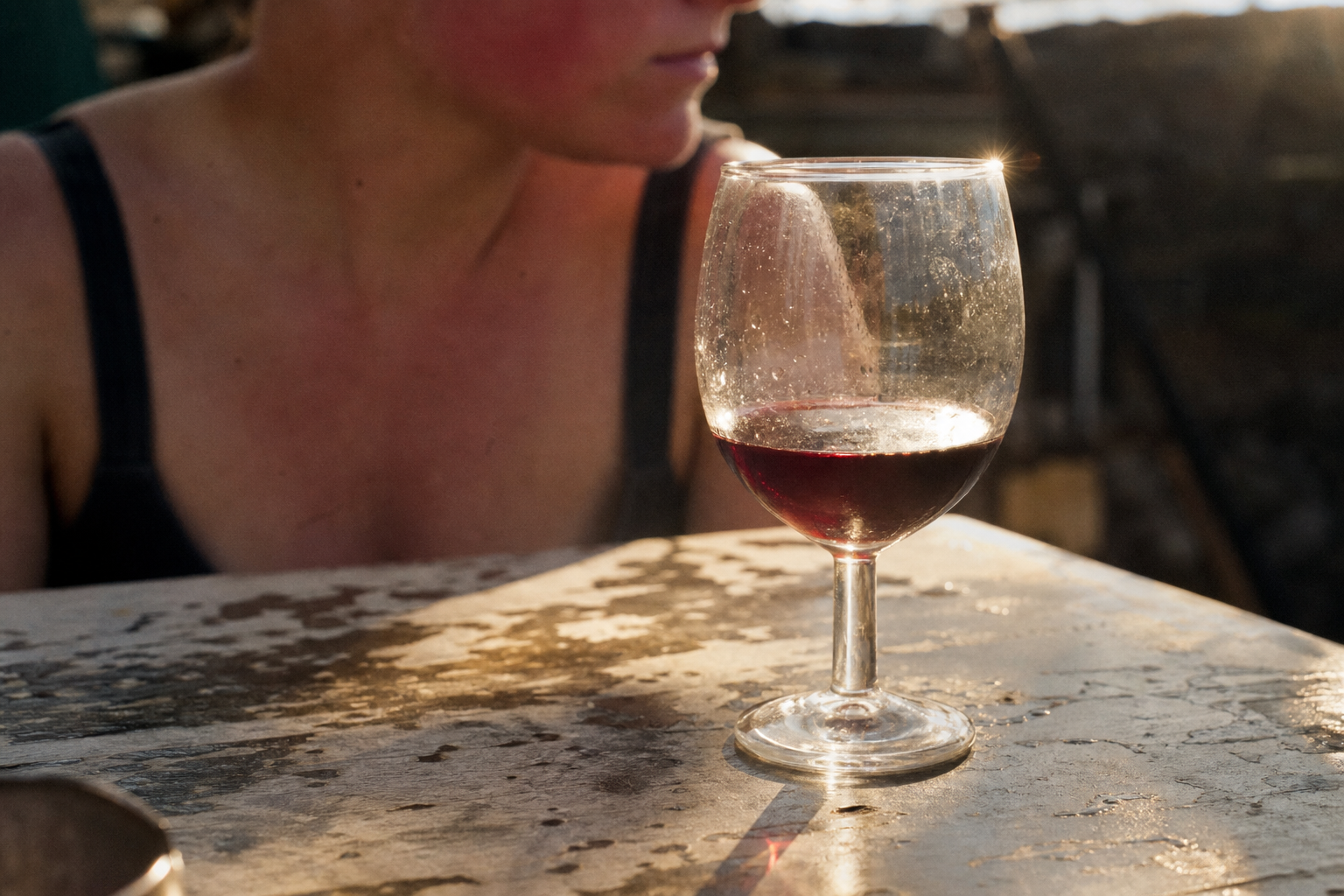
The same glass of malbec did nothing on Tuesday. On Saturday it lit your cheeks up inside twenty minutes, and you crossed wine off your list.
Here is the problem with that list. Saturday was not Tuesday. Saturday came after an afternoon in the sun, a bad night's sleep, and a week that ran hot at work. Tuesday was cool, rested, and quiet. Same wine, two different bodies, one flare. If you blame the wine, you have written down a fact that will fail you the next time you drink it on a calm day and nothing happens. Most people with rosacea have a drawer full of these contradictions: the food that flares sometimes, the walk that flares sometimes, the trigger that isn't reliably a trigger. That inconsistency is not noise in your data. It is the actual clinical picture.
A threshold, not a culprit
Rosacea flares behave like a threshold, not a switch. No single input trips them on its own reliably. Instead, several sub-flare inputs stack, and when the running total clears your personal line, the vessels dilate and the skin goes hot. Wine on a low-load day sits well under the line. Wine on a day already loaded with sun, heat, and stress is the last increment that pushes you over.
The standard mental model is a switchboard: find the one wire, cut it, problem solved. The threshold model is a bucket that different taps fill at once. What matters is not which tap you can name but how full the bucket already was when that tap opened.
Wine on a calm day sits under the line. Wine after sun, heat, and a bad week is just the last increment.
Why elimination diaries mislead
The generic skin diary asks one question on a flare day: what did you do differently? So you log the wine, or the sushi, or the workout, and the app dutifully files it as a suspect. What the app never records is the four other loads that were already in the bucket, because you had no reason to log a normal amount of sun or an ordinary stressful Tuesday.
This produces two errors, and they run at roughly the same rate. False positives: you flag wine because it coincided with a flare, when the sun did most of the work. False negatives: you clear wine because it did nothing on a low-load day, when it will absolutely contribute on a high-load one. A log that captures only the suspected trigger cannot tell these apart. It is structurally built to hand you a confident, wrong answer.
The core failure of single-variable logging
Logging only the trigger you suspect on flare days cannot separate a real contributor from a coincidence. It generates false positives (blaming the bystander) and false negatives (clearing the accomplice) at roughly equal rates. More flare-day entries do not fix this. The missing data is the load you never thought to record.
Why does rosacea flare some days and not others?
Two bodies of evidence line up behind the threshold picture. The first is what patients actually report. The National Rosacea Society's patient trigger survey found no single dominant cause: sun exposure led at 81 percent, emotional stress at 79 percent, hot weather at 75 percent, alcohol well down the list at 52 percent. When most patients name most of these as triggers, no one variable is carrying the flare on its own. The list is a set of contributors.
The second is the biology of how those contributors act. Heat, sunlight, ethanol, spicy food, and stress all converge on the same sensory nerve channels in the skin, the transient receptor potential family, chiefly TRPV1 and TRPA1. Sulk et al. (J Invest Dermatol 2012) documented altered expression of these channels in rosacea skin. Capsaicin activates TRPV1, environmental cold and certain chemicals activate TRPA1, and heat activates both. The point is that these are summing detectors, not independent alarms. Several mild stimuli arriving together drive a larger neurogenic-inflammation response than any one of them alone. The literature does not settle every detail here, and it disagrees on some specifics such as red wine versus white, but the additive mechanism is the consistent thread.
81%
name sun exposure as a triggerNational Rosacea Society patient survey
79%
name emotional stressNational Rosacea Society patient survey
75%
name hot weatherNational Rosacea Society patient survey
52%
name alcoholNational Rosacea Society patient survey
A Saturday, hour by hour
Walk the bucket forward. Saturday morning starts with a short night, so stress and fatigue are already adding a little. Early afternoon brings two hours outside without much shade, so UV and heat stack on top. By evening the bucket is most of the way up, quietly, from inputs you would never bother to write down. Then the wine arrives. It is a modest pour, the same one that did nothing on Tuesday, but on Saturday it is the increment that clears the line. Cheeks flush, the flare runs its course.
Now run the same wine on Tuesday. Rested, indoors, cool, unstressed. The bucket started near empty, the wine barely moved the level, and nothing happened. In a single-variable log these two days produce opposite verdicts on wine. In a threshold log they tell one coherent story: wine is a real contributor that only shows itself when the baseline load is already high.
What changes if flares are additive
If the threshold model is right, the whole job of tracking changes. You stop hunting for the one villain and start watching the total load. Management becomes about margin: keeping the daily baseline low enough that a normal glass of wine or a warm afternoon does not push you over. That is a very different and far more livable goal than a permanent ban list.
It also changes what a useful record has to contain. To see a threshold you need the whole day's inputs on flare days and on calm days, because the calm days are the control that tells you how much room you had. A record of only the bad days, tagged only with the obvious suspect, can never show you the line. It shows you a wall of coincidences.
Logging built for a threshold
We built Skinframe around this problem specifically. On any day, flare or calm, you capture the full set of inputs at once: sun and heat exposure, alcohol type and amount, stress and sleep, hot drinks, and a dated photo as the evidence layer. Not the single suspect, all of them, together, so the data can actually show a threshold instead of a stack of unrelated guesses.
That design is not a longer questionnaire for its own sake. It is the direct consequence of the mechanism. Because the nerve channels sum simultaneous inputs, the log has to capture them simultaneously, or it is measuring the wrong thing. The photo matters for the same reason: your memory of how red you were on a given day drifts, and a threshold pattern only emerges when the visible outcome is pinned to the full input set on the same date. What you bring to your dermatologist then is not a list of banned foods. It is a picture of where your line sits and what fills your bucket fastest.
What we're tracking next
The open question we care most about is individual variation in where the line sits and how fast the bucket drains. Two people can share the same trigger list and live completely different lives, because one clears the load overnight and the other carries yesterday's stress into today. The recovery curve, how long an input keeps contributing after it happens, is thinly studied in rosacea specifically, and it is where personal data beats population averages. That is the pattern we are building the tracking to surface.
None of this is a substitute for a diagnosis or a treatment plan. If your flares are frequent, worsening, or affecting your eyes, talk to your dermatologist. A record of your own threshold makes that conversation sharper, not unnecessary.
Capture every variable at once, flare day or calm day, so your data can show the line instead of a stack of guesses. Track your rosacea with Skinframe.
The National Rosacea Society survey and the TRPV1/TRPA1 literature both point the same way: rosacea flares are a running total of many inputs, not the work of one. A log that captures only the suspected trigger on bad days is built to mislead. Capturing the full input set on every day, flare or calm, is what makes a personal threshold visible.