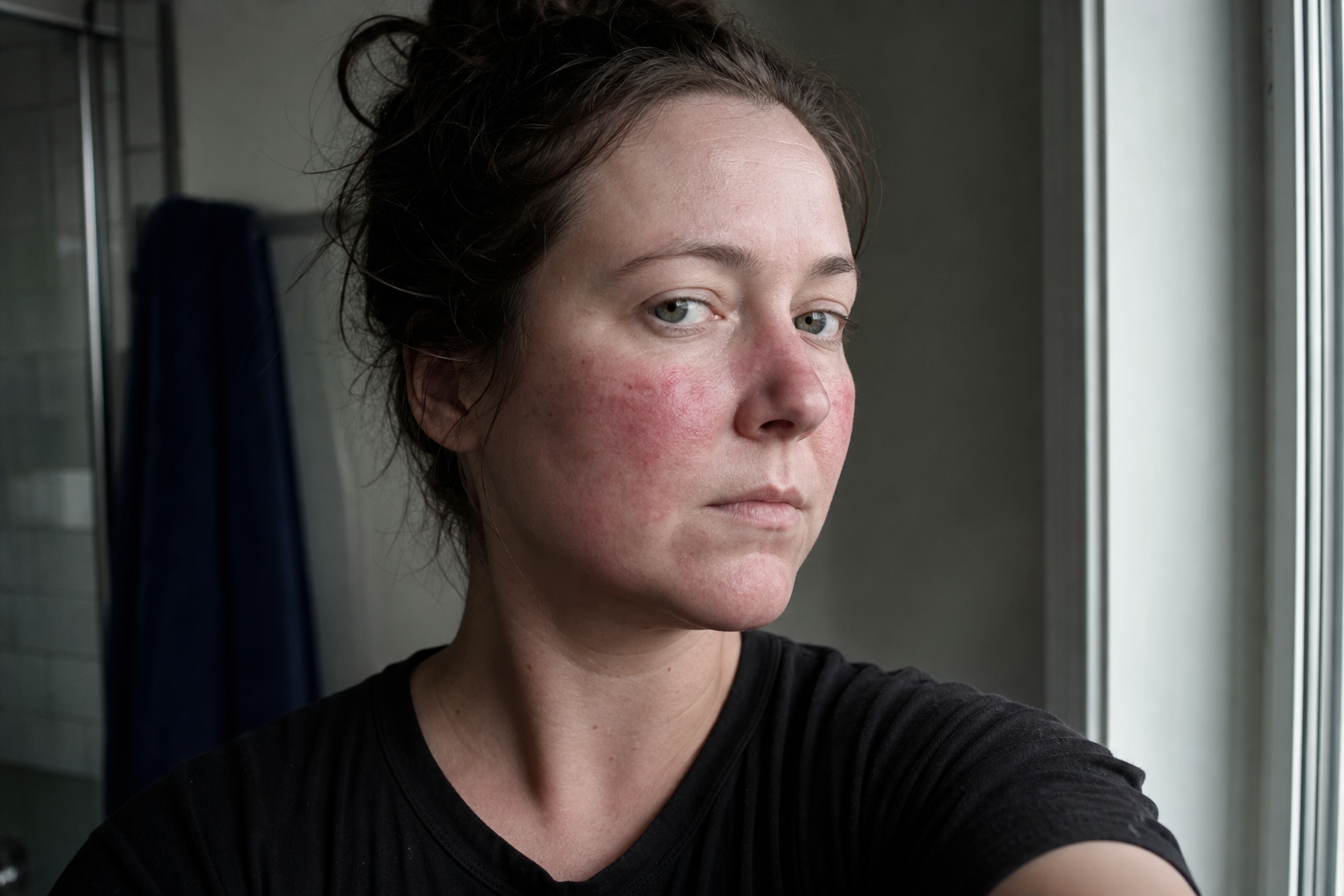
Your rosacea cream has a six-week trial. Log it so it counts.
Rosacea topicals come with a built-in trial period before your dermatologist decides they worked. Almost nobody tells you what to record while it runs.
The question at the follow-up you can't actually answer
Six weeks after the prescription, you are back in the dermatologist's chair and she asks the only question that matters: is it working? You say you think so. The flushing seems less. The bumps around your nose felt calmer two weeks ago, or was it three, and you cannot quite hold the comparison in your head anymore. She nods and writes something down. That shrug, translated into a chart note, becomes the entire evidence base for whether you keep the cream, switch to another, or escalate.
This is how most rosacea trial periods actually end. Not with data. With a memory of a feeling about a face you see every day and therefore cannot see changing.
The blank trial window
Rosacea topicals, metronidazole, azelaic acid, and ivermectin cream, are prescribed with an explicit waiting period baked in. You do not judge them in week one. You judge them at the reassessment visit weeks later. That waiting period has a name in the guidelines and a slot on the calendar. What it does not have is a patient-facing standard for what you are supposed to be recording while it runs.
Call it the blank trial window. The medication is chosen carefully. The follow-up is booked. And the thing that makes the whole exercise meaningful, a record of what the skin did between the two appointments, is left entirely to recall.
The trial period only means something if someone was measuring it.
Everyone argues the medication. Nobody minds the measurement
Search rosacea treatment and you drown in the wrong debate. Metronidazole versus ivermectin. Azelaic acid gel versus cream. Which one for papulopustular rosacea, the subtype with inflammatory bumps, versus which for persistent redness. All of it is about the input. Almost none of it is about the readout.
That imbalance is the mistake. A trial without a measurement is not a trial, it is a wait. Two patients on the identical cream can walk into the same six-week visit, one with a clean weekly photo series showing bumps resolving and one with 'I guess a little better,' and only one of them gives the dermatologist something to decide on. The medication was the same. The documentation was the whole difference.
What the guidelines actually build in
The waiting period is deliberate, not incidental. The 2019 update from the National Rosacea Society Expert Committee (Thiboutot et al., JAAD 2019) treats topical therapy as something assessed over a span of weeks rather than days, with a reassessment point that falls well into the treatment course rather than after a handful of applications.
The drug trials themselves tell you why the window is long. Ivermectin 1% cream's pivotal phase 3 studies measured their primary response at 12 weeks (Stein Gold et al., 2014), with improvement still building in the later weeks. The pivotal trials for azelaic acid and metronidazole ran on a similar order. A pivotal trial comparing 15% azelaic acid gel and 0.75% metronidazole gel ran 15 weeks, with azelaic acid demonstrating significant superiority ([source](https://pubmed.ncbi.nlm.nih.gov/14623704/)). Judge any of these in week two and you are reading noise. The signal accrues slowly, which is precisely the reason a single end-of-window impression is such a weak instrument.
The log that turns six weeks into a record
A usable trial-window record is small. It is a handful of things captured on a fixed rhythm so the trend, not the memory, does the talking. Take the same photo, from the same angle, in the same light, once a week. Put a severity number on the features that bother you, on the same scale each time. Count new inflammatory bumps in one zone so the drug's main target has a measurable line. Note stinging or dryness in the early weeks, because tolerability, not efficacy, is what makes people quit before the window even closes. Tag the week's flares to their likely triggers so a bad hot-yoga Tuesday does not get mistaken for the cream failing.
Six weeks of that is a before/during/after series a dermatologist can read in thirty seconds. It either confirms the topical is working or documents plainly enough that it is not.
What to capture
How often
Why the follow-up needs it
Same-angle face photo, consistent light
Weekly
Gives a before/during comparison the naked eye cannot hold across six weeks
Severity number, fixed scale, per feature
Weekly
Turns 'I think it's better' into a trend line
New bump count in one facial zone
Weekly
Inflammatory papules are what these topicals target first
Stinging, burning, dryness on application
Each use, early weeks
Tolerability failure is the top reason people quit before week six
Flares and their likely triggers
As they happen
Separates true treatment signal from ordinary trigger noise
The trial-window log: a documentation protocol for the treatment-response phase.
Same light, or the photos lie
Lighting is the single biggest confound in home face photography. A cream can look like it is failing under harsh bathroom downlight and working under soft window light on the same day. Fix the light and the angle before you fix anything else. Inconsistent conditions do not just weaken the record, they can reverse what it appears to show.
What a real record changes at the visit
When the documentation exists, the six-week conversation stops being a guess and becomes a decision. A clear improving series confirms efficacy and gives your dermatologist grounds to continue. A flat or worsening series, captured under honest conditions, is a clean case for switching agents or escalating, months earlier than a vague impression would justify. Either outcome is more useful than 'maybe a little.'
There is a paperwork dividend too. Continued prescriptions and prior-authorization requests lean on evidence of response. A timestamped photo series plus a weekly severity trend is exactly the kind of documentation that makes the case for keeping a working medication covered, instead of relitigating it from scratch.
Documentation infrastructure, not a verdict
This is the specific gap we built Skinframe to close. Not to tell you whether your cream is working, that judgment belongs to your dermatologist, but to make the six-week window produce a record instead of a shrug. The app holds the weekly photo under consistent conditions, keeps the severity number on a fixed per-feature scale, and timestamps everything so the sequence is legible at the follow-up.
The honest framing on efficacy: no rosacea-specific trial has proven that tracking apps change outcomes. What the evidence in adjacent conditions does show, in atopic dermatitis and psoriasis, is that structured patient-reported documentation improves what happens at the visit. We apply the same documentation approach to the rosacea trial window, and leave the clinical call where it belongs.
What we're watching next
The open question is whether the reassessment window itself is drifting. As newer topicals and combination regimens land, the point at which a dermatologist judges response may move, and the trial-window log has to move with it. We are tracking the next NRS and AAD guideline revisions for exactly that. Until then, if you have a fresh prescription, start the record before the next dose, and bring it with you. Then let your dermatologist read it and make the call.
Photos under consistent light, a weekly number, timestamps that hold up at the six-week follow-up. Start your trial-window record before the next dose.
Evidence in adjacent dermatology conditions, atopic dermatitis and psoriasis, shows that structured patient-reported tracking improves what happens at the visit. Skinframe applies the same documentation approach to the rosacea trial window: a consistent weekly photo, a per-feature severity number, and timestamps your dermatologist can actually read.