Rosacea severity is scored by facial zone, so photograph it that way
One front-on selfie can't show where your rosacea lives. Here's a zone-by-zone capture protocol that matches how clinicians score severity.
One cheek flares. The selfie averages it away.
A rosacea flare rarely lands evenly across the face. One cheek runs hot after a steep walk uphill while the chin stays calm. The nose keeps a stubborn baseline redness that never fully clears between flushes. Then the daily log entry gets made: one front-facing selfie under the bathroom light and a single number, maybe a 6.
Six what, and where?
By the time that log reaches a dermatologist, every one of those differences has been averaged into a score the clinician can't map onto anything they measure. The photos look alike. The numbers drift with mood and lighting. So three months of careful tracking can end up saying less than one honest sentence about which part of the face is getting worse.
The zone gap: severity has an address
Rosacea severity has an address. The Rosacea Area and Severity Index (RASI), validated by Wienholtz and colleagues in 2023 (Wienholtz NK, Christensen CE, Egeberg A, et al. 'Validity and reliability of the Rosacea Area and Severity Index (RASI).' Journal of the European Academy of Dermatology and Venereology (JEADV), 2023, volume 37, issue 3, pages 573–582.), scores four facial areas separately and then combines them (The Rosacea Area and Severity Index (RASI) in Wienholtz 2023 scores erythema, papules/pustules, telangiectasia and rhinophyma across four facial subareas: cheek, nose, chin and forehead. The per-area scores are combined using area-weighted multipliers, as in PASI/EASI. Skinframe takes the area-weighted idea as a structuring principle for photo capture and tracks each feature separately instead of using a single global score.). Location is part of the measurement.
We call the mismatch the zone gap. A one-angle photo log with one overall number can't be lined up against an instrument that looks at each area on its own terms. The fix is low-tech: make the log copy the structure of the score. Same areas, photographed the same way, every time.
The trouble with the daily selfie
The standard advice for rosacea tracking is to take a photo every day. It's well meant, and it's half right. A front-on shot foreshortens the cheeks, shadows the sides of the nose and tucks the chin under the jawline. Whatever sits at the edge of the frame gets the least detail, and for a lot of people that's exactly where the redness is.
The single overall number has a second problem: it blends two different things. The global ROSacea COnsensus panel (Tan et al., British Journal of Dermatology, 2017) moved rosacea assessment toward individual features, and it treats transient erythema (flushing that comes and goes) separately from persistent erythema (the background redness that stays). A 6 logged mid-flush and a 6 logged on a quiet day with heavy baseline redness are different readings. One score can't tell them apart.
Capture the evidence. Leave the scoring to your clinician.
RASI is a clinical instrument used by trained assessors. A zone-based log gives your dermatologist consistent, comparable photos of each area. Calculating the score is their job, so don't try to work out your own RASI at home.
How is rosacea severity measured?
Two pieces of the literature shape what a useful log looks like. ROSCO splits rosacea into features, so redness, bumps, visible blood vessels and eye symptoms are each assessed on their own. RASI adds the spatial layer, scoring signs area by area across the face.
Taken together, they point to a log with two axes. One axis is *what*: a flush episode or persistent redness. The other is *where*: which facial area. A record that keeps both can be read the way a clinician reads skin. A record that keeps neither is mostly a mood diary with pictures.
Source
What it separates
What your log should do
ROSCO panel (Tan et al. 2017)
Individual features, including transient vs. persistent erythema
Log flush episodes separately from baseline redness
RASI (Wienholtz et al. 2023)
Four facial areas, each scored on its own
Photograph so every area is clearly visible, every session
Sources: Tan et al., Br J Dermatol 2017 (ROSCO); Wienholtz et al. 2023 (RASI validation).
How to photograph rosacea for a dermatologist, zone by zone
The protocol is boring on purpose. A change in light or distance can look like a change in skin, so consistency matters more than anything else.
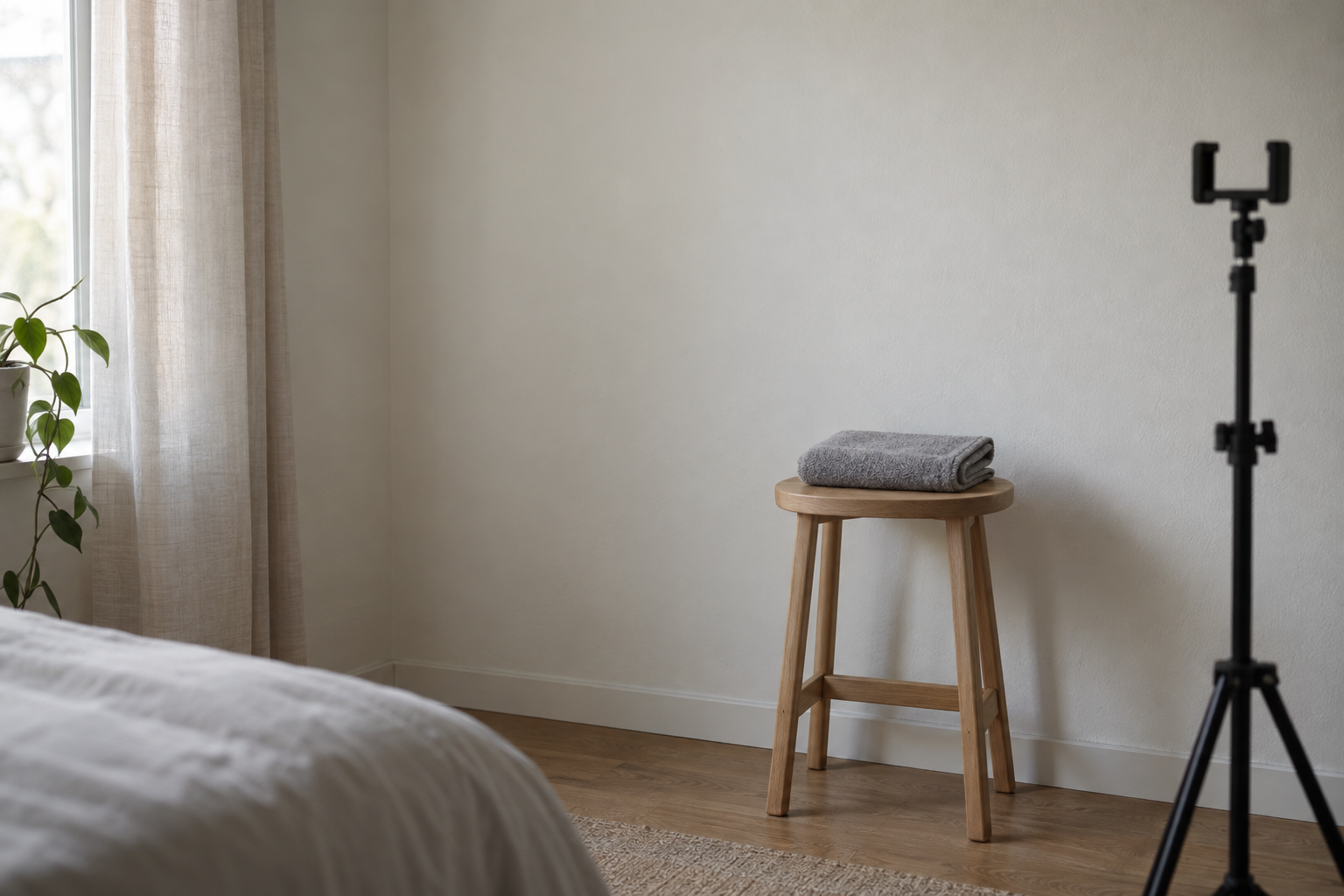
Pick one spot with steady, indirect daylight (a window beside you, not in front of you) and use it every time. Turn the flash off, because it bleaches redness. Keep the phone at the same distance, either at arm's length or on a stand, and take the same views in the same order: straight on, then a three-quarter view from each side so each cheek gets its own frame. Shoot at the same time of day, before skincare or makeup if your routine allows. Then log each area separately. Was it a flush or baseline? How did it feel?
Picture three weeks logged this way. The front-on shots barely change. The left three-quarter view shows something else: a cheek that flushes on long outdoor commute days while the nose holds steady. One daily selfie would have buried that pattern. A dermatologist can actually use it.
Variable
Keep it fixed
Why it matters
Light
Same spot, indirect daylight, flash off
Light color and flash change how red skin looks
Distance
Same distance every session
Moving closer exaggerates color and texture
Angles
Front, then left and right three-quarter
Each cheek fills its own frame instead of the edge of one
Timing
Same time of day, before products
Heat, skincare and makeup change visible redness
Log entry
Per area: flush or baseline, plus sensations
Matches how features and areas are assessed
A repeatable capture protocol based on general clinical-photography practice. RASI doesn't specify it.
What changes when the log has a map
If the zone gap is real, the question you bring to an appointment changes. 'Is my rosacea getting worse?' becomes 'my right cheek has flushed more often since I switched cleansers, and the nose looks the same.' That's specific enough to act on.
It matters even more on deeper skin tones. Redness is harder to see and to photograph on Fitzpatrick IV to VI skin. Adamson & Smith (JAMA Dermatology, 2018) flagged how poorly darker skin is represented in dermatology's image record, and Daneshjou and colleagues (Science Advances, 2022) showed dermatology algorithms performing worse on darker skin in a diverse clinical image set. For many readers, the note logged for each zone carries as much weight as the photo. Burning, stinging, tightness and heat (the sensory phenotype, meaning how rosacea feels rather than how it looks) belong in the record, area by area, even when the camera barely registers anything.
Where Skinframe fits
We built Skinframe for this kind of record. It keeps a dated photo log with notes for each feature, so a flush and a baseline day don't collapse into one number. The photos stay on your phone, and no skin-analysis algorithm reads your face, for the reasons in the section above. The protocol here works in any camera app. Skinframe makes it easier to keep the same one going for months.
Bring the log to your dermatologist and let them do the scoring. And talk to your dermatologist before you change anything about your treatment based on what your photos seem to show.
Keep your rosacea log zone by zone. Get Skinframe for iPhone.
Skinframe is a rosacea tracker built around the 2017 consensus shift to feature-based assessment. It has notes for each feature, a dated photo log stored on your phone, and no skin-analysis AI. No rosacea-specific trial of tracking apps exists yet. Evidence in adjacent dermatology conditions (atopic dermatitis, psoriasis) shows patient-reported tracking improves visit outcomes, and Skinframe applies the same approach to rosacea. Lifetime is $29.99, or $4.99/mo with one-tap cancel and no rate hikes.