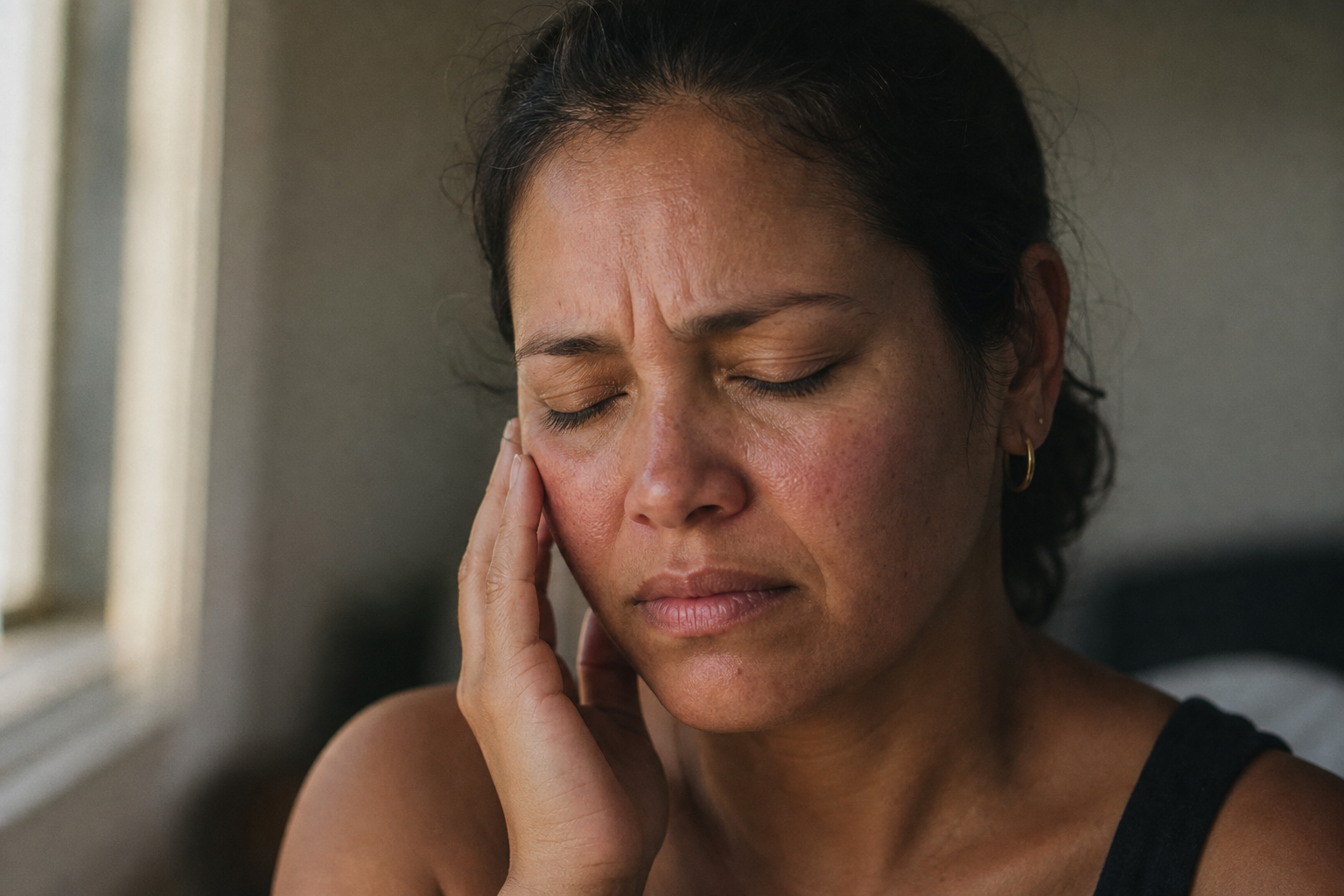
The most common rosacea symptom isn't on the scale that grades it.
Burning is the primary symptom for 94.75% of rosacea patients, yet the grading scale clinicians use to score severity has no line for it, and that gap costs you at your next appointment.
A flare that hurts more can chart as improvement
A flare that burns like a bad sunburn can read as progress on the form your dermatologist fills out. In a 2025 analysis of rosacea patients (PMC12728489), burning was the primary symptom for 94.75% of them. Nearly everyone. And yet the grading scale most clinicians reach for to score severity has no line for it. It counts what the camera sees: redness, bumps, pus-filled spots. The heat and the sting that almost every patient describes first gets no number at all. So you sit in the chair describing a face that feels like it is on fire, and the record being built beside you is measuring something else.
The half-picture problem
Call it the half-picture problem: the most common rosacea symptom is missing from the scale clinicians use to grade severity, which means a patient and a dermatologist can spend an entire appointment measuring two different diseases. One of them is tracking how the skin photographs. The other is living inside how it feels. When the visible signs and the sensory signs move in opposite directions, and they often do, the appointment tends to resolve in favor of the one that has a number attached to it.
Why 'just bring photos' is right and incomplete
The standard advice, from clinics and tracking apps alike, is to photograph your face during flares and bring the images in. That advice is right and incomplete. A photo is excellent evidence for erythema (persistent facial redness), for papules and pustules (the inflammatory bumps), for the flushing that comes and goes. It is close to useless for stinging, for the tight, drawn feeling across the cheeks, for the way a warm room turns the skin hot within minutes. None of those cast a shadow a lens can catch. A documentation habit built only around the camera quietly trains you to under-report the symptoms that dominate your day, because they leave no visual trace to pin them to.
A documentation habit built only around the camera trains you to under-report what you feel most.
Why does rosacea burn so much, and why isn't it graded?
The grading instruments in common clinical use score visible signs. The National Rosacea Society's severity grading rates erythema, papules, and pustules, plus telangiectasia (the visible dilated vessels), each on a bounded scale. The NRS standard grading system scores primary rosacea features on a 0-to-3 scale (absent, mild, moderate, or severe), with secondary features rated absent/present. ([source](https://www.academia.edu/67093588/Standard_grading_system_for_rosacea_report_of_the_National_Rosacea_Society_Expert_Committee_on_the_classification_and_staging_of_rosacea)) What it does not assign a score to: stinging and burning, skin tightness, dryness, and photosensitivity, the sensitivity to light that many patients rank among their most disabling symptoms. This is not a gap the field is unaware of; it is a documented one. The 2025 analysis (PMC12728489) put a size on it: burning was the primary symptom for 94.75% of the patients studied. A symptom that near-universal, absent from the primary severity instrument, is not a rounding error. It is a structural blind spot.
Scored by the grading scale
Left unscored
Erythema (persistent redness)
Burning and stinging
Papules (inflammatory bumps)
Skin tightness
Pustules (pus-filled spots)
Dryness
Telangiectasia (visible vessels)
Photosensitivity
The visible-sign grading approach vs. the sensory symptoms it omits. Sign list per National Rosacea Society severity grading; burning prevalence per 2025 analysis (PMC12728489).
The flare that photographs as progress
Picture two appointments eight weeks apart. At the first, your cheeks are visibly red, a few papules sit along the nose, and it stings. The clinician grades it moderate. You start a topical. Eight weeks later the visible redness has genuinely calmed and there are fewer bumps. On the scale, that is a clear improvement, and it is real. But the burning has not budged, and the tightness after your morning shower is worse. On the erythema line you have dropped a full step. In the room, the sentence you keep repeating is 'it still burns constantly,' and there is nowhere on the form for that sentence to land. The treatment gets marked as working. The symptom driving most of your day goes unrecorded. Not because anyone did anything wrong, but because the instrument was never built to hold it.
This gap is wider on darker skin
If the record leans on what photographs, the people it fails hardest are the ones whose rosacea photographs least clearly. Erythema is defined by contrast against baseline skin tone, and on Fitzpatrick IV to VI skin that contrast is lower, sometimes reading as dusky or violaceous rather than bright red. Adamson & Smith (JAMA Dermatology, 2018) documented how dermatology tools built and validated on lighter skin underperform on darker skin; Daneshjou et al. (2022) showed the same imbalance running through the image datasets those tools learn from. A grading approach anchored to visible redness inherits that bias directly. For a patient of color whose flares burn severely but never turn camera-bright, a visual-only record can undercount the disease twice: once for the sensory symptoms it never scored, and again for the erythema it struggles to see.
What a fuller record looks like
The design response is not more sophisticated photography. It is logging the sensory phenotype (the burning, stinging, tightness, and light sensitivity) as structured data that sits beside the photo, rather than buried in a free-text note nobody re-reads. We built Skinframe around that pairing: a photo captures what the flare looks like, a quick structured sensory log captures what it feels like, and the two arrive at your appointment as one record instead of half of one. A flare that burns at a 9 but photographs mild then shows up as exactly that, a mismatch your dermatologist can see and act on, instead of a contradiction that quietly resolves toward the camera. The evidence that this helps comes from adjacent conditions: in atopic dermatitis and psoriasis, patient-reported tracking is associated with better-informed visits. Skinframe applies the same approach to rosacea.
What we're tracking next
Two threads. First, whether the field's grading instruments start to fold sensory symptoms in: the 2017 phenotype update moved rosacea toward a feature-based model, and a sensory dimension is the logical next addition. The ROSCO 2019 consensus panel (published in British Journal of Dermatology 2020) reaffirmed the phenotype-based framework established in 2017 and explicitly recognized burning and stinging as formal secondary phenotypes alongside visible signs like flushing and papules. This means sensory symptoms are part of the official diagnostic and severity picture, not just incidental patient complaints, which is why Skinframe tracks them as a first-class daily metric rather than burying them under photo-derived redness. Second, how much a paired visual-and-sensory record actually changes what happens in the appointment. Until either is settled, the safest move for any patient is to bring both halves yourself. And if your rosacea is changing, talk to your dermatologist. A log is documentation, not a diagnosis.
Log the burning, not just the redness. Bring your dermatologist the whole picture, not half of one.
The rosacea grading scales in clinical use today were built to score what a camera can see. Skinframe was built by a small team that read the same literature your dermatologist did, and decided the sensory half of the disease, the burning that 94.75% of patients name first, deserved a structured record too.