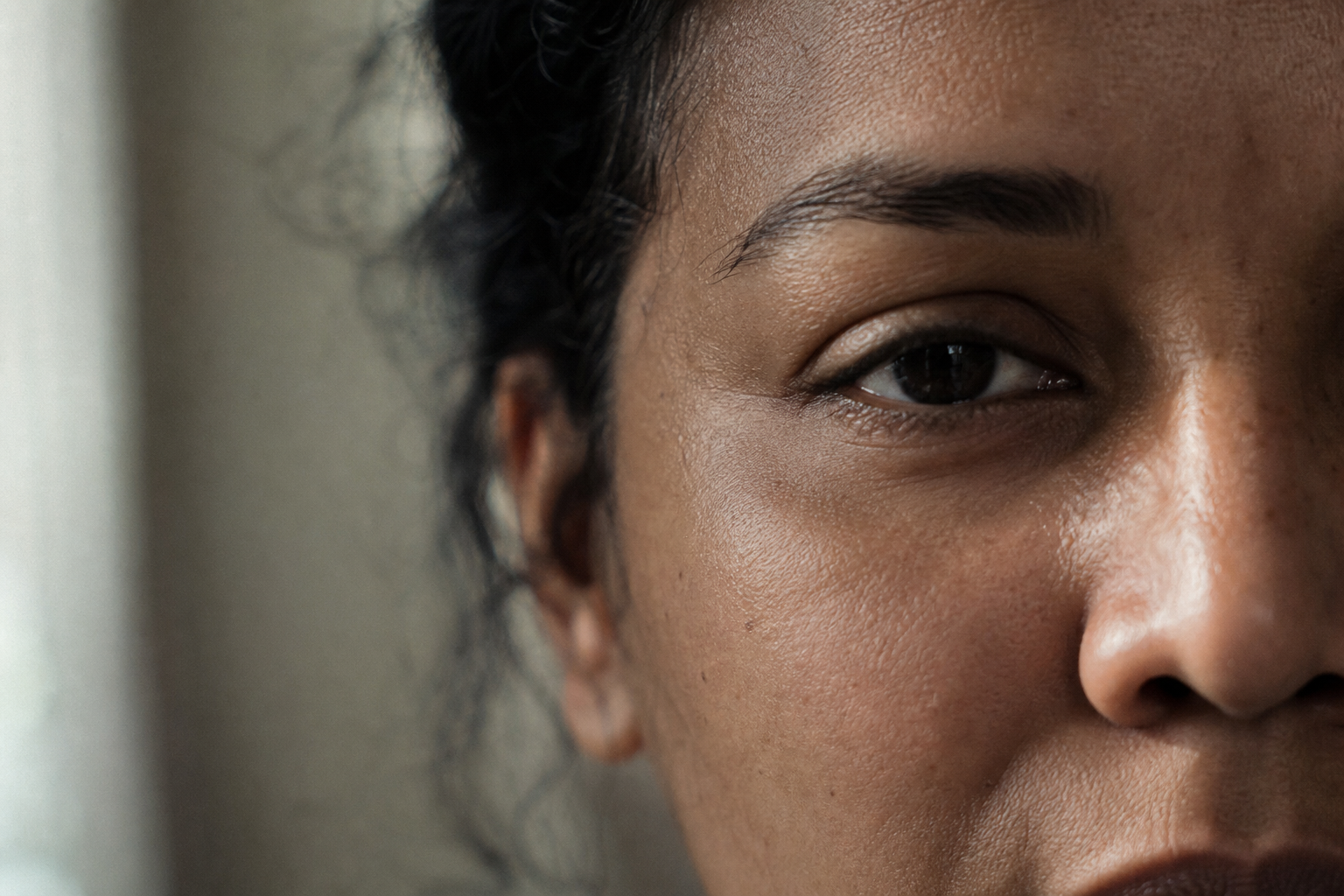
When rosacea cream skips your brows and hairline, suspect a second condition.
Seborrheic dermatitis is rosacea's most common look-alike. The harder problem is having both at once, and only facial geography tells them apart.
The cream is working. The brows are not.
The rosacea cream is finally working. Six weeks of azelaic acid, and the flush across the cheeks has settled, the little papules are fading. But the eyebrows still flake. The creases beside the nose stay pink and scaly. The hairline itches in a way the cheeks never did, and it turns greasy by afternoon. The reasonable move looks like more cream, applied harder, spread over a wider patch of face. That move is often the thing making the second problem worse.
The two-map face
What flakes at the brow and greases at the hairline usually isn't stubborn rosacea. It's seborrheic dermatitis, a separate inflammatory condition tied to Malassezia, a yeast that lives on everyone's skin and overgrows in oil-rich zones (the same process is dandruff when it lands on the scalp). And the standard guides skip this: you can carry both conditions on one face at the same time. We call it the two-map face. Rosacea and seborrheic dermatitis follow two different maps of the same skin, so a treatment aimed at one map can leave the other untouched, or quietly aggravate it.
Rosacea or sebderm is the wrong question
Type 'do I have rosacea or seborrheic dermatitis' into a search bar and nearly every result frames it as a fork: one or the other, here's how to tell which. That framing comes from how the conditions are taught, as items on a differential diagnosis list, the set of look-alikes a clinician rules out one by one. Seborrheic dermatitis is a genuine rosacea mimic, so the confusion is real. But co-occurrence, both present together, is documented in the dermatology literature, and it's common enough that clinicians are taught to look for the second when they find the first. The one-or-the-other search result answers a question your face may not be asking.
Geography is the tell, not intensity
The most reliable way to tell the two apart is where they sit, not how red or how severe they look. Rosacea favors the central face: the convex cheeks, the nose, the chin, the middle of the forehead. Seborrheic dermatitis favors the oil-rich seams: the eyebrows and the skin between them, the folds running from nose to mouth (the nasolabial folds), the hairline, behind the ears, the scalp. Scale and grease point toward sebderm; papules, pustules, and visible vessels point toward rosacea. When one face shows a calm center and an inflamed border, that split is the map telling you two conditions are in play.
Intensity is an even weaker guide on darker skin. Redness (erythema) is harder to see on Fitzpatrick IV to VI tones, where rosacea can read as warmth, swelling, or a violaceous cast rather than red, and seborrheic dermatitis often shows as lighter, scaly patches. Dermatology's visual datasets under-represent these tones (Daneshjou 2022; Adamson & Smith 2018), so any read that leans on how red something looks fails harder here. Where the inflammation sits, and what it feels like, burning, stinging, itching, flaking, carries more of the signal.
Facial zone
Points toward rosacea
Points toward seborrheic dermatitis
Cheeks (convex)
Typical
Uncommon
Nose
Typical
Uncommon
Chin
Typical
Uncommon
Central forehead
Typical
Sometimes
Eyebrows / between brows
Uncommon
Typical
Nasolabial folds
Sometimes
Typical
Hairline / scalp
Rare
Typical
Behind the ears
Rare
Typical
Distribution patterns as taught in standard dermatology references. Overlap zones (central forehead, nasolabial folds) are where the two blur most, which is exactly where co-occurrence is easiest to miss.
Why both at once is coherent, not coincidence
Two conditions on one face could be bad luck. The mechanism suggests otherwise. Both rosacea and seborrheic dermatitis run through the skin's innate immune system, the fast, non-specific defense layer, and both are driven by a resident microbe tipping from harmless to provocative: Demodex mites and their bacteria in rosacea, Malassezia yeast in seborrheic dermatitis. A face whose barrier and immune signaling already overreact to one resident organism is primed to overreact to another. That shared wiring is why co-occurrence reads as pathologically coherent rather than coincidental: the same reactive skin can host both maps at once, which is also why calming one inflammation can leave the other burning.
How the pattern hides before an appointment
Picture eight weeks of tracking before a dermatology visit. The log says: redness 4/10 Monday, 6/10 after wine Friday, 3/10 Sunday, a stinging day, a good day. Photos, if any, are full-face and scored for overall redness. On paper the trend looks like partly-controlled rosacea. What the log never captured is that every high-redness reading came from the brows and hairline while the cheeks kept improving. The bimodal pattern, two conditions on two zones moving in opposite directions, got averaged into one wobbly number. The dermatologist sees a single severity line, not the split. And the one clue that would have flagged the second condition, where the inflammation actually sits, was the first thing the tracking threw away.
Track the zone, not just the redness
This is where how you document matters more than how diligently you do it. A redness score compresses a whole face into a single digit, and that compression is exactly where a coexisting condition disappears. What survives the averaging is location: a full-face photo with the active areas marked by zone, taken in consistent light, so the brow-and-hairline pattern sits visibly next to the calm center. That is a record a clinician can read in seconds. We're building Skinframe around zone-annotated photo logging for this reason, so the map your face is drawing shows up at the appointment instead of collapsing into an intensity number on the way there. Two things still belong to your dermatologist and not an app: whether both conditions are actually active, and how to sequence treatment when they are, since a topical steroid reached for to quiet sebderm flaking can tip rosacea the other way. Bring the map. Let the clinician read it.
A steroid that calms sebderm can flare rosacea
Topical corticosteroids are sometimes used short-term for seborrheic dermatitis, but corticosteroids are a documented trigger of rosacea and can worsen it, including a rebound when stopped. If both conditions share your face, that sequencing is a decision for your dermatologist, not a self-directed swap. Prolonged and continuous use of topical steroids leads to rosacea-like dermatitis with variable clinical presentations. ([source](https://ijdvl.com/topical-corticosteroid-induced-rosacea-like-dermatitis-a-clinical-study-of-110-cases/))
Skinframe is coming to iPhone. Join the waitlist and be first to log your skin by zone, not just by redness, so a coexisting condition shows up at your appointment instead of averaging away.
We read the dermatology literature before we write a line of product. Skinframe is being built by a small team around what that literature actually supports: where inflammation sits on the face, not just how intense it looks, is what a clinician needs to see two conditions instead of one.