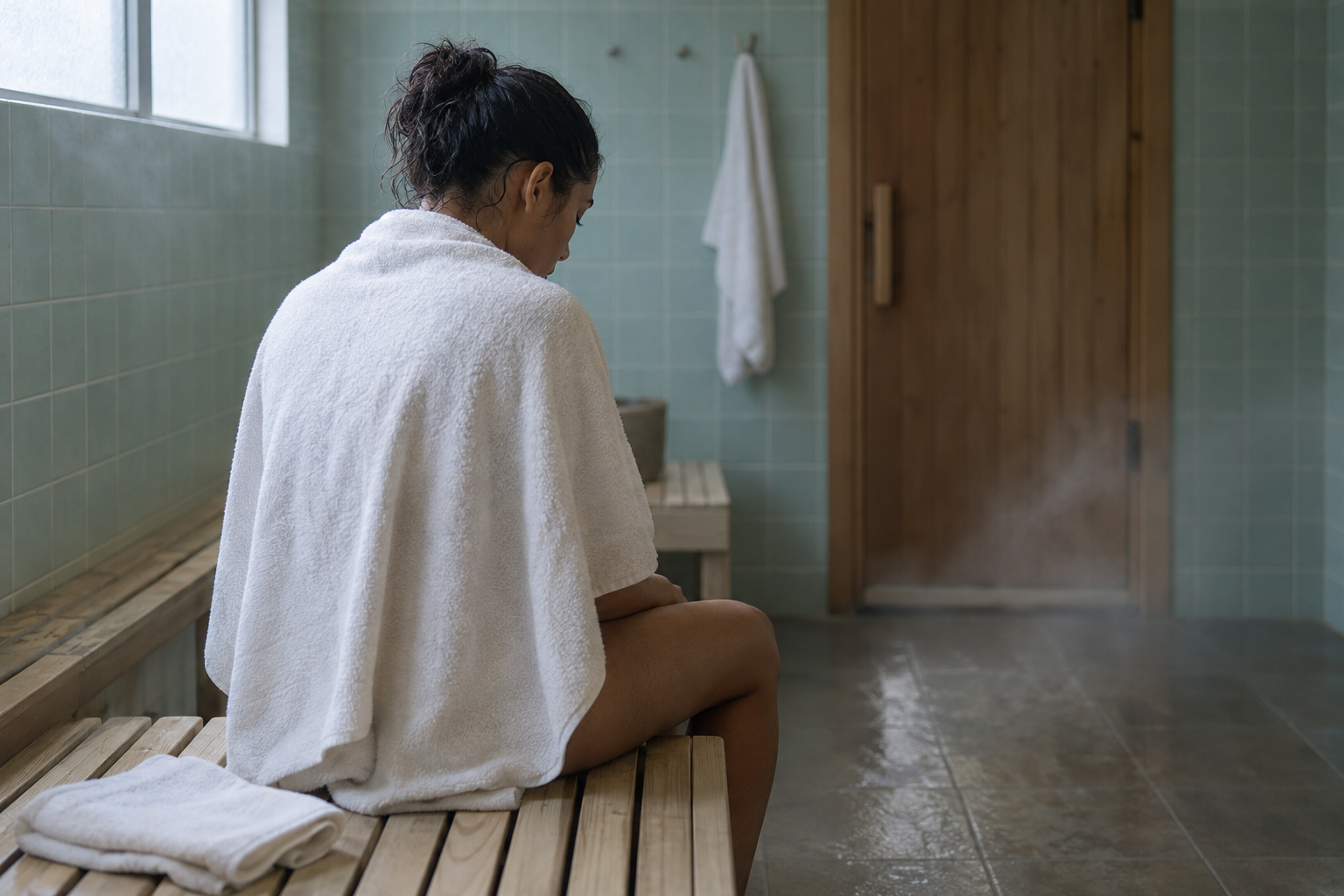
Sauna, steam room, hot tub, shower: four heats your rosacea reads differently.
A single 'avoid heat' rule hides which exposure actually flushes you. Dry heat, humid heat, immersion and cooldown speed each load skin differently, and you can log the difference.
The flush that shows up after the cold rinse
Fifteen minutes on the top bench of a dry sauna, and your face feels hot but holds. Then the cold shower, the towel, the walk back to the locker room. And somewhere between the bench and the mirror, the flush arrives: cheeks and nose lit up, a prickling warmth that wasn't there while you were sitting in the heat.
So which part flared you? The sauna, the cold water, the switch between them, or the hot shower you took afterward to warm back up?
Most rosacea advice can't answer that, because most rosacea advice says one thing about all of it. Avoid heat.
That rule points in the right direction and helps almost nobody in practice. A dry sauna, a steam room, a hot tub and a hot shower load your skin in different ways, and there's no reason to assume a face that flares in one will flare the same way in another. The only way to find out is to log them as separate exposures.
The four-heats problem
We call it the four-heats problem. Recreational heat gets treated as one trigger when it's at least four, separated by three variables.
Humidity. Dry air lets sweat evaporate and carry heat off your skin. Near-saturated air, like a steam room, shuts that cooling route down, so your skin keeps taking on heat it can't shed.
Medium. Water moves heat into the body far faster than air at the same temperature, which is why a hot tub that looks mild on a thermometer can warm you faster than a much hotter sauna. Immersion also heats your core, and your face sits in the vapor just above the waterline.
Cooldown. How you exit is its own exposure. A slow walk in room air, a lukewarm rinse and a cold plunge are three very different temperature swings.
Add duration and you have the full shape of a heat session. Change any one variable and you've run a different experiment.
Exposure
Medium
Humidity
What heats
Typical exit
Dry sauna
Hot air, 80 to 100°C
Low, 10 to 20%
Whole body, face in the hottest air
Room air, shower or plunge
Steam room
Hot air, cooler than a sauna
Near saturated
Whole body, face in vapor
Shower
Hot tub
Water, capped at 40°C (104°F)
Vapor above the waterline
Core immersed, face just above
Climbing out into air
Hot shower
Water spray
High in an enclosed stall
Face directly, if you turn into the spray
Towel off, room air
Hot yoga
Heated air plus exertion
Varies by studio
Whole body, while working
Room air, often a shower
Sauna temperature and humidity from Laukkanen et al., Mayo Clinic Proceedings 2018. Hot tub limit from the U.S. Consumer Product Safety Commission. Other cells are qualitative.
Why 'avoid heat' fails people with rosacea
Blanket avoidance fails in two predictable ways. Some people take it literally and quit every warm thing, including the ones their skin tolerates. Others try a sauna once, flare, can't tell why, and decide the advice was overcautious. Neither group learns anything.
The rule also ignores the exit. A flare that starts after the cold rinse gets filed under "sauna" by default, and the cooldown never gets tested on its own.
And it assumes you'll see the flare. The 2017 ROSCO panel (Tan et al., British Journal of Dermatology) moved rosacea diagnosis to phenotypes, meaning the individual features a person actually shows, and listed burning, stinging and swelling alongside visible redness. On deeper skin tones (Fitzpatrick IV to VI, the darker end of the standard six-type scale), flushing can be hard to read in a mirror or a photo. The warmth and sting you feel may be your most reliable signal.
That's also why we're wary of anything that grades redness from a face photo. Adamson & Smith (JAMA Dermatology, 2018) warned that dermatology algorithms trained mostly on lighter skin would underperform on darker skin, and Daneshjou et al. (Science Advances, 2022) measured that drop on a diverse clinical image set.
What the evidence says about heat and rosacea
The best-known patient-reported data comes from the National Rosacea Society's trigger survey of 1,066 people with rosacea The National Rosacea Society trigger survey dates to 2002 and covered 1,066 patients; the repo's research dossier ranks sun exposure first, then emotional stress, hot weather and wind as the most commonly reported aggravators. The request doesn't say which four percentages to check, so I can't confirm a match. The dossier's percentages for these four triggers are in the cited file, and a separate 2010 NRS survey covered alcohol only.. Hot weather, heavy exercise, hot baths and humidity all ranked among the most commonly reported triggers. Hot baths are the closest item on that list to a hot tub or a long hot shower. Humidity is what defines a steam room.
On mechanism, the evidence points at heat itself. Wilkin (Journal of Investigative Dermatology, 1981) showed that hot coffee triggered flushing in people with rosacea while the same coffee served cold didn't, which pinned the effect on temperature, since the caffeine was the same in both cups. Later, Sulk et al. (Journal of Investigative Dermatology, 2012) found that heat-sensitive TRPV ion channels, receptors that register heat and can help widen blood vessels, are expressed differently in rosacea skin. Whole-body heat plausibly loads that same system harder than a mug does.
The evidence gets thin fast after that. So the four-heats model is a structured hypothesis built from physiology and survey data, and your log is how you test it on one face.
75%
reported hot weather as a triggerNRS trigger survey, n=1,066
56%
reported heavy exerciseNRS trigger survey, n=1,066
51%
reported hot bathsNRS trigger survey, n=1,066
44%
reported humidityNRS trigger survey, n=1,066
Where the evidence stops
We haven't found a controlled rosacea study that compares sauna, steam room, hot tub and shower head to head, and none that tests cold plunges or contrast therapy in people with rosacea. Any rosacea-specific sauna protocol you see is extrapolation.
How to log a heat session so it tells you something
A good heat log looks boring. One session, one change.
Say you use the gym sauna twice a week. For two weeks, keep everything fixed except the cooldown: some sessions end with a slow walk in room air, others with the cold shower. Then hold the cooldown steady and change the time you spend inside. If the flush only shows up on cold-shower days, and it starts after you exit, the sauna probably isn't your main problem. If it climbs with minutes on the bench no matter how you exit, you've found a duration threshold.
The same structure works for a hot tub (vary soak length, keep the exit the same) and for showers (vary temperature, and whether the spray hits your face). Hot yoga is the hard case. It stacks heat, humidity and exertion, three triggers from the NRS list in one room, so a flare there can't tell you which one did it. Compare it against a regular-temperature class of similar effort.
Field
What to record
Why it matters
Exposure
Sauna, steam room, hot tub, shower or hot yoga
Keeps the four heats separate
Duration
Minutes inside or in the water
Lets a threshold show up
Cooldown
Room air, lukewarm rinse, cold shower or plunge
Tests the exit as its own variable
Time-to-flush
When redness or burning starts, counted from exit
Separates heat flares from cooldown flares
Features
Flushing, burning, stinging, swelling, eye irritation, each rated on its own
Catches sensory flares on every skin tone
Photo
Same spot, same light, before and at a fixed interval after
Gives your dermatologist something to see
The six-field heat session log. Change one field per session where you can.
What changes when heat has a shape
If heat has a shape, the question shifts. "Can I use a sauna with rosacea" becomes "which version, for how long, and how do I get out."
That's a far better conversation to have with a dermatologist. A record showing that steam sessions flare you within minutes of leaving, while dry sauna with a slow cooldown mostly doesn't, gives them something specific to work with.
It also protects what you'd rather keep. Giving up every form of heat on a hunch is a real loss if only one form is the problem. Your log might confirm you should skip all of it. That's a fine answer too, as long as it's based on your own record.
What a log can't do is replace medical advice. Changes to your heat habits are experiments to bring to your dermatologist, and they're no substitute for treatment.
A rule you can't test is a rule you'll eventually ignore.
Where Skinframe fits
Skinframe is built around the 2017 phenotype model, so it logs visible and sensory features one at a time, such as flushing, burning and stinging, instead of rolling them into a single severity score. For heat that matters. A sauna session that leaves your cheeks quiet but your skin burning is a different result from one that does the reverse, and a composite number blurs the two together.
You log the exposure, take a photo with the same setup each time, and rate what you feel as well as what you see. That's how the sensory side of a flare gets recorded on every skin tone. We don't grade your face with an algorithm, for the reasons Adamson & Smith and Daneshjou laid out.
On evidence: no published trial has tested a tracking app in rosacea. Evidence in adjacent dermatology conditions (atopic dermatitis, psoriasis) shows patient-reported tracking improves visit outcomes, and Skinframe applies the same approach to rosacea.
If your eyes feel gritty, burning or swollen after steam or a soak, log it and mention it specifically. Ocular rosacea, the form that affects the eyes, is easy to miss. If heat ever leaves you dizzy or faint, get out and cool down, because that's a heat-safety issue before it's a skin one. And talk to your dermatologist about whatever your log shows.
What we're tracking next
Two gaps we'd like to see filled. Infrared saunas heat the body at lower air temperatures than a traditional sauna, and we haven't found a study of them in rosacea. Contrast therapy and cold plunges keep spreading through gyms and spas with no rosacea data at all. When a study on either lands, we'll update this piece.
Log your next sauna, soak or shower as its own exposure. Start your heat log on Skinframe.
Skinframe logs each rosacea feature on its own, visible and sensory, so a sauna, a steam room and a cold rinse stop blurring into one vague 'heat' entry. It's built on the 2017 phenotype model and doesn't grade your face with an algorithm. Every feature is open during a 14-day trial. After that it's Lifetime $29.99 (recommended) or $4.99/mo with one-tap cancel, no rate hikes, and the same features on either plan.