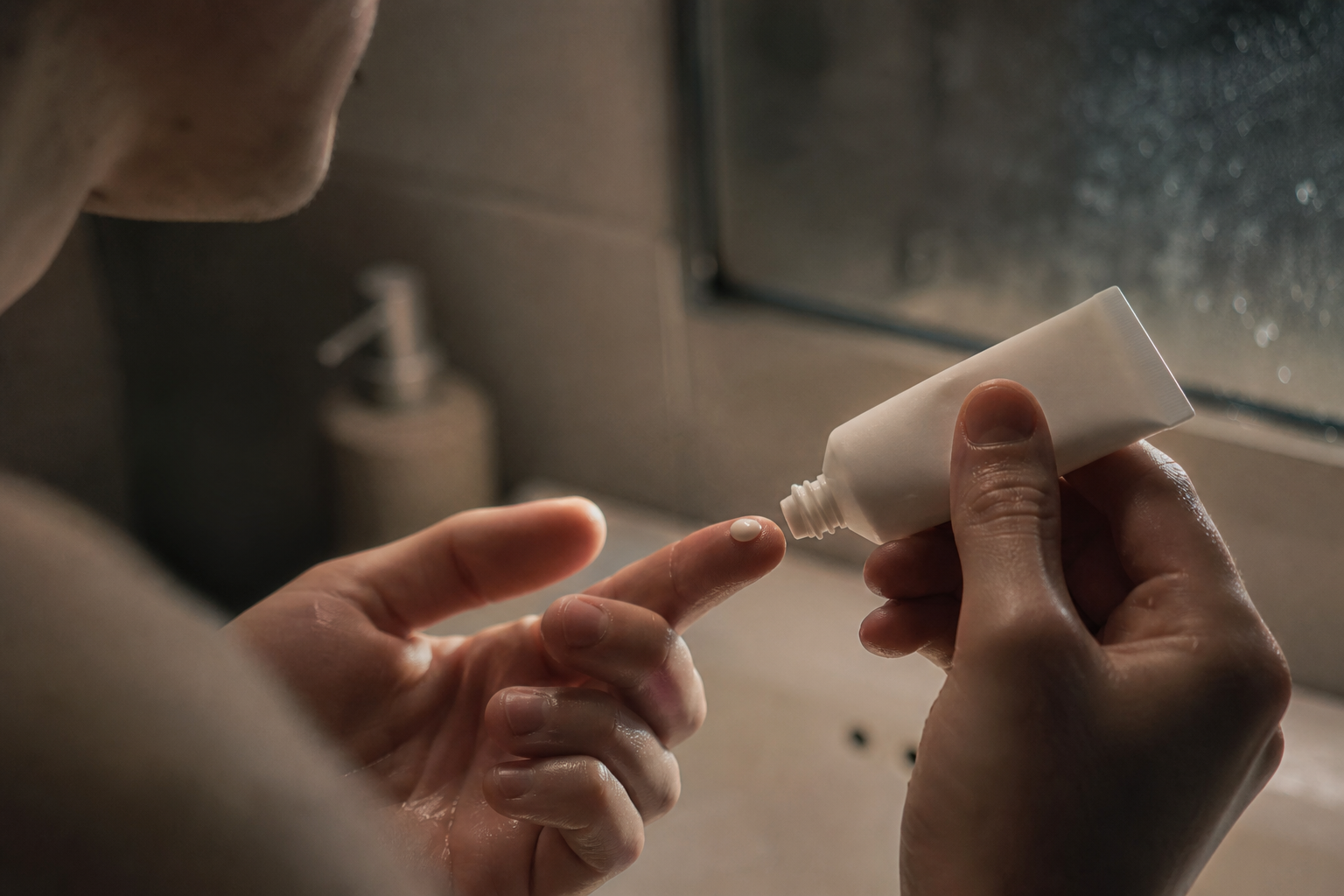
Rosacea skin rarely fails retinol itself: it fails the dose, frequency, and vehicle.
Blanket avoidance is triage, not a protocol. The barrier literature supports a titration you can actually measure, and a log that tells irritation apart from a flare.
Ten minutes, then washed off
Monday night: a pea-sized amount of adapalene goes on dry skin, over a thin layer of plain moisturizer, sits for ten minutes, then gets rinsed off. Thursday, the same, at fifteen minutes. The Monday after that, twenty. Week four it stays on overnight, still sandwiched between two layers of moisturizer. Week six, three nights a week with the top buffer layer dropped.
That's a protocol. It has a starting dose, a step size, a stop rule, and a single variable you can change when your skin complains. Most people with rosacea who go looking for whether they can use a retinoid never see anything shaped like it. They get one word back: don't. Then they're left to work out alone whether the stinging on night three means stop forever, or means the step was too big.
The exposure budget
Four knobs set how hard a topical retinoid hits a compromised barrier: which form of the molecule it is, what concentration it sits at, how long it stays in contact with skin, and how often you repeat it. Call the product of those four the exposure budget.
Rosacea skin runs a smaller budget than average skin. That's a barrier problem, and it's measurable. A smaller budget is still a budget.
Blanket avoidance sets the number to zero and stops thinking. The buffering approach, what dermatologists usually describe as the sandwich method, spends the budget on purpose: moisturizer first, retinoid on top, moisturizer again, short contact at the start, frequency raised only after a quiet week. Same molecule either way. What changes is how much active drug reaches living skin per night, and how much recovery time sits between exposures. Skin responds to that, and you can steer it.
Why "just avoid it" became the default answer
The avoidance advice didn't come from nowhere. In the National Rosacea Society's patient trigger surveys, skin-care products sit alongside sun, heat, and alcohol among commonly reported flare triggers, which makes "stop putting actives on your face" a defensible opening move for a clinician with fifteen minutes and a patient in visible distress. According to the National Rosacea Society's 2002 Rosacea Triggers Survey of 1,066 rosacea patients, sun exposure was the top-reported trigger at 81%, followed by emotional stress (79%) and hot weather (75%); skin-care products tied with indoor heat at 41% (11th/12th of 20 ranked triggers).
The trouble is triage hardening into the whole answer. Plenty of people with rosacea have a second reason to want a retinoid on the same face: photodamage, texture, acne that coexists with the rosacea, or a prescription written for a different indication entirely. For them, "avoid" ends the conversation without supplying a next step.
And the search results mirror the clinic. People type a yes-or-no question, the top answers say no, and almost none of them describe the titration that would let the answer be a qualified yes.
81%
reported sun exposure as a flare triggerNational Rosacea Society patient trigger survey
41%
reported certain skin-care products as a flare triggerNational Rosacea Society patient trigger survey
What the barrier literature actually supports
Three findings carry the argument. First, rosacea-affected skin shows measurable barrier impairment, with elevated transepidermal water loss reported against controls. Dirschka et al. (Br J Dermatol 2004) found significantly increased TEWL at lateral chin, perinasal cheek, and nose in rosacea patients ([source](https://onlinelibrary.wiley.com/doi/abs/10.1111/j.1365-2133.2004.05985.x)) A leakier stratum corneum means more of what you apply gets through, and gets through faster.
Second, retinoid irritation tracks with concentration and with vehicle rather than behaving as an on-off property of the molecule. The entire formulation history points at it: microsphere-delivery tretinoin gels exist specifically to release drug more gradually and reduce irritation, and adapalene was designed as a receptor-selective synthetic retinoid with a gentler irritation profile than tretinoin.
Third, irritation from a new retinoid is front-loaded. It's heaviest in the early weeks and eases as skin adjusts, which is the whole reason a slow ramp works at all. Retinization typically clears up and prevents acne within six to eight weeks of starting retinoid use ([source](https://www.self.com/story/retinization-period))
Put together, those three give you a ladder rather than a gate.
Form
US availability
Conversion steps to active retinoic acid
Retinyl palmitate (ester)
Over the counter
3
Retinol
Over the counter
2
Retinaldehyde
Over the counter
1
Adapalene 0.1%
Over the counter since the FDA's 2016 switch
0, binds retinoic acid receptors directly
Tretinoin
Prescription
0, is retinoic acid
Tazarotene
Prescription
1, hydrolysed to tazarotenic acid
More conversion steps generally means less active drug reaching receptors per unit applied, which is why a cautious titration usually starts near the top of this list. Availability reflects the US market.
Running the titration, one variable at a time
Here's what a real eight-week ramp looks like. Weeks one and two: two nights a week, short contact only, ten to fifteen minutes, buffered on both sides, rinsed off. Weeks three and four: same two nights, contact time up to twenty or thirty minutes. Weeks five and six: leave it on overnight, still sandwiched, still twice a week. Weeks seven and eight: third night added, only if the previous two weeks were quiet.
One change per step. That's the rule that makes the whole thing readable later. If you raise contact time and frequency in the same week and your cheeks flare, you've learned nothing about which one did it.
A quiet week means no new persistent redness at 48 hours, no burning that outlasts the rinse, no papules appearing where there weren't any. A loud week means you drop back one step and hold, not that you quit. The ladder goes both directions.
A retinoid is not a rosacea treatment
Nothing here is a treatment recommendation. Retinoids are prescribed for other things on rosacea-affected skin, and rosacea itself has its own topical and oral options that a dermatologist decides on. If you have eye symptoms, active pustules, or a flare that isn't settling, that's a clinic conversation, not a titration problem. Ask your dermatologist before night one.
The attribution problem
Six weeks in, your face is red on a Tuesday morning. Was that the retinoid step you took on Sunday, the wine on Saturday, the first cold snap of the season, or the flare that was coming anyway?
This is where most retinoid attempts die, and it isn't a willpower failure. Retinoid irritation and a rosacea flare can look similar enough in the mirror that telling them apart takes pattern, not appearance: what preceded it, how long it lasted, whether it repeats at the same step. Dose-linked irritation tends to follow applications and settle when you skip one. A trigger-driven flare follows the trigger.
The catch is that the pattern only exists in the aggregate, across weeks, and human recall is terrible at exactly this. Asked in week six what week two felt like, most of us reconstruct rather than remember. That reconstruction is what people then report to their dermatologist, and it's what the decision to abandon the retinoid gets made on.
What a titration log has to capture
Structure beats a notes app here, because the fields are known in advance. Each night: form and concentration, contact time, whether both buffer layers went on, and what else touched your face. Each morning after: burning, stinging, tightness, and dryness rated separately from visible redness, plus a photo under the same light in the same spot.
Separating those matters more than it sounds. On Fitzpatrick IV to VI skin, erythema is far harder to see, and image-based dermatology tools have documented performance gaps on darker skin, described by Adamson & Smith in JAMA Dermatology 2018 and measured again by Daneshjou and colleagues in 2022. That's one reason we don't ship a skin-scanning feature in Skinframe, and it's why the sensory phenotype, the burning and stinging you feel rather than what a camera sees, is recorded as its own set of fields. Composite severity scores collapse all of this into one number and destroy the signal you spent eight weeks generating.
Bring the log to your dermatologist. Let them read the pattern.
Set your log fields up before night one, and let the next eight weeks answer the question instead of your memory. Skinframe is on iPhone: lifetime $29.99, or $4.99 a month with one-tap cancel and no rate hikes, after a 14-day trial with every feature unlocked.
Skinframe was built for exactly this shape of problem: a slow titration where the answer lives in eight weeks of small observations rather than in any single day. Per-feature severity instead of one composite score, photos captured under repeatable conditions, sensory symptoms logged separately from visible ones, everything stored on your device. We won't claim this changes treatment outcomes in rosacea, because no rosacea-specific trial has tested that. No rosacea-specific trial exists yet, but adjacent-condition evidence supports the idea: a meta-analysis of over 1,000 atopic dermatitis patients found mobile self-management tracking produced a clinically meaningful improvement in eczema severity and quality-of-life scores, and the broader dermatology literature frames patient-reported tracking as a 'vital sign' that helps patients communicate concerns more efficiently and improves the clinician-patient relationship during visits. What we will say is that a structured record beats a reconstruction, and your dermatologist can only work with what you can actually show them.