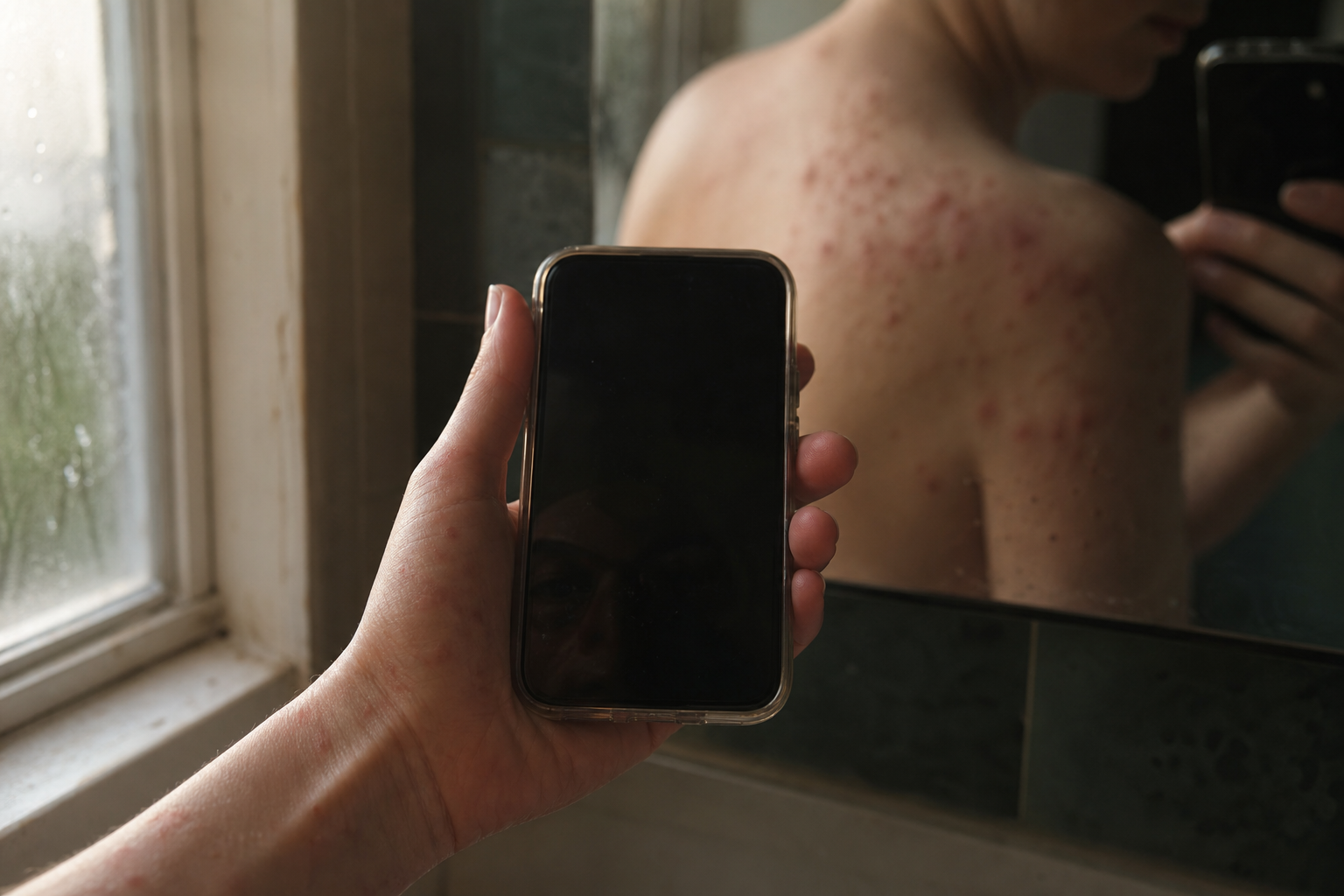
Your rosacea log is a prior-authorization document
Prior authorization for rosacea topicals gets denied on thin records. A timestamped photo and trigger log is the objective evidence payers actually ask for.
The pharmacy calls and asks what you can prove
The prescription is written. You leave the dermatology office with a plan for the papules and pustules that keep flaring across your cheeks. Two days later the pharmacy calls: the medication needs prior authorization, and the office wants to know what documentation you have. You think back to the visit. You said the flares had been bad. You mentioned they come and go. Then the question lands that nobody prepared you for. The reviewer wants a severity record, a frequency, objective evidence. What actually exists is a fifteen-minute appointment and your memory of it.
Your log is evidence, not a diary
Most people build a rosacea log for themselves. They track what they ate, what the weather did, whether the flush followed a glass of red wine. Useful work, and only half of what the log is. That same timestamped record is the exact material a payer's prior-authorization reviewer is trained to weigh: dated evidence of how severe the condition is and how often it flares. Prior authorization, or PA, is the insurer's gate before it will cover a drug. We treat the log as a PA-grade record from the first entry, because the day the request comes back is the day it is already too late to start building one.
Trigger-mapping is only half of what a log is for
Search results and app store listings frame rosacea logging one way: find your triggers. Cut the caffeine, watch the heat, notice the wine. That framing is real and it is incomplete. It stops at self-knowledge and never mentions the downstream stake, which is money. Topical rosacea drugs (ivermectin cream, azelaic acid, several branded formulations) are common prior-authorization targets. When the PA request comes back, self-knowledge is not what the reviewer scores. A structured, objective record is. The trigger map is for you. The severity record is for the people deciding whether your treatment gets paid for.
What a prior-authorization reviewer actually asks for
A prior-authorization submission is not a vibe check. Reviewers work from criteria, and the recurring ones are consistent across payers: how severe the condition is, how frequently it flares, how long each flare lasts, whether there is objective evidence rather than self-report, and what treatments have already been tried and failed (often called step therapy). Rosacea clinical guidance broadly recommends that patients document their patterns and triggers before starting treatment, both to inform the care plan and to build a record of disease behavior over time. That is the same record a PA reviewer asks to see. The table below maps each criterion against what a short visit can produce and what an accumulated log can.
What the PA reviewer asks for
A 15-minute visit produces
A timestamped log produces
Severity, scored per feature
A single-day clinician impression
Per-feature severity across many days
Flare frequency
A verbal estimate ('a few times a month')
Dated entries the reviewer can count
Flare duration
'They come and go'
Start-to-clear timestamps per episode
Objective evidence
Notes from one appointment
Timestamped photos of the actual flares
Treatment history
Recalled from memory
A logged record of what was tried and when
How five common prior-authorization criteria are served by a short visit versus an accumulated log.
A log strengthens a submission. It does not guarantee approval.
No documentation approach can promise an insurance outcome. Coverage decisions rest with the payer and the specific plan. What a structured record does is give your dermatology office concrete, dated evidence to submit and, if needed, to appeal with. Talk to your dermatologist about what your plan requires.
A verbal summary and a structured log read very differently
Picture the two submissions side by side. The first is a verbal summary transcribed into the note: patient reports facial redness and bumps, worse with heat, present for months. A reviewer reads it as one person's recollection on one day. The second is a structured log: fourteen dated flare entries over ninety days, each with a timestamped photo, a per-feature severity score, and the trigger conditions logged alongside. A reviewer reads the second as a pattern with dates attached. Same patient, same rosacea. One reads as a story. The other reads as a record.
The record is built during flares, not during the appointment
A rosacea flare can build and clear within hours, and its visual peak, the papules and the flush at its worst, is usually gone before the next day. Memory sands it down further. By the time a prescription is written and a PA request comes back, the strongest evidence would have needed to be captured weeks earlier, during flares nobody knew would matter later. Reconstructing severity after the fact is the weakest version of the record. The useful version is built in the moment, on the days it does not yet feel important.
The record a payer needs is built during flares, not during the appointment where you finally need it.
Why we built the record to live on your phone
We built Skinframe around one problem: documenting a flare in the seconds you actually have. A photo, a per-feature severity tap, the triggers of that day, all timestamped and kept on your device, because a health record you are assembling for an insurer should not be quietly harvested by the tool that holds it. We do not run a skin-analysis scan over your photos. The dermatology literature is clear on why that would be a hazard: deployed dermatology algorithms have underperformed on darker skin (Adamson & Smith 2018), and the datasets behind them have been documented as skewed toward lighter skin tones (Daneshjou 2022). Erythema is harder to auto-detect on Fitzpatrick IV to VI skin, so we keep the objective evidence as your own timestamped photographs for your dermatologist to read, rather than a model guessing at a severity score.
What this does and does not do
To be clear about the limits: a log does not appeal your denial for you, and it cannot promise a payer says yes. What it does is hand your dermatology office something concrete on the day the PA request lands, instead of a scramble to reconstruct months of flares from memory. Whether a specific drug is covered, and what your plan needs to see, is a conversation for your dermatologist and your insurer. Start the record before you need it, and bring it to that conversation.
Skinframe is coming to iPhone. Join the waitlist and start the record before your next flare, not after the pharmacy calls.
Skinframe keeps a timestamped, on-device photo and trigger record built to the same criteria a prior-authorization reviewer weighs: per-feature severity, dated frequency, flare duration, and treatment history. Not a diagnosis, not a promise of coverage. The evidence your dermatology office can actually submit.