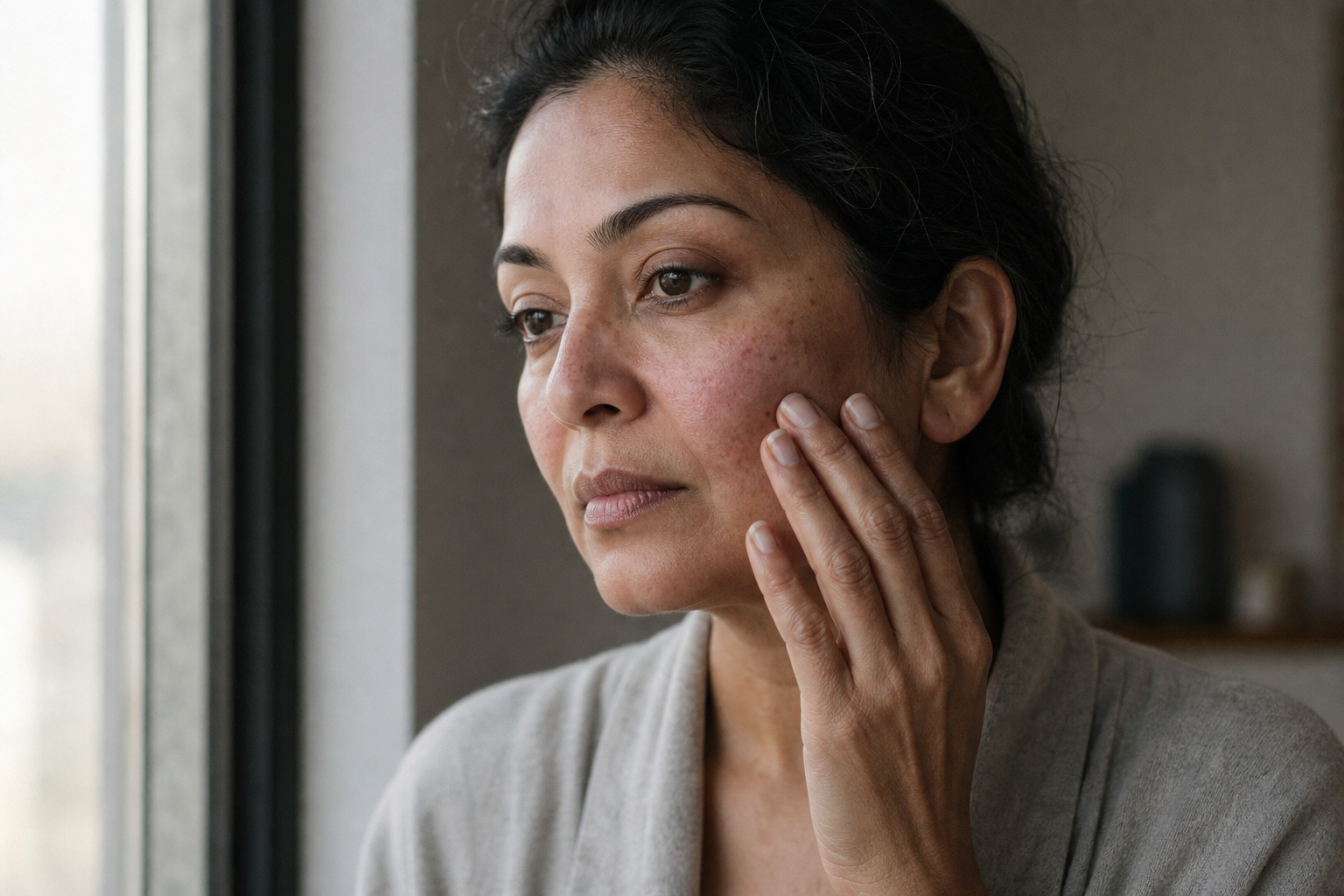
Document the flare before it clears: the 72-hour rosacea window
Rosacea is episodic, so the redness and bumps a dermatologist most needs to see usually fade before exam day. Here is the evidence packet to capture first.
What to bring, before it fades
Bring three things to a rosacea appointment: photos of the flare taken across different lighting, a short log of how long each flare lasts and how often they arrive, and enough dated trigger entries to show a pattern. Capture all of it while the flare is active. Rosacea is episodic, meaning the flushing and the papulopustular episodes (the visible bumps and pustules) usually clear within a day or two. By the time you reach the exam chair, the features your dermatologist most wanted to see are often gone, and you are left describing from memory what the doctor needed to look at.
Why your skin looks fine on exam day
This is a timing problem, not a diary problem. Transient flushing and papulopustular flares are dynamic: they rise, peak, and settle on their own schedule, while your appointment was booked weeks earlier and lands whenever there was an opening. Fixed centrofacial redness can linger, but the reactive features that carry the most diagnostic weight tend to be the first to vanish.
That matters more now than it used to. Since the 2017 update to the rosacea consensus (Gallo et al. 2018, JAAD), dermatologists diagnose and grade rosacea by observed phenotype, the actual features present on the skin, rather than by asking which subtype you fall into. Phenotype-based assessment needs something to observe. A flare that cleared three days ago gives it nothing.
What the exam needs vs. what patients usually bring
The American Academy of Dermatology and Mayo Clinic patient guidance both point patients toward tracking triggers and flare patterns before a visit. In practice, most people arrive with a verbal recollection and one recent selfie taken on a calm skin day. The gap between those two is the whole problem, and it is fixable with a little structure captured at the right moment.
What patients usually bring
What the exam actually needs
A description recalled from memory
Photos of the flare near its peak
One recent selfie on a calm day
The same area across warm indoor light and daylight
A vague sense of triggers
Dated entries linking flares to specific exposures
How the skin feels today
Frequency and duration tracked over weeks
Based on American Academy of Dermatology and Mayo Clinic patient guidance on documenting rosacea before a visit.
The 72-hour capture protocol
Start the moment a flare begins. Photograph the affected area more than once, and do it under both warm indoor light and natural daylight, because erythema reads differently depending on the source. What looks faint under a bathroom bulb can be obvious by a window, and a single lighting condition can quietly understate what is happening.
Keep the timestamp on every shot, then add two lines of context: what the skin was doing (burning, stinging, swelling) and what preceded it (a hot drink, sun, alcohol, heat, stress). Repeat across the flare so the duration is visible, not guessed. A handful of dated entries that cluster around the same exposures tells a clinician far more than one dramatic photo with no context.
On deeper skin tones, redness is not the whole signal
Facial erythema can be hard to see and hard to photograph on Fitzpatrick IV to VI skin. Deployed dermatology tools have documented worse performance across skin tone (Adamson & Smith 2018, JAMA Dermatology; Daneshjou 2022). So do not rely on the camera catching redness alone. Record warmth, swelling, and sensory symptoms (burning, stinging, dryness) as evidence in their own right.
Turning captures into a packet
The hard part is not deciding to document. It is having timestamps, lighting-varied photos, and trigger notes in one place when the appointment finally arrives, instead of scattered across a camera roll and a memory that has already blurred.
We built Skinframe around exactly what the 2017 consensus asks clinicians to observe: real features, captured when they appear. Each photo keeps its timestamp, carries a lighting tag, and sits alongside the duration and trigger log as a single packet you can hand across the desk. Everything stays on your iPhone, not on a server. Evidence in adjacent dermatology conditions such as atopic dermatitis and psoriasis shows that patient-reported tracking improves visit outcomes; Skinframe brings that same documentation habit to rosacea.
Bring what your skin looked like when it was reacting, not just how it looks the day you happen to be seen.
One thing worth flagging early
If your eyes are involved (grittiness, burning, dryness, or a foreign-body sensation), note it and raise it directly, because ocular symptoms are easy to overlook when the conversation is about the skin. The same goes for any flare that changes quickly or does not settle the way your usual episodes do. None of this is a diagnosis you can make from a photo. The packet exists to give the person who can make one something real to work from. Bring it, and talk to your dermatologist.
Set Skinframe up before your next flare. It timestamps every photo, tags the lighting, and keeps your duration and trigger log in one packet on your iPhone, ready to hand your dermatologist.
Skinframe was built around what the 2017 rosacea consensus asks clinicians to observe: real features, captured when they appear. Photos stay timestamped and on your device, never uploaded to a server. Evidence in adjacent dermatology conditions like atopic dermatitis and psoriasis shows patient-reported tracking improves visit outcomes, and Skinframe applies the same documentation approach to rosacea.