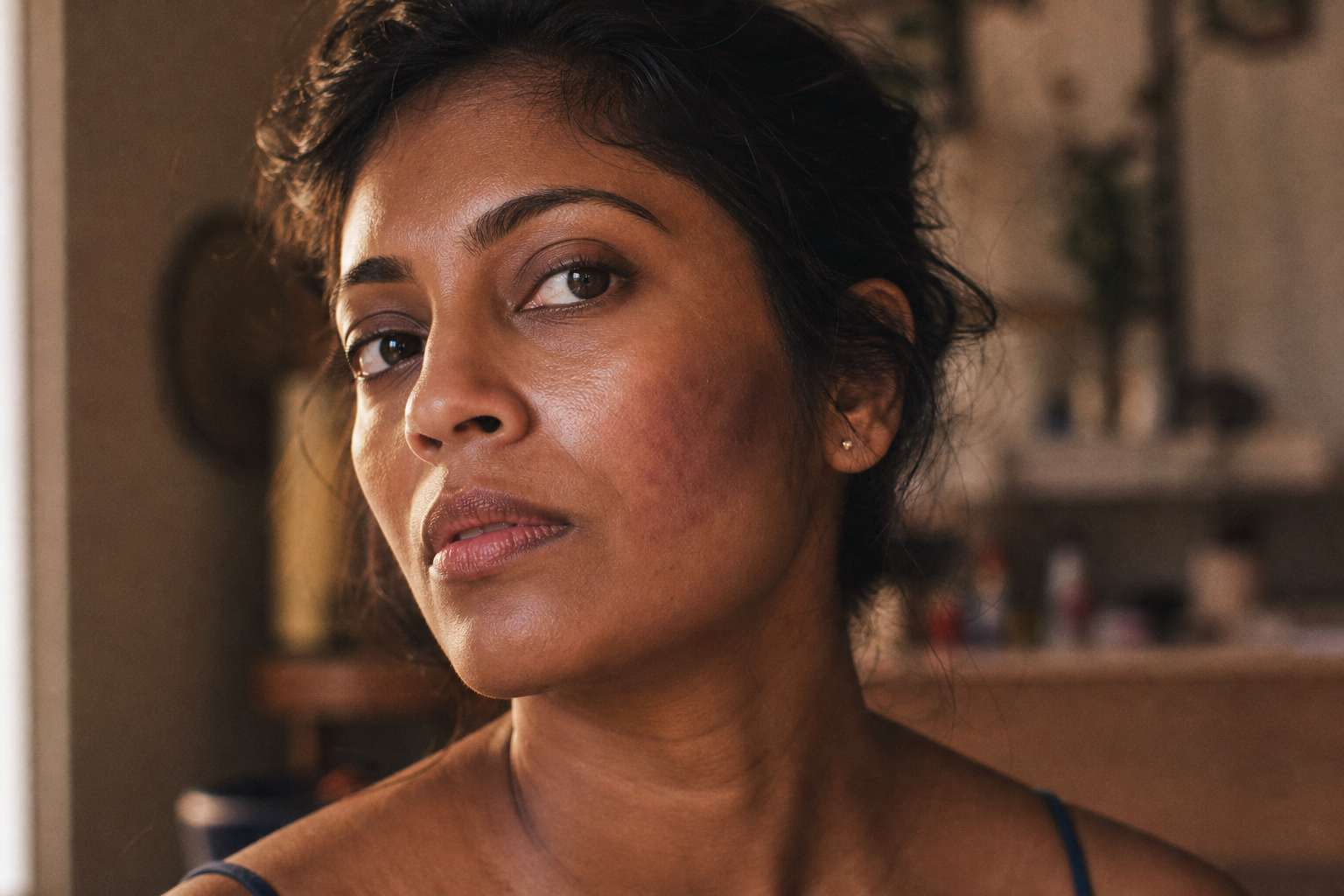
On darker skin, rosacea's flush isn't red, so the photo is the proof.
On deeper skin tones flushing reads dusky purple or brown, not red, and fades without a trace. That makes a timestamped photo log diagnostically load-bearing, not optional.
The flush that leaves nothing behind
The flush hit during a work call. Cheeks hot, that familiar prickle, and for twenty minutes the skin along the jaw went a deep dusky violet instead of the pink a textbook would draw. By the dermatology appointment three weeks later, there's nothing to point to. The skin looks even. The doctor asks what it looked like, and the honest answer is: bad, warm, sort of purple, last Tuesday, maybe. That sentence is the entire evidentiary record.
For a fair-skinned patient, a description like that is a backup. The clinician still has erythema, the persistent background redness, as a visual anchor to reason from. On brown and deep skin, that anchor often isn't there, and the flush that would have carried the diagnosis has already vanished into skin that reads as calm.
Load-bearing evidence, not a nice-to-have
Here's the shape of it. On darker skin, a photo log isn't a convenience that helps you remember your triggers. It's the piece of evidence the diagnosis rests on, because the flush itself doesn't survive to the appointment and, on deeper skin tones, often doesn't announce itself as red even while it's happening.
Call it load-bearing evidence. For fair skin, remove the photo and a clinician still has visible erythema and telangiectasia (the small dilated vessels) to examine in the room. For deeper skin, remove the photo and what's left is the patient's memory of a color and a bad afternoon. The log carries weight that, for lighter skin, other cues carry instead. That's a difference in kind, not a difference in how organized you are.
Why 'just keep a diary' misses the point
The standard advice, from clinics and skincare forums alike, is to keep a trigger diary. Jot down what you ate, the weather, the wine, how the skin felt. Useful advice. But it treats the written note as the artifact and the photo as optional garnish.
That ordering is backwards for skin of color. A written note reconstructs your theory of what happened. A photo reconstructs what actually happened, at a time you can prove. When the visible sign is a dusky, transient dyschromia (a change in color) rather than a stable redness, the theory and the fact drift apart fast, and the clinician has no way to close the gap from your description alone.
What the literature actually says about presentation on deeper skin
This isn't a hunch. Maliyar et al. 2022 documented that rosacea on skin of color frequently presents without the classic erythema, showing instead as dusky brown or violaceous discoloration that is far harder to read against a deeper baseline. The National Rosacea Society's March 2023 guidance on skin of color makes the downstream point explicit: because the standard visual signs are unreliable on darker skin, clinicians must lean on patient-reported history rather than examination cues alone.
Read those two together and the problem is concrete. 'Rely on patient history' is not a soft suggestion to chat more. It's a working constraint: the history is the data. And an active People-Also-Ask query, 'Can darker skin tones have rosacea?', tells you how upstream the confusion still runs. Yes, they can, and the search itself is evidence of how often the red-face mental model erases the question.
What the clinician works from
Fair skin (Fitzpatrick I-III)
Deeper skin (Fitzpatrick IV-VI)
Flush color during an episode
Pink to bright red erythema
Dusky brown or violaceous, often not read as red
Trace left after the episode
Persistent background redness, visible vessels
Frequently no lasting visible mark
Primary in-room diagnostic cue
Direct examination of visible signs
Patient-reported history (NRS March 2023)
What closes the evidence gap
Exam plus history
A timestamped photo captured during the flush
Presentation differences per Maliyar et al. 2022; the reliance-on-history constraint per NRS March 2023 guidance on skin of color.
'A bad day last Tuesday' versus a file with a timestamp
Walk it through. You tell the dermatologist you had a bad flare last Tuesday. From that, they can extract almost nothing usable: not the true color, not the distribution across the face, not whether it was one episode or three, not what preceded it by how long. Memory compresses a flush into a mood.
Now replace the sentence with a file. An image captured Tuesday at 2:14pm, dusky violet across both cheeks and the chin, sitting next to a note that says hot shower plus half a glass of red wine forty minutes earlier. Do that across six weeks and the clinician gets what history alone can't give: real frequency, real distribution, real color at the moment it mattered, and a rough map of what precedes an episode. The timestamp is doing quiet, essential work. Without an accurate capture time, a photo is just a picture; with it, the photo is testimony.
Memory compresses a flush into a mood. A timestamped image keeps the color, the spread, and the hour it happened.
The gap this closes: misattribution to hyperpigmentation
The stakes aren't abstract. When a flush on deeper skin does leave a faint mark, that residual color is easy to file under post-inflammatory hyperpigmentation, the darkening that follows almost any skin irritation, and to treat as a pigment problem rather than a vascular flushing pattern. The rosacea underneath goes unnamed, and the tracking that would have surfaced the trigger pattern never starts.
A log built from timestamped images during flares changes the input the clinician reasons from. It documents the episode as an episode, in sequence, with timing, before it fades or gets reinterpreted. That's the specific misattribution a photo record is positioned to prevent, and it's why the method matters more here than almost anywhere else in dermatology tracking.
Where the record breaks down
On deeper skin, a faded flush can be misread as post-inflammatory hyperpigmentation rather than rosacea flushing. A timestamped image captured *during* the episode is what keeps the two from being confused after the fact.
Building for the skin the exam room can't see
We built Skinframe around this constraint rather than around it. The capture flow preserves accurate timestamps, because on deeper skin the time a photo was taken is part of the evidence, not metadata. Everything stays on your device, which matters when the record is a running visual log of your face. And we branch the phenotype prompts by skin tone, asking about the sensory phenotype (the burning, stinging, and heat you feel) rather than only the color you see, because for many darker-skinned patients the sensation is the more reliable signal.
We deliberately don't ship a skin-scanning classifier that judges your photos. Adamson & Smith 2018 and Daneshjou 2022 both documented that automated dermatology tools underperform on darker skin, and building the exact tool that fails the users this article is about would be indefensible. The photos are yours to bring to a clinician who reads them, not ours to grade. Rosacea is a diagnosis a dermatologist makes, so if any of this sounds like your skin, the log is what you bring to that conversation. Talk to your dermatologist.
What we're watching next
Two things sit on our radar. First, cross-polarized smartphone photography, which suppresses surface glare and can make vascular flushing more legible on any skin tone; if a validated capture method reaches consumer phones, it changes what a home photo log can prove. Second, the next consensus updates from the ROSCO panel and the NRS, whose skin-of-color guidance is still young. When the reference standards move, the tracking method should move with them.
Skinframe is coming to iPhone: a private, timestamped photo log built for skin the exam room can't always see. Join the waitlist and be first in when it ships.
This piece runs on named primary sources, Maliyar et al. 2022 on presentation differences and the NRS March 2023 skin-of-color guidance, not on vibes. It's written for readers who fact-check by reflex and have been told to document before treatment starts.