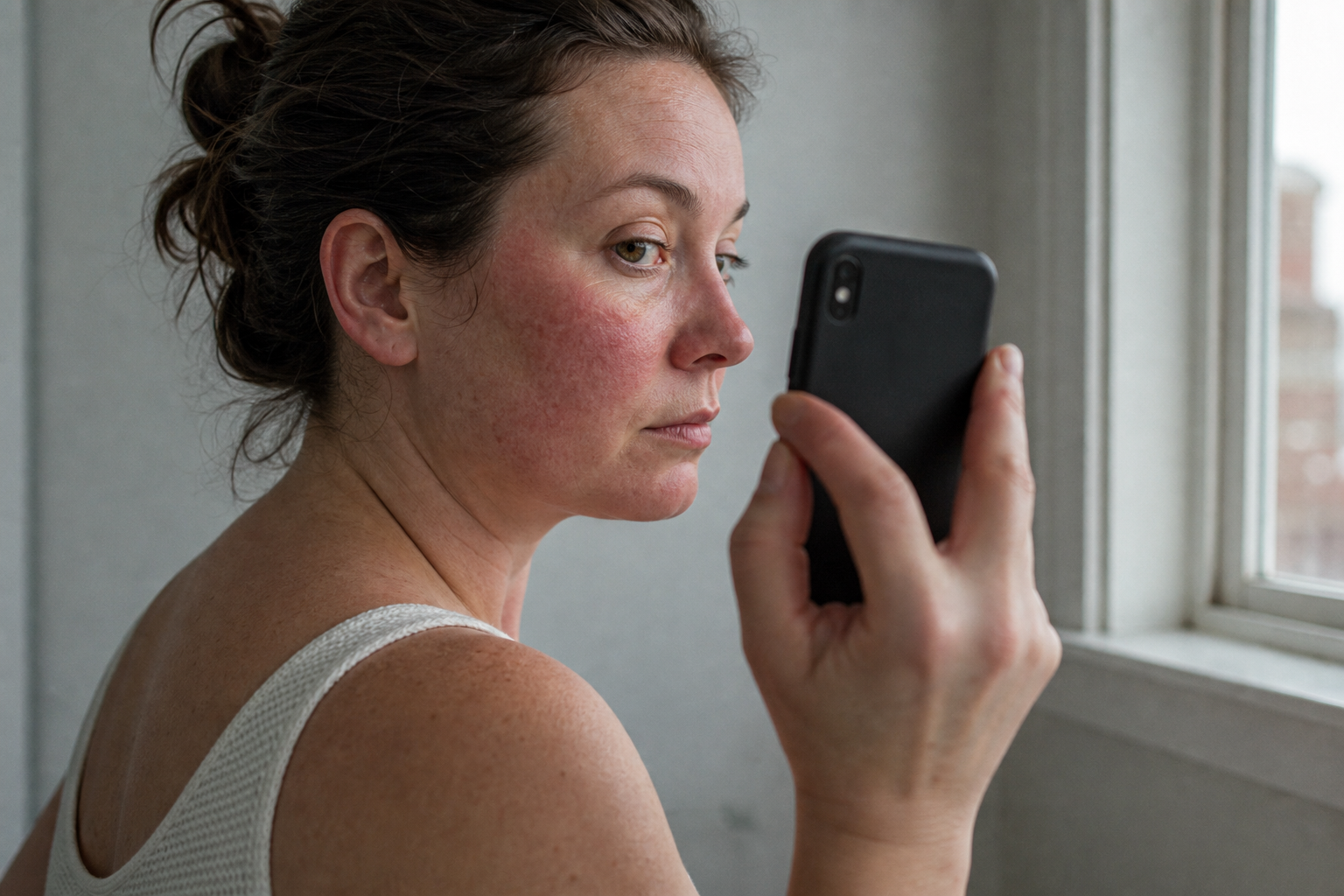
Your rosacea photo shows the skin, not the pattern your dermatologist actually treats.
A timestamped photo captures severity at one moment. The questions that drive rosacea treatment, triggers, frequency, progression, live in the context around it.
The photo nobody can read
A dermatologist opens the photo a patient uploaded the night before the appointment. Flushed cheeks, a scatter of papules near the nose, a few visible vessels tracking across the skin. It's a good photo: sharp, well lit, in focus. And it answers almost none of the questions that will decide what she prescribes.
Is this a flare or a baseline? Was the skin like this yesterday, or is this the worst it's looked in a month? Did something set it off, or is it just Tuesday? The photo can't say. It's a single frame from a film nobody recorded, and the appointment clock is already running.
The context gap
A timestamped photo does one thing well and one thing badly. It documents phenotype and severity at a single moment: what the skin looks like, how inflamed it is, which features are present. That's real clinical information. But the questions that actually drive rosacea treatment aren't about one moment. They're about pattern. What triggers a flare, how often flares happen, whether the phenotype is progressing. None of those live inside a single image. They live in the space around it, the context, and that context is almost never attached to the photo by the time it reaches a dermatologist. We call the missing piece the context gap, and it's the whole reason a clear photo can still be diagnostically thin.
"Just take photos" is half of the advice
The standard guidance a patient hears is take pictures of your skin. It's good advice as far as it goes, and it stops halfway. It treats the photo as the deliverable, as if a folder of images were the record. A folder of images is a pile of evidence with no case file. Twenty photos of a red face, undated in the mind of the person who took them, don't tell a dermatologist whether the redness clusters after red wine, after heat, after a specific moisturizer, or after nothing the patient can name. The photo is the exhibit. The context is the testimony. Advice that produces exhibits and no testimony leaves the clinician doing archaeology in a window measured in minutes.
A folder of images is a pile of evidence with no case file.
What dermatologists actually read from a photo
Rosacea diagnosis moved to a phenotype model in the 2017 update The ROSCO panel published 'Updating the diagnosis, classification and assessment of rosacea' in the British Journal of Dermatology, authored by J Tan et al., 2017. ([source](https://pubmed.ncbi.nlm.nih.gov/27718519/)), away from the older subtype buckets. Phenotype just means the specific features visible on the skin. A clinician reads a photo for those features: persistent central redness, papules and pustules, visible vessels, phymatous change (thickening of the skin), and any signs of ocular involvement, meaning the eye symptoms rosacea can produce. A photo can show most of that at a glance. What it can't show is frequency or trigger, and those are what separate one treatment path from another. Standard dermatology visit prep asks patients for exactly this: bring a symptom record, note what preceded flares, list products and medications. The record is the point. The photo is one line in it.
Skin tone changes what a photo shows
Rosacea's redness is harder to read from a photo on Fitzpatrick IV to VI skin, where erythema can register as dusky or warm rather than pink. Sensory phenotype, the burning, stinging, and dryness a patient *feels*, carries more of the signal there. It's also why we don't lean on image-only skin analysis: Adamson & Smith 2018 and Daneshjou 2022 both documented that automated dermatology tools fail measurably harder on darker skin. The darker the skin, the more the context and the felt symptoms matter, not less.
Fifteen minutes, one photo, and the questions it can't answer
Picture the appointment. The patient sits down, the dermatologist pulls up the photo, and the interview starts because the photo alone can't carry it. When did this start? What makes it worse? What have you tried? The patient reaches back through memory, which is where trigger data goes to die. Most people can't reconstruct last month's hot showers, glasses of wine, or the new SPF they switched to, not on the spot. So the visit runs on approximation. The clinician makes a reasonable call from a phenotype snapshot and a fuzzy history, books a follow-up, and the trigger question gets pushed to next time.
Now run the same appointment with each photo already carrying its context: the ambient temperature, what the patient ate and drank, the products applied that day, the stress and the sleep. The interview stops being reconstruction and becomes review.
Diagnostic question
Standalone photo
Photo plus context
Is this a flare or a baseline?
Can't tell from one frame
Comparable across dated entries
What triggered it?
No signal
Diet, heat, product, stress logged that day
How often do flares happen?
Unknown
Frequency visible across the log
Is the phenotype progressing?
Needs a prior to compare against
A dated timeline to read
What a rosacea photo answers, with and without its surrounding context.
Context is the variable that makes a photo diagnostic
If the pattern holds, the photo was never the bottleneck. Cameras are everywhere and they're good. The bottleneck is that the photo arrives naked, stripped of the metadata that would let a clinician read pattern instead of guessing at it. Change that one thing and the whole encounter shifts. The dermatologist spends the fifteen minutes deciding instead of interviewing. The patient stops being an unreliable narrator of their own month. Trigger identification, the question generic advice keeps deferring, becomes answerable, because the data got captured when it was still fresh and not reconstructed under pressure at a desk.
Logging the context at the moment you log the skin
This is the workflow problem we built Skinframe around. A photo taken in the app carries its context by design: the timestamp, and the surrounding variables a dermatologist would otherwise have to pull out by interview. Temperature, what you ate and drank, products applied, how the day felt. It all attaches to the frame instead of evaporating into memory. The photos stay on your device, because skin data is sensitive and we treat it that way. What you bring to the appointment isn't a folder of red faces. It's a record a clinician can actually read: dated, contextualized, and comparable over time. We don't tell you what your skin is doing. We make it legible enough that the person qualified to tell you can.
What we're watching
The open question is how far structured photo-plus-context logging moves the actual clinical encounter, not just the patient's confidence walking in. The adjacent evidence is encouraging: in conditions like atopic dermatitis and psoriasis, patient-reported tracking has been associated with better visit outcomes A 2024 systematic review and meta-analysis of 1,038 atopic dermatitis patients found that mobile self-management with patient-reported outcome tracking produced a clinically meaningful mean improvement of −1.57 on the POEM scale, with DLQI improving alongside, evidence that structured self-tracking improves patient outcomes in inflammatory skin conditions adjacent to rosacea.. No rosacea-specific trial has tested it directly yet. We'd like to see one, and we'll say so plainly until it exists: this is an approach with evidence next door, applied to a condition that hasn't been studied head-on. And whatever your log shows, the diagnosis and the plan belong to your dermatologist, not to a folder on your phone.
See how Skinframe logs your skin and its context in a single shot.
Skinframe attaches the context a dermatologist would otherwise reconstruct by interview to every photo you take, and keeps it on your device. It's built by a small team that reads the literature, for people who've been told to document before treatment starts. It doesn't diagnose anything. It makes your record legible enough that your dermatologist can.