The rosacea update stopped at the diagnosis, not the prescription.
Rosacea became overlapping phenotypes in 2017, but the treatment pipeline downstream still reasons in four subtypes, and concurrent activity slips through the log.
One label, half a prescription
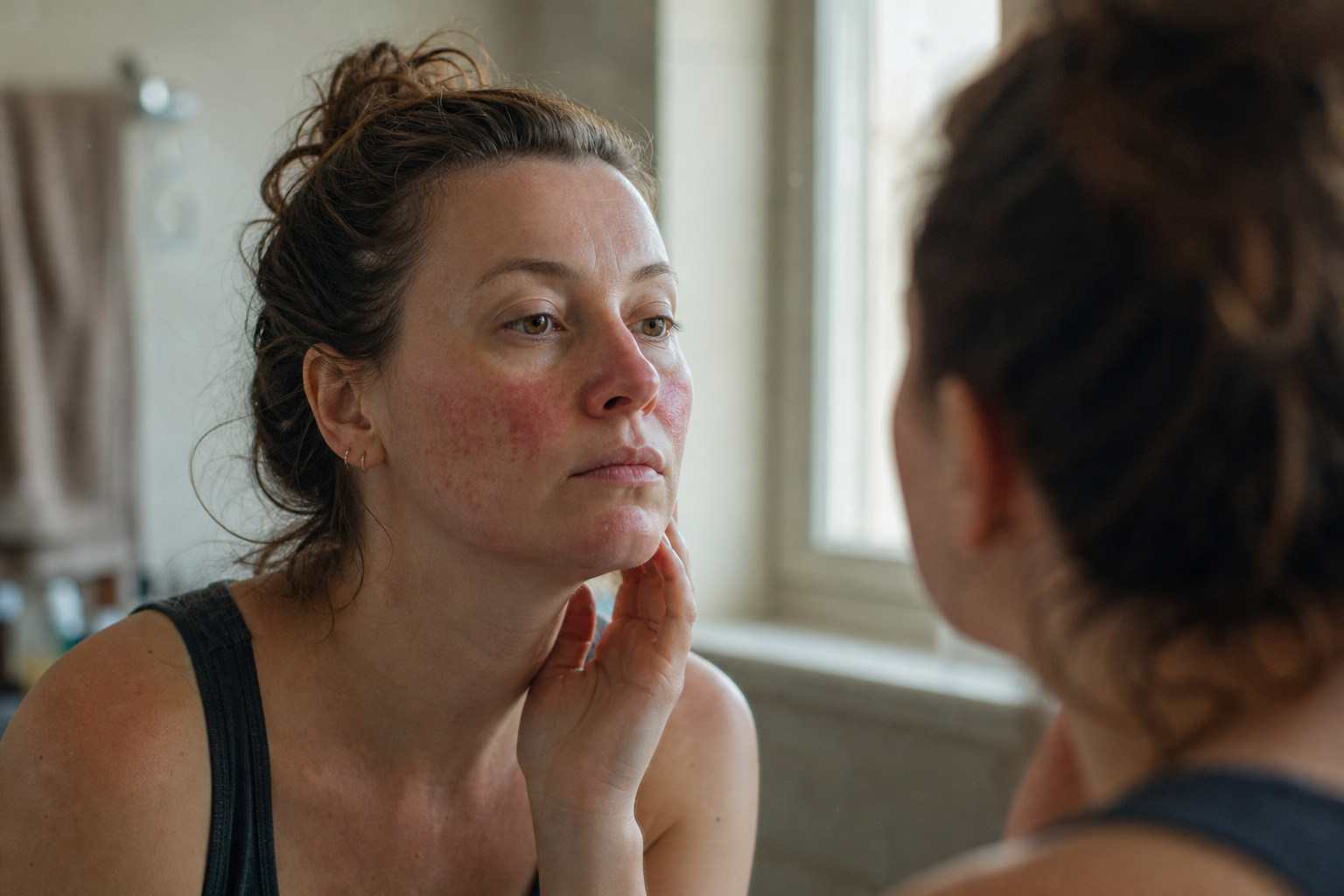
The chart said erythematotelangiectatic rosacea. Subtype one. She walked out with brimonidine for the flushing and nothing for the ring of papules along her jaw, because subtype one, on paper, doesn't come with an antimicrobial arm.
Six weeks later the redness had eased and the bumps hadn't moved. The follow-up note read "partial response." It wasn't a partial response. It was a full response to half a treatment, aimed at half of what was actually on her face.
The prescription lag
Rosacea stopped being a set of four boxes in 2017. The National Rosacea Society's update (Gallo et al. 2017) replaced the subtype system with a phenotype approach: you don't have a type, you have a set of features that can each be present, absent, or somewhere in between. A 2021 review (PMC8200341) carried that further, describing rosacea as overlapping phenotypes rather than discrete categories.
Here's what didn't move with it. The prescription logic sitting downstream of the label. A clinician still reasoning in subtypes reads "erythematotelangiectatic" and reaches for a vascular drug, and if papules are also present, they don't always get their own line, because the subtype label never asked about them. We call that the prescription lag: the diagnosis migrated to phenotypes, and the treatment reflex stayed in subtypes.
Why "what type do you have?" is the wrong question
Type your symptoms into a search bar and the result is still the four-types explainer: erythematotelangiectatic, papulopustular, phymatous, ocular. Pick one. It's tidy, and the original 2002 classification (Wilkin et al., National Rosacea Society) put those four in place for a good reason: it gave dermatology a shared vocabulary when there wasn't one.
But a single-type answer quietly encodes a single-treatment plan. If you're a "type one," the bumps you also get read as noise around your real diagnosis instead of a second phenotype with its own intervention. The four-box model under-prescribes, because concurrent activity has nowhere to live in the format. The mislabeling is the smaller problem.
Rosacea's features run in parallel, not in sequence
Phenotypes co-occur. A patient can carry persistent central erythema, active papulopustular features, and ocular irritation at the same time, and the 2017 and 2021 frameworks both treat that as ordinary rather than exceptional. Overlap across phenotypes is common enough that the frameworks were built to accommodate it, not flag it as unusual.
Each phenotype maps to a different intervention class, and the classes don't substitute for each other. A vascular drug does nothing for papules. An antimicrobial does nothing for background redness. When two phenotypes are active, the literature-consistent plan is two arms, which is what combination therapy means in practice.
Eye irritation, grittiness, lid margin involvement
Lid hygiene; ophthalmology referral
Phenotype-to-intervention mapping, per the 2017 NRS update (Gallo et al.) and ROSCO panel recommendations. The classes don't substitute for one another.
What concurrent activity looks like in a log
Walk it through. Someone flushes daily, carries a persistent pink band across both cheeks, and gets 6 to 8 papules a week that come and go on a slower clock than the flushing does. Under the old frame she's "erythematotelangiectatic with some breakouts." Under the phenotype frame she has two active streams running on two different timelines.
Now look at how she's documenting it. A narrative diary says "bad skin week." A single 1-to-10 severity slider says "7." Both collapse the two streams into one figure. Her dermatologist reads that number, watches the redness improve on the vascular drug, watches the composite score drop, and never sees that the papule stream sat flat the entire time. The data hid the second phenotype.
The fix is separating the streams, not scoring them together
If phenotypes are what get treated, then phenotypes are what a log has to keep apart. A single global score is the documentation version of the subtype label: it forces parallel activity into one number and discards exactly the signal that justifies a second prescription.
Separate the streams and the conversation changes. Erythema on its own line, papules on theirs, ocular symptoms on theirs, each with its own timeline and its own photo trail. The dermatologist can see the vascular arm working and the inflammatory arm untreated in the same view, and that side-by-side is the evidence a combination plan actually rests on.
The number that hides the second phenotype
A single global severity score, or a "bad skin week" diary entry, collapses concurrent phenotypes into one figure. If redness improves while papules hold steady, a composite score can drop while half your rosacea goes untreated. Track each feature on its own line.
Logging built around features, not a single number
This is the design decision behind Skinframe. We log rosacea per feature, not as one composite severity score, because a composite score is where concurrent phenotypes go to disappear. Redness, papules, flushing, and ocular symptoms each get their own track and their own photo evidence over time.
A prettier chart isn't the goal. When your treatment isn't working, the log can show whether it's failing outright or succeeding on one phenotype while a second one never got addressed. That's a distinction you can hand your dermatologist, and it's the one the subtype-era diary was structurally unable to make.
A composite severity score is where concurrent phenotypes go to disappear.
What we're watching
The open question is how far consumer content lags the consensus. The 2017 update is years old and the four-types explainer is still the default first result, which means many patients build their trigger and symptom logs on a model dermatology already retired. We're tracking whether the phenotype frame reaches people before their next appointment, because the record they bring is what their treatment plan gets built on.
If you're mapping redness and bumps that move on different clocks, that isn't one condition to score. It's two to document. Talk to your dermatologist about whether concurrent phenotypes are accounted for in your plan.
Log your rosacea as separate phenotype streams, not one score, and bring your dermatologist a record that shows what's actually active. That's what Skinframe is built for.
We built Skinframe around the phenotype model, not the retired subtype one. Rosacea's features run as separate streams, so we log them that way: redness, papules, flushing, and ocular symptoms each on their own track, with photo evidence over time and everything stored on-device. When two phenotypes are active at once, that structure is what lets your record show it, and it's the evidence a combination plan is built on.