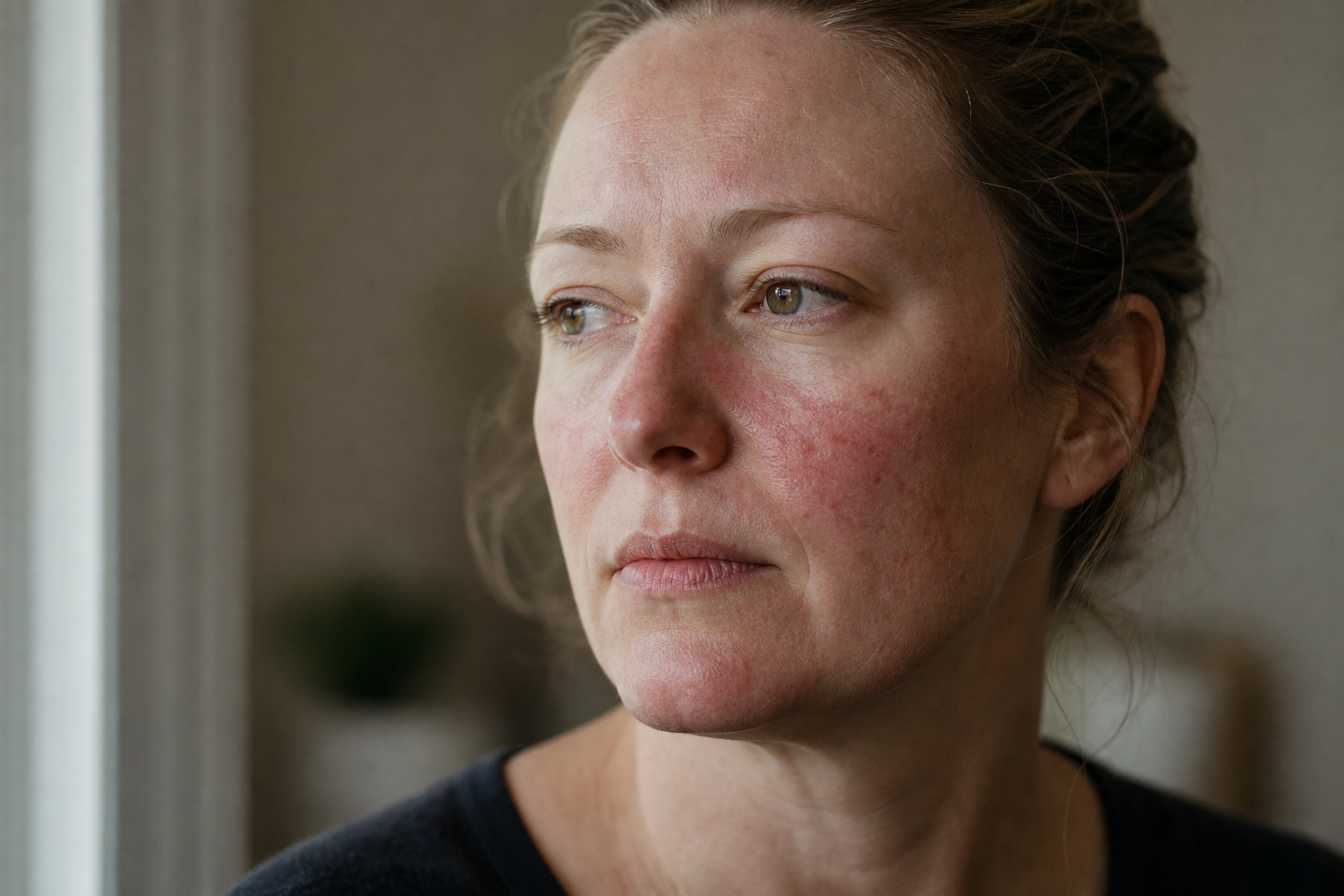
Your rosacea prescription should follow features, not type numbers
Dermatology stopped prescribing by subtype in 2017. Here's how feature-matched treatment works, and why a logged symptom set beats telling your derm 'I have type 2.'
One face, two problems, one prescription
A patient sits down with a scatter of small bumps along the nose and a flush across both cheeks that never fully settles. The dermatologist writes one prescription, a topical for the bumps, and books a follow-up. Six weeks later the bumps are calmer and the redness hasn't moved an inch.
Nothing went wrong with the medication. It did the job it was picked for. The gap opened earlier, at the moment two different problems on one face got filed under a single label, and the label only had room for one treatment line.
Feature-matched prescribing
Here's the shift that most rosacea advice still hasn't caught up to. Around 2017, dermatology stopped treating rosacea as a set of subtypes you get slotted into, and started treating it as a set of phenotypes, individual features that are present or absent on a given face. The National Rosacea Society's 2017 update (Gallo 2018) formalized the classification change, and van Zuuren 2021 carried it into treatment logic.
Call it feature-matched prescribing. You don't treat 'the type.' You treat each feature that's actually there. Persistent redness is one target. Papules are another. Visible vessels are a third. Each has its own first-line answer, and a face can carry several at once.
Why 'what type am I' is the wrong question at the prescription pad
The old model sorted rosacea into four boxes: erythematotelangiectatic (redness and vessels), papulopustular (bumps and pustules), phymatous (thickened skin), and ocular (eye involvement). It was a tidy way to talk about a messy condition, and it's still everywhere, which is why the question people type into search is 'what subtype do I have' and 'can type 1 turn into type 2.'
That second question is the tell. People ask it because their face doesn't obey the boxes. Redness and papules show up together constantly. Under the four-type frame, a clinician has to pick the box that fits best, and the box points at one treatment line. So the feature that didn't make the cut, usually the background redness, goes untreated. The label didn't just describe the rosacea. It quietly narrowed the prescription.
What the literature actually maps
The phenotype approach isn't a vibe, it's a lookup table. van Zuuren 2021 and the National Rosacea Society's 2019 treatment update (Thiboutot 2020) pair each feature with a first-line category, and they're specific about it. A face with papules and pustules points at a different shelf than a face with fixed redness, and both are different again from visible vessels.
Read the table as a menu, not a diagnosis. Every one of these is a starting point a dermatologist selects and adjusts, not something to self-prescribe.
Phenotype (the feature you see or feel)
First-line approach in the literature
Fixed centrofacial redness (persistent erythema)
Topical brimonidine or oxymetazoline for the redness; vascular laser or IPL for the background
Visible vessels (telangiectasia)
Vascular laser or intense pulsed light (IPL)
Papules and pustules (bumps)
Topical ivermectin, azelaic acid, or metronidazole; oral doxycycline for moderate-to-severe
Flushing (transient redness)
Trigger avoidance first; brimonidine can blunt episodes
Phymatous change (thickened skin)
Oral isotretinoin early; ablative laser or surgery once established
Ocular involvement (eye symptoms)
Lid hygiene and artificial tears; oral doxycycline; ophthalmology referral
Phenotype-to-first-line map, per van Zuuren 2021 and NRS 2019 treatment guidance (Thiboutot 2020). Starting points a clinician selects, not self-treatment instructions.
The pattern in practice
Back to the face from the opening: papules along the nose, plus a flush across both cheeks that stays. Two phenotypes, present at the same time.
Under feature-matched prescribing, that's two concurrent lines, not a choice between them. The papules get a topical like ivermectin or azelaic acid. The persistent redness gets its own answer, a topical alpha-agonist for the flush and, often, vascular laser or IPL for the background vessels feeding it. Treat only the bumps and you get exactly what happened: calmer bumps, unchanged red. The redness was never going to respond to a papule drug, because it was never the same problem.
The old type-number framing collapsed those two targets into one box and the prescription followed the box. The phenotype framing keeps them separate, which is the whole point.
Two features can mean two prescriptions
Co-present papules and persistent redness are two phenotypes, and the literature matches them to two different first-line approaches given together. A single prescription aimed at one feature can leave the other untouched even when the medication works perfectly.
What this changes for the visit you actually get
If the prescription follows features, then the most useful thing you can walk in with is a feature list. 'I have type 2' hands a dermatologist one word. A record that says papules three days last week, cheeks flushed and slow to settle after hot drinks, eyes gritty by evening hands them five prescribing-relevant features and a rough frequency for each. That's the difference between one line of treatment and a plan matched to what's actually on your face.
This matters more, not less, on deeper skin tones. Redness reads faintly against brown and Black skin, and rosacea in skin of color is under-represented in the imaging literature to begin with (Daneshjou 2022). When the visible feature is hard to see, the sensory phenotype carries the signal instead: burning, stinging, dry patches, the eye grittiness. Logging what you feel, not just what a camera catches, is often what makes a phenotype legible at all.
A record built around features, not a label
This is the gap we built Skinframe to close. It records each rosacea feature on its own line, papules, persistent redness, flushing episodes, eye symptoms, with dates and a photo when there's something to see, instead of asking you to pick a type. The output is the thing a phenotype-based prescription actually reads from: a per-feature history you can hand across the desk.
We're careful about what that does and doesn't mean. No rosacea-specific trial has shown that app tracking changes outcomes. What's documented, in adjacent conditions like atopic dermatitis and psoriasis, is that patient-reported tracking improves the clinical visit. We apply that same approach here, and we don't try to name your phenotype for you. That's your dermatologist's call, made from features you've documented rather than a box you guessed at.
'I have type 2' hands a dermatologist one word. A logged feature set hands them five, and a plan.
Skinframe is coming to iPhone. Join the waitlist and start your next visit with a feature list, not a single type number.
No published rosacea-specific trial has tested whether app-based tracking changes outcomes, and we won't claim one. What the literature does show, in adjacent dermatology conditions like atopic dermatitis and psoriasis, is that patient-reported symptom tracking improves the quality of the clinical visit. Skinframe applies that documented approach to rosacea: a per-feature record you bring to a dermatologist, so the prescription can follow what's actually on your face.