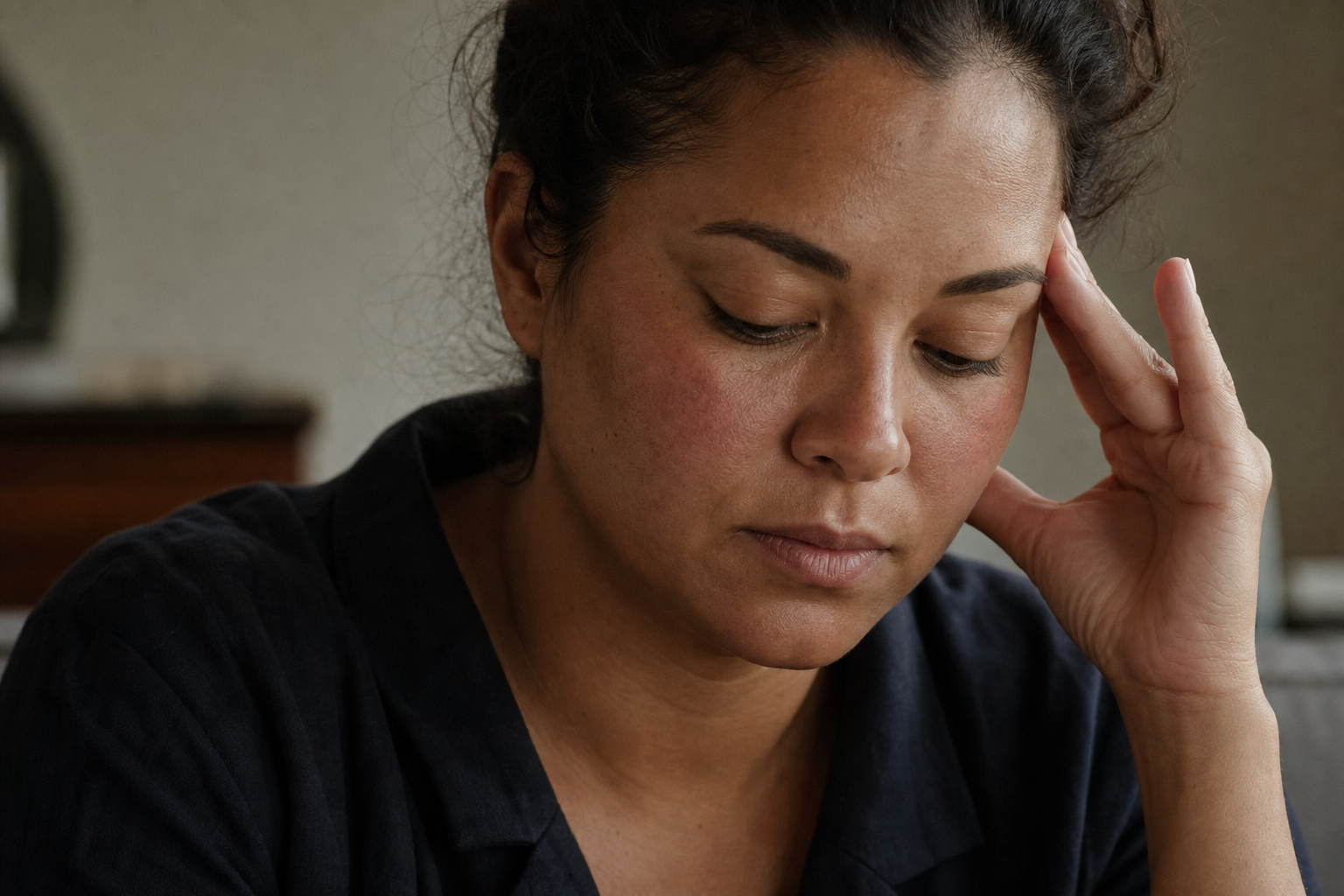
Two doctors, two charts, one patient: rosacea and migraine share a nerve signal.
Rosacea and migraine co-occur at elevated rates and share a nerve signal called CGRP. Two care teams, one patient, zero shared data. A combined log is the first document that shows it.
The patient who noticed her skin, not her head
A woman three months into a CGRP inhibitor for chronic migraine notices the flushing across her cheeks has changed, and the first place she takes that observation isn't her neurologist or her dermatologist. It's a search bar.
CGRP inhibitors, the migraine drug class that blocks a nerve-signaling molecule called calcitonin gene-related peptide, reached patients between 2018 and 2020. Large numbers of people now take them. Some notice their skin behaving differently and go looking for an explanation, and they find almost nothing written for them. The reason is quiet and structural: the two specialists who could connect flushing to headache have never read each other's notes on the same patient.
The two-chart problem
Rosacea and migraine co-occur more often than chance would predict, and they share more than a patient who happens to have both. They share a mechanism. Both involve neurogenic vasodilation, the process where nerves signal blood vessels to widen and flush, and CGRP is one of the messengers doing that signaling in each condition.
Call it the two-chart problem. Your skin lives in a dermatology chart. Your headaches live in a neurology chart. The overlap between them, the shared triggers and the shared timing, lives in neither, because no single document has ever held both. Each doctor treats a fragment. Nobody sees the pattern, because the pattern only exists when the two records sit side by side.
Two conditions, two care teams, zero shared data.
Why 'skin problem, headache problem' is the wrong split
The dominant framing sorts these into separate organ systems: one is a complexion issue, one is a brain issue, and they get referred down separate hallways. That split is clinically tidy and biologically wrong.
Both rosacea and migraine are neurovascular. In rosacea, sensory nerves in the skin release neuropeptides that drive the redness and the burning (Schwab 2011). In migraine, the same family of signaling molecules drives the vascular and pain response that decades of work by Goadsby and Edvinsson traced to CGRP. When a field splits one nerve-signaling story into two specialties, the patient standing on both sides of the wall is the one who loses the thread.
What the comorbidity research actually found
The strongest population evidence comes from a Danish national cohort. Egeberg 2017, published in the Journal of the American Academy of Dermatology, tracked rosacea patients against the general population and found migraine occurred at a meaningfully elevated rate, with the association strongest in women and in patients over 50. It's a correlation in a large registry, not a claim that one causes the other. But it's specific, it's named, and it points at a shared substrate rather than coincidence.
Line the two conditions up on that substrate and the overlap stops looking accidental:
What a shared log shows that two separate ones can't
Picture a month logged in one place. A hot yoga class on the 4th, followed by facial flushing that evening and a headache the next morning. Two glasses of red wine on the 12th, flushing within the hour, a migraine by midnight. A stressful week mid-month with both firing together. Logged separately, each doctor sees half: the dermatologist sees three flush days, the neurologist sees three headache days, and neither sees that the same triggers set off both, often inside the same 24 hours.
Logged together, the clustering is the finding. Heat, alcohol, and stress are documented rosacea triggers (National Rosacea Society trigger surveys) and documented migraine triggers, and when your own record shows them lighting up both systems on the same days, that's a pattern worth putting in front of both care teams.
One document, two care teams
If the thesis holds, the highest-value thing a patient with both conditions can produce isn't a better description for either doctor. It's one timeline both can read. A neurologist adjusting a migraine plan gains from seeing whether skin flares track the headaches. A dermatologist mapping triggers gains from knowing a headache pattern shares them. Neither insight requires a new drug or a new diagnosis. It requires the data to stop living in two buildings that never exchange files.
That's a documentation problem, not a medical mystery, and documentation problems are solvable by the person who owns the data: the patient.
Why we built the log to travel between doctors
We built Skinframe as that single timeline. It holds dated photos, flare notes, and trigger tags in one record, on your device, so the document you bring to a dermatology visit is the same one you can hand a neurologist. We track skin the way both fields actually document: what happened, when, and what preceded it, without guessing at causes the literature hasn't settled.
A shared log makes the overlap visible so the two people responsible for your care can finally see the same picture. Bring it to your dermatologist, bring it to your neurologist, and let them read the pattern you've been living. If you have rosacea and migraine, or noticed skin changes on a migraine medication, talk to your dermatologist before you draw any conclusion from what you see.
A log is not a treatment
Early reports describe skin changes in some people on CGRP inhibitors, but the evidence that these drugs affect rosacea is preliminary (A case report documented psoriasiform skin lesions associated with galcanezumab in a 65-year-old female with chronic migraine. ([source](https://www.researchgate.net/publication/394796901_Galcanezumab-induced_psoriasis-like_lesions_of_the_eyebrows_A_case_report_and_review_of_CGRP's_role_in_cutaneous_inflammation))). Nothing here says a migraine drug treats rosacea, or the reverse. Logging both conditions documents a pattern for your doctors to interpret. It does not diagnose, and it does not replace them.
Skinframe is coming to iPhone. Join the waitlist and we'll let you know when you can start one timeline your whole care team can read.
Skinframe is a rosacea tracker built by a small team that reads the dermatology literature before it writes a feature. Every clinical claim on this page cites a named source, the record stays on your device, and it's shaped to be the one document you can carry between a dermatologist and a neurologist.