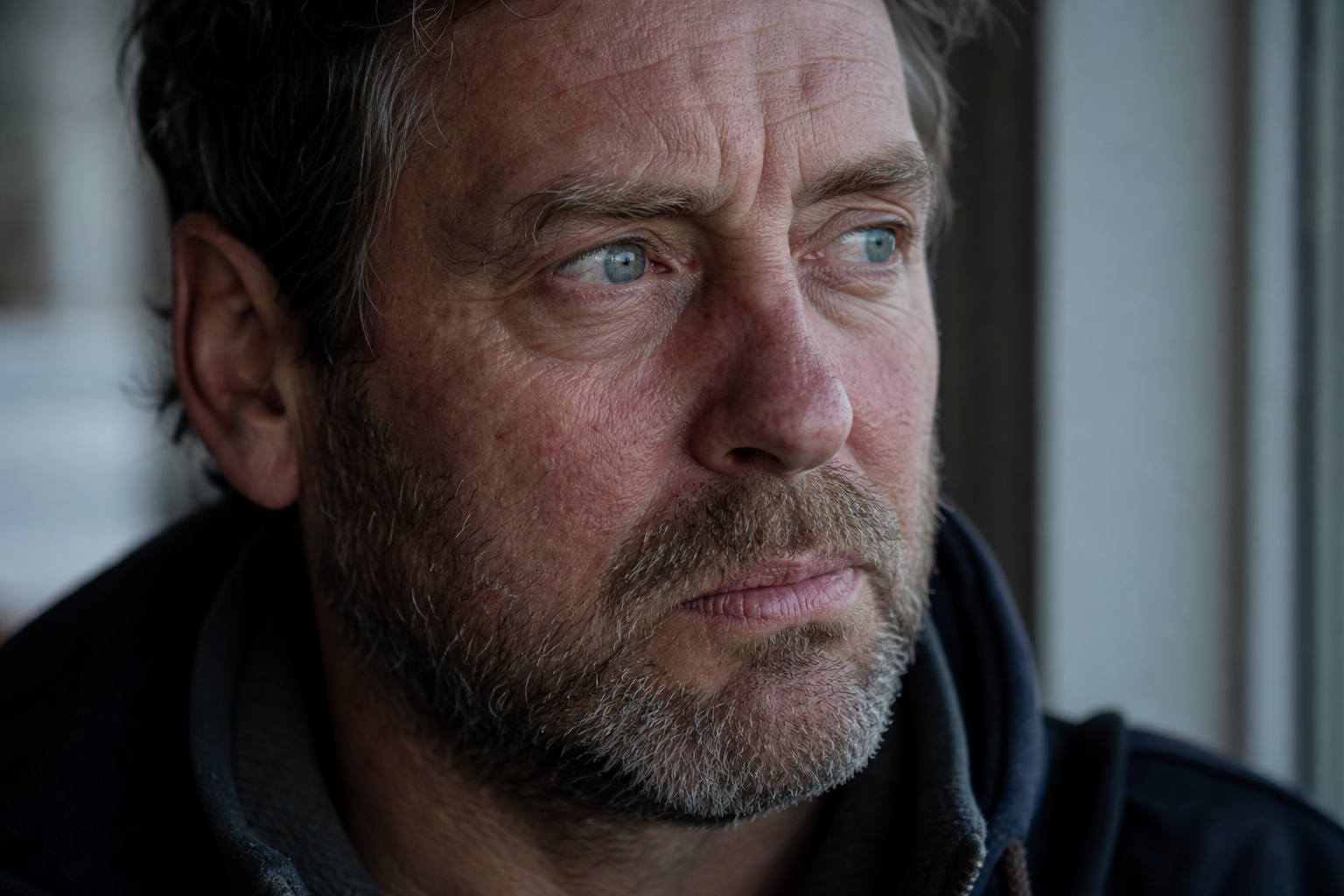
Rosacea's one irreversible outcome hits men, who get diagnosed years too late.
Rhinophyma, the nose-thickening rosacea outcome that needs surgery, is almost entirely a men's disease. So is the diagnosis delay that makes it worse.
The nose that finally sent him to a dermatologist
A man books his first dermatology appointment in his late fifties because the tip of his nose has thickened, the skin has gone bumpy and oil-slicked, and glasses no longer sit right. He describes it as something that crept up over a couple of years. The exam tells a longer story: the central redness across his cheeks and nose, the visible fine blood vessels, the history of flushing at every hot meal. The nose is the phymatous stage of a condition that was quietly present a decade before he sat down.
Rhinophyma is the plain word for that outcome: rosacea skin on the nose that has thickened and remodeled into a nodular, enlarged surface. It is the version of rosacea most people can picture without knowing its name. And it almost never happens to women.
The redness alibi
Here is the pattern we want to name, because naming it is half the point. Call it the redness alibi: a man with rosacea has a ready, socially acceptable explanation for his face that lets him avoid ever calling it a medical condition. Too much sun. Too many years outdoors. A few drinks. Just a ruddy complexion, always been that way. Each alibi is plausible enough to survive another year, and rosacea is a slow disease, so another year rarely forces the issue.
The alibi is not vanity or denial in the usual sense. It is a category error. The redness gets sorted into the lifestyle bin instead of the medical bin, and once it lands there, no appointment ever gets made.
Why 'a women's condition' is the expensive framing
Rosacea is coded, in culture and in a lot of clinical messaging, as something that happens to fair-skinned women. Marketing for redness products skews female. The stock imagery skews female. Even patient-facing explainers tend to open on a woman examining her cheeks in a mirror.
That framing does real damage on the male side of the ledger. A man who has absorbed the idea that rosacea is a woman's skin problem has one more reason to reject the label for what is on his own face. So he stays in the lifestyle bin longer, and he self-selects out of the exam room. The underdiagnosis here is not driven by a tool failing to see dark skin or a camera getting the color wrong. It is driven by attribution: the redness is seen clearly and filed under the wrong cause.
What the phymatous stage actually costs
Rosacea is now described by its phenotypes, the observable features, rather than the old numbered subtypes, following the 2017 update from the National Rosacea Society Expert Committee (Gallo et al., published in the Journal of the American Academy of Dermatology, 2018). Phymatous change, the thickening that produces rhinophyma, is one of those phenotypes. It sits at the far, established end of the disease.
Two facts about it drive this whole piece. First, rhinophyma is overwhelmingly male: the male-to-female skew is large enough that most clinical reviews describe it as occurring almost exclusively in men (The male-to-female ratio in rhinophyma ranges from 5:1 to 30:1, per a 2020 PMC review (Chauhan et al.). ([source](https://pmc.ncbi.nlm.nih.gov/articles/PMC7429105/))). Second, the flushing and papulopustular rosacea that precede it are typically diagnosed later in men than in women (Rosacea prevalence was significantly higher among women until age 49; among the elderly (50–59 and 60–70 years), this gap narrowed. ([source](https://onlinelibrary.wiley.com/doi/full/10.1111/ijd.15989))). Put those together and the shape is clear: the group most likely to reach the irreversible stage is the same group least likely to get seen early.
Phymatous change does not reverse on its own
Once the skin of the nose thickens into rhinophyma, topical and oral rosacea therapy can slow progression but cannot undo tissue that has already formed. Correction at that stage is procedural: ablative laser, dermabrasion, or surgical debulking. The window that matters is the years before it gets there.
The four things men call it instead
The alibi is not vague. It shows up as a small set of specific misattributions, and each one has a tell that separates lifestyle redness from rosacea. The point of laying them out is not to hand anyone a diagnosis. It is to show how easy the wrong call is to make, and how a longer view of the same face makes the right call obvious.
Rosacea's central-face pattern, its persistence between the supposed triggers, and the slow arrival of visible blood vessels (telangiectasia) and thickening are what the alibi has to keep explaining away. Over months, it stops being able to.
What men call it
The rosacea tell it misses
Drinker's nose, alcohol flush
The redness stays through sober weeks and centers on the cheeks and nose, not just after a drink
Windburn, sun-weathered skin
It doesn't fade indoors over winter, and the fine visible blood vessels stay put
Just my complexion, always been ruddy
The flushing episodes are getting longer and the skin is starting to feel thicker or bumpy
Razor burn, rough shaving skin
Stinging and burning happen on days without shaving, and papules and pustules keep returning to the same central zone
The four common lifestyle explanations men give for facial redness, and the feature each one has to ignore. Not a diagnostic tool; a prompt to get it looked at.
The nose that needs surgery in a man's sixties was treatable redness in his thirties.
What changes if the delay is the disease
If the mechanism is attribution rather than access, the intervention changes too. You do not fix an attribution error with a better camera or a smarter scan. You fix it by making the pattern visible over time, so the lifestyle story runs out of room.
That is the practical stakes of getting this right. Papulopustular and erythematotelangiectatic rosacea, the earlier phenotypes, respond to standard treatment. Phymatous rosacea, once it has remodeled the nose, is a procedure. The distance between those two outcomes is mostly time, and time is exactly what the alibi buys back. Earlier documentation does not treat rosacea, but it is what gets a man into the room while the redness is still the treatable kind.
A record instead of a story
This is where a timestamped photo log earns its place, and it is worth being precise about why. The thing keeping men out of the exam room is a narrative: this is just how I look, it's always been like this, it's the sun. A single glance in the mirror confirms whatever story you already hold, because today's face looks like yesterday's.
A private, dated series of photos does the opposite. It shows the March face next to the September face. It shows the flushing episode that lasted longer than the last one, the blood vessels that were not there a year ago, the first hint of thickening. It replaces the story with evidence a person can hand to a dermatologist. Skinframe is built to keep that record on the device, with no face scan and no diagnosis, because the job is not to tell a man what he has. The job is to make the change undeniable enough that he goes and asks.
What we're tracking next
The open question we are watching is whether the male search behavior matches the male clinical behavior. The queries men actually type ("why is my nose getting bigger," "red nose not from drinking," "bumpy skin on nose") tend to describe the late symptom, not the condition, which is consistent with a group that reaches for a cause before it reaches for a name. We will keep mapping those symptom-first queries against the phenotype language the literature uses.
If any of this is on your face, the next step is not an app. It is a dermatologist, who can tell rosacea apart from the conditions that mimic it and stage where you actually are. Bring more than a memory. Bring the pictures.
Skinframe is coming to iPhone. Join the waitlist and start keeping a dated record of your skin now, so the next time someone calls it a drinker's nose, you have the timeline instead of the story.
Skinframe is built by a small team that reads the dermatology literature, not a wellness brand. We do not run a face scan, we do not tell you what condition you have, and photos stay on your device. What we do is keep an honest, timestamped visual record of your skin so persistent redness has evidence a dermatologist can actually use.