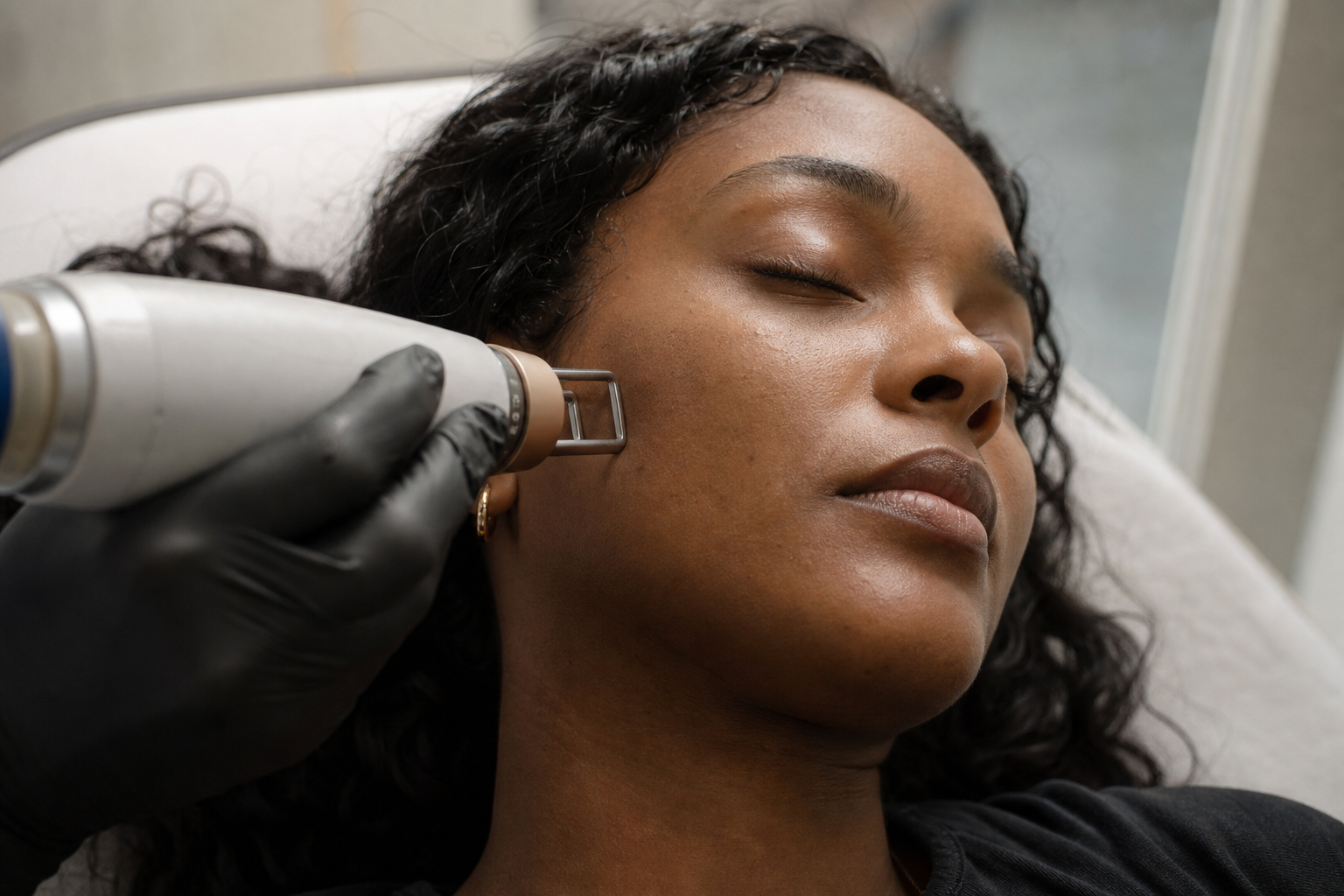
Rosacea laser treatment works differently depending on your skin tone.
IPL and PDL target hemoglobin, but melanin absorbs the same wavelengths. What that means for Fitzpatrick IV-VI patients before they consent to an in-office procedure.
The dermatologist's default first-line isn't always the right first-line
For patients with fair skin and persistent erythema, the conversation in a dermatology office often moves quickly: IPL (intense pulsed light) or PDL (pulsed dye laser), a few sessions, measurable clearance. The evidence supports that pathway. IPL and PDL work by targeting oxyhemoglobin in dilated blood vessels, collapsing them with selective photothermolysis. On Fitzpatrick I-III skin, where epidermal melanin is low, the laser energy hits its intended target with high specificity.
For patients with Fitzpatrick IV-VI skin, the physics change in a clinically important way. Melanin and hemoglobin absorb overlapping wavelengths. The same pulse that collapses a telangiectatic vessel also deposits energy in the surrounding melanin-rich epidermis. The result, when fluence isn't carefully adjusted downward or when the operator isn't experienced with darker skin, can be post-inflammatory hyperpigmentation (PIH), blistering, or frank burns. None of that is hypothetical. It's the predictable consequence of chromophore physics applied without Fitzpatrick stratification.
This doesn't mean IPL and PDL are categorically contraindicated for Fitzpatrick IV-VI patients. They aren't. It means the risk profile is genuinely different, the margin for operator error is narrower, and patients deserve to know that before they consent.
Why the standard rosacea laser protocol assumes skin you may not have
Rosacea clinical trials have historically enrolled predominantly fair-skinned patients. That's not a cynical observation, it reflects the epidemiological skew. Rosacea prevalence estimates lean heavily toward Northern European ancestry, which also concentrates recruitment in Fitzpatrick I-III cohorts. The consequence is that most published IPL and PDL efficacy data comes from populations where the melanin-hemoglobin competition problem is at its lowest.
When a dermatologist has treated 200 rosacea patients and 180 of them have Fitzpatrick I-III skin, their intuitions about fluence settings, cooling protocols, and expected side-effect profiles are calibrated to that cohort. That calibration isn't wrong, it's just incomplete when applied across the full Fitzpatrick range.
The 2022 work from Daneshjou et al. (published in Science Advances) documented that AI dermatology tools trained on fair-skin-skewed data performed significantly worse on darker skin tones, a direct consequence of the same training-data gap that shapes clinical intuitions. The pattern isn't unique to algorithms; it runs through the entire evidence base.
The dermatology literature on laser and light-based therapies in skin of color has made clear that while IPL can be used on Fitzpatrick IV-V skin with appropriate parameter adjustments, longer wavelengths and lower fluences are required, and the risk of dyspigmentation rises meaningfully without careful titration. That body of work is explicit that these are not minor parameter tweaks. They represent a different treatment protocol, not the same protocol applied more cautiously.
IPL on Fitzpatrick IV-VI: risk-stratified, not contraindicated
IPL and PDL are not categorically banned for darker skin tones. They require lower fluences, longer wavelengths, aggressive cooling, and an operator with documented experience on Fitzpatrick IV-VI skin. The clinical error is applying fair-skin fluence settings without adjustment, not the modality itself.
What the wavelength data actually shows
Selective photothermolysis, the principle underlying IPL and PDL, works when the target chromophore absorbs the laser wavelength more strongly than surrounding tissue. For vascular lesions, the target is oxyhemoglobin, with peak absorption around 418nm, 542nm, and 577nm. PDL typically operates at 585-595nm. IPL spans 500-1200nm (filtered to a narrower band per device). Both overlap meaningfully with melanin's absorption spectrum, which is broadband but strong in the 500-700nm range.
NdYAG lasers, operating at 1064nm, sit in a region where melanin absorption is substantially lower while still achieving vascular effect through deeper penetration. That's why a 2020 review in Lasers in Surgery and Medicine Nd:YAG laser proves effective for hemangioma and vascular malformation in darker skin patients, offering major advantages for such cases. ([source](https://pmc.ncbi.nlm.nih.gov/articles/PMC9270095/)) found NdYAG to be the modality of choice for vascular lesions on darker skin, with a more favorable dyspigmentation risk profile than IPL or PDL.
For rosacea specifically, the NdYAG evidence base is smaller than for IPL (again reflecting the enrollment skew), but the chromophore physics rationale is consistent: longer wavelength, lower melanin competition, wider margin for safe operation on higher Fitzpatrick types.
Topical-first protocols (azelaic acid 15% gel, brimonidine 0.33% gel, ivermectin 1% cream) carry no Fitzpatrick-stratified risk profile at all, because they don't interact with melanin. For patients with Fitzpatrick IV-VI skin who are weighing first-line in-office treatment, a topical-first trial isn't a compromise, in some contexts it's the better-evidenced starting point.
Modality
Wavelength
Melanin absorption risk
Rosacea evidence base
Fitzpatrick IV-VI safety
IPL
500-1200nm (filtered)
High (broadband overlap)
Strong (fair-skin cohorts)
Lower, fluence reduction required
PDL
585-595nm
High (peak melanin overlap)
Strong (fair-skin cohorts)
Lower, requires parameter adjustment
NdYAG 1064nm
1064nm
Low (minimal melanin absorption)
Smaller (growing)
Higher, modality of choice per review evidence
Azelaic acid / brimonidine / ivermectin (topical)
N/A
None
Strong across skin tones
Consistent, no Fitzpatrick stratification needed
Chromophore physics and Fitzpatrick safety profiles across rosacea treatment modalities. Evidence-base ratings reflect volume of published RCT data; NdYAG has strong theoretical and observational support but fewer large rosacea-specific RCTs than IPL/PDL. Melanin absorption coefficient decreases from 690 nm (228 cm⁻¹) to 1064 nm (55 cm⁻¹), reducing energy loss in skin. ([source](https://www.primescholars.com/articles/spectral-dependence-of-laser-light-on-light-tissue-interactions-and-its-influence-on-laser-therapy-an-experimental-study-95553.html))
What a Fitzpatrick IV-VI patient should ask before consenting
The problem isn't that darker-skinned rosacea patients can't be treated with laser. It's that the consent conversation often doesn't surface the modality-selection question explicitly. A dermatologist who defaults to IPL because it's the clinic's primary device, without discussing the NdYAG alternative or the fluence rationale, isn't being negligent in the categorical sense, but the patient is missing information that's directly relevant to their risk.
Three specific questions worth bringing to the appointment:
1. What modality are you recommending, and why for my skin tone? This surfaces whether the recommendation is Fitzpatrick-stratified. An answer that references your skin tone directly and explains the wavelength reasoning is a good sign. An answer that doesn't mention skin tone at all is a prompt to ask the follow-up.
2. What's your experience treating Fitzpatrick IV or V skin with this protocol? Volume matters. The margin for error on higher Fitzpatrick types is narrower, and an operator with a hundred procedures on darker skin has calibrated intuitions that a lower-volume operator hasn't developed yet.
3. Is NdYAG an option here, and would you recommend it over IPL for my skin? If the clinic doesn't have a NdYAG device, that's a relevant constraint, not a judgment on the dermatologist, but information that may be worth factoring into whether to seek a second consultation elsewhere.
For patients who aren't yet in the in-office treatment conversation, who are still in the documentation-and-pattern-mapping phase, this risk-stratification question is worth adding to the dermatologist visit prep. Knowing which modalities carry different risk profiles by skin tone is the kind of background that changes the quality of the consent conversation.
Where post-inflammatory hyperpigmentation fits in
PIH after a rosacea laser procedure on darker skin isn't a rare adverse event, it's the predictable outcome of undertreated melanin competition. When the epidermis is thermally injured (even subtly), melanocytes respond by producing more pigment. On Fitzpatrick I-II skin, that response is usually mild and transient. On Fitzpatrick V-VI skin, the same injury can produce persistent darkening that outlasts the original rosacea symptom in visual severity.
This creates a specific irony for patients with darker skin seeking rosacea treatment: the procedure intended to address a skin appearance concern can produce a different skin appearance concern that is, in some cases, harder to treat than the rosacea itself.
Topical retinoids, hydroquinone (where available), and azelaic acid are all used to address post-procedure PIH, but treatment duration is measured in months, not sessions. Preventing PIH through appropriate modality selection and fluence titration is substantially simpler than reversing it.
Adamson and Smith's 2018 paper in JAMA Dermatology on disparities in dermatologic care documented patterns of unequal access to specialized procedures for patients with skin of color. The PIH risk in laser treatment is one concrete clinical mechanism behind those disparate outcomes, it isn't purely systemic access; it's also physics, applied without stratification.
The treatment decision and the documentation that precedes it
Laser treatment decisions for rosacea rarely happen in a single appointment. A dermatologist who is stratifying carefully will want a clear picture of: how long symptoms have persisted, which phenotype features are driving the severity score (persistent erythema, telangiectasia, papulopustular activity), how the skin is currently responding to topical treatments, and, directly relevant here, what the skin's baseline pigmentation and PIH history looks like.
That's a documentation problem before it's a treatment problem. A patient who arrives with three months of systematic photo logs, triggered-event records, and a clear phenotype summary is giving their dermatologist the substrate to make a more specific recommendation. A patient who arrives with recall alone is giving them less.
The gap matters more for Fitzpatrick IV-VI patients because the cost of an undertailored laser protocol is higher. A few sessions of IPL at a fair-skin fluence on Fitzpatrick V skin, before anyone recognized the risk, is harder to reverse than it was to avoid.
We built Skinframe specifically around the documentation gap: systematic photo capture with clinical framing, phenotype tracking across time, trigger logging that builds a pattern over weeks rather than relying on appointment-day memory. The documentation angle isn't a workaround for in-office treatment, it's the input that makes in-office treatment safer and better targeted. Talk to your dermatologist before any laser procedure, and bring them something more than what you remember.
What we're watching next
Two developments worth following on the Fitzpatrick-stratified rosacea treatment front:
First, the NdYAG evidence base for rosacea specifically is growing. Most current literature on NdYAG in skin of color focuses on vascular lesions broadly, port-wine stains, hemangiomas, rather than rosacea-specific erythema. As rosacea research catches up with its own Fitzpatrick enrollment gap, we'd expect NdYAG rosacea protocols to develop more standardized fluence guidelines for Fitzpatrick IV-VI, rather than the extrapolated-from-vascular-lesion parameters used today.
Second, the AAD has been expanding its skin-of-color curriculum and task force outputs. Any updated clinical guidance on Fitzpatrick-stratified in-office rosacea treatment would be worth tracking, particularly if it formalizes the NdYAG preference for higher skin types into a named recommendation rather than review-level consensus.
Track your rosacea before the treatment conversation
Skinframe is built around the documentation gap that precedes the in-office treatment decision. Systematic photo logs, phenotype tracking, and triggered-event records give dermatologists the substrate to stratify treatment more precisely, and for Fitzpatrick IV-VI patients, that precision has a higher clinical cost when it's missing. We built the tracking experience around clinical framing, not wellness aesthetics.