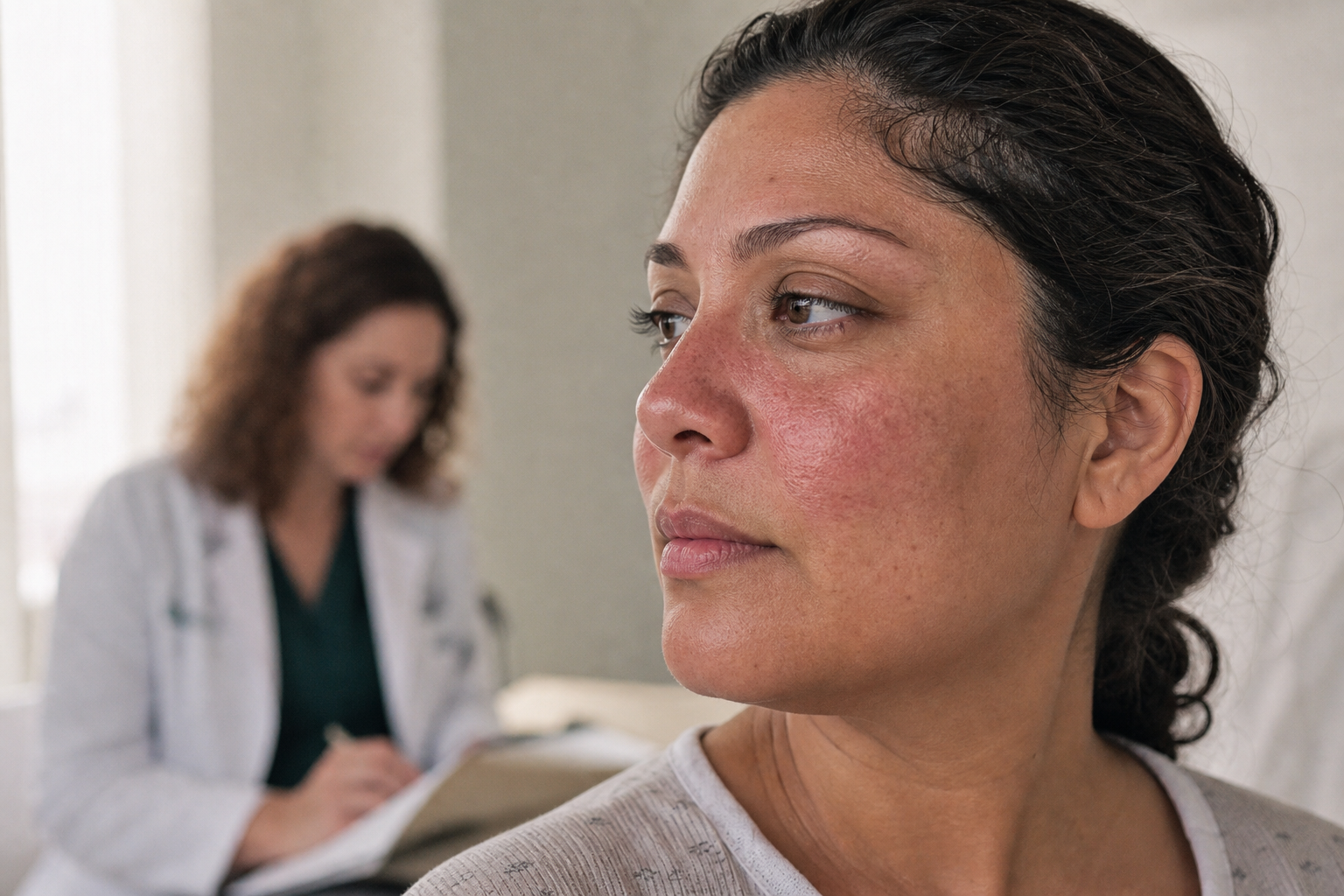
Your rosacea already has a number. You just haven't asked for it.
Dermatologists grade rosacea 0 to 4 on the IGA scale at every visit, and that number drives coverage and treatment escalation. Most patients never learn their own.
The digit in your chart you never see
The visit ends, you leave with a prescription or a "let's keep an eye on it," and somewhere in your record a single digit gets logged that you will never lay eyes on.
At most rosacea appointments the dermatologist assigns an Investigator's Global Assessment, or IGA: a whole-face severity grade from 0 to 4. It is a number, not a paragraph. It moves faster than any sentence you could write in a symptom diary. And it is the thing an insurer reads when deciding whether to cover a prescription topical, and the thing a clinician leans on when deciding whether to escalate you from a cream to an oral medication.
You have one. You just have not been told it.
Call it your clinical number
Every graded rosacea visit produces one figure on a 0-to-4 scale that dermatology has used in clinical trials for decades. The scale exists. The problem is where it lives.
It sits on the clinician's side of the chart, next to the diagnosis codes and the plan, and almost no patient thinks to ask for it. That single number is your clinical number, and knowing it changes what you can do with the months between appointments.
The number is already in your chart. You just have to ask for it.
Why "keep a better diary" answers the wrong question
Most rosacea advice tells you to keep a better diary. Log what you ate, the weather, your stress, the wine. That advice is not wrong. It answers the wrong question for the moment that matters most.
When coverage or an escalation is on the line, no one is reading your prose about a Tuesday flare. They are reading a severity grade, and increasingly a quality-of-life score alongside it. A richer diary does not move either figure unless it changes what the clinician records. So the useful skill is not writing more. It is understanding the number your writing is supposed to influence, and giving your dermatologist the evidence to grade you accurately.
What the 0-to-4 scale actually measures
The IGA used in papulopustular rosacea trials grades the whole face on three things at once: inflammatory lesions (the papules and pustules), background erythema (redness), and, at the severe end, edema (swelling). The grader collapses all of it into one number.
In most trials, treatment "success" is defined as reaching IGA 0 or 1, meaning clear or almost clear. That is the bar a new topical has to clear to prove it works, and it is the same language your own chart speaks. Knowing where you sit on this scale tells you what your dermatologist is watching, and gives you a shared vocabulary at the next visit instead of a mismatched conversation about how "bad" things feel.
Grade
Label
What it describes
0
Clear
No inflammatory lesions, no erythema
1
Almost clear
Rare papules or pustules, faint erythema
2
Mild
Few papules or pustules, mild erythema
3
Moderate
Several papules or pustules, moderate erythema
4
Severe
Numerous papules or pustules, severe erythema, possible edema
IGA structure per FDA papulopustular rosacea trials (Stein Gold et al 2014, J Drugs Dermatol); exact grade wording varies by study.
The one sentence to say before you leave the room
Try this at the end of your next appointment: "What IGA grade did you put me at today?" Most dermatologists will tell you without hesitation, because they just recorded it. Write it down, or better, photograph the same way every time so the next grade is anchored to evidence rather than memory.
There is a fairness problem baked into a scale built heavily on redness. Erythema-based grading was validated largely on lighter skin, and deployed dermatology tools have been shown to perform worse on darker skin (Adamson & Smith, JAMA Dermatology 2018; Daneshjou et al 2022). On Fitzpatrick IV to VI skin, flushing can read as dusky, brown, or violaceous rather than pink, and a grader working from a single office glance may underscore it. This is where your sensory phenotype (the burning, stinging, and dryness you feel) and a consistent photo trail carry extra weight. They give the clinician information a one-visit look cannot.
If you have deeper skin, ask twice
The IGA leans on visible redness, and redness is harder to read on Fitzpatrick IV to VI skin, where rosacea can look brown, dusky, or violaceous rather than pink. If your grade feels lower than how your skin behaves, say so, and bring what you feel (burning, stinging) plus consistent photos. Named evidence: Adamson & Smith 2018, Daneshjou et al 2022.
The score that measures your life, not your face
The IGA captures what the clinician sees. It says nothing about what you live with. That is what a second instrument is for.
The Dermatology Life Quality Index, or DLQI (Finlay & Khan 1994), is ten questions scored 0 to 30, where higher means more disruption to work, sleep, relationships, and mood. For several advanced dermatology treatments, a DLQI at or above a set threshold is part of what justifies coverage, because it documents impact a photo cannot. In rosacea, whether a specific score figures into prior authorization depends on the payer and the treatment being requested, so it is worth asking your prescriber how they plan to document severity for any coverage submission. The point for you is simpler: two numbers describe your rosacea to the system, and you are entitled to know both.
A snapshot cannot show a slope
An IGA taken at a single visit is one dot. What a dermatologist actually treats on is the slope: is this getting better, holding, or climbing. A grade taken once every few months cannot show a slope, and your face on the day of the appointment may not be your face on a flare week.
This is where consistent photos matter. If your between-visit images arrive framed the same way each time, same angle, same lighting cue, kept on your own device, they turn scattered flare days into a record a clinician can grade against. We built Skinframe to make that consistency the default instead of a thing you have to remember, so the evidence you bring lines up with the number your dermatologist is already assigning. It does not replace the exam or the grade. It gives both something real to stand on.
And when the number, or your read of it, does not match how your skin behaves, that is the conversation to have out loud. Ask for your IGA, track it honestly, and take the trajectory to your dermatologist.
Bring your dermatologist a record they can actually grade. Start keeping consistent, on-device rosacea photos with Skinframe, then ask for your IGA at your next visit.
Skinframe keeps your rosacea photos framed consistently and stored on your device, so the between-visit record you hand your dermatologist is anchored evidence, not a phone camera roll. Built by a small team that reads the dermatology literature, for patients told to document before treatment.