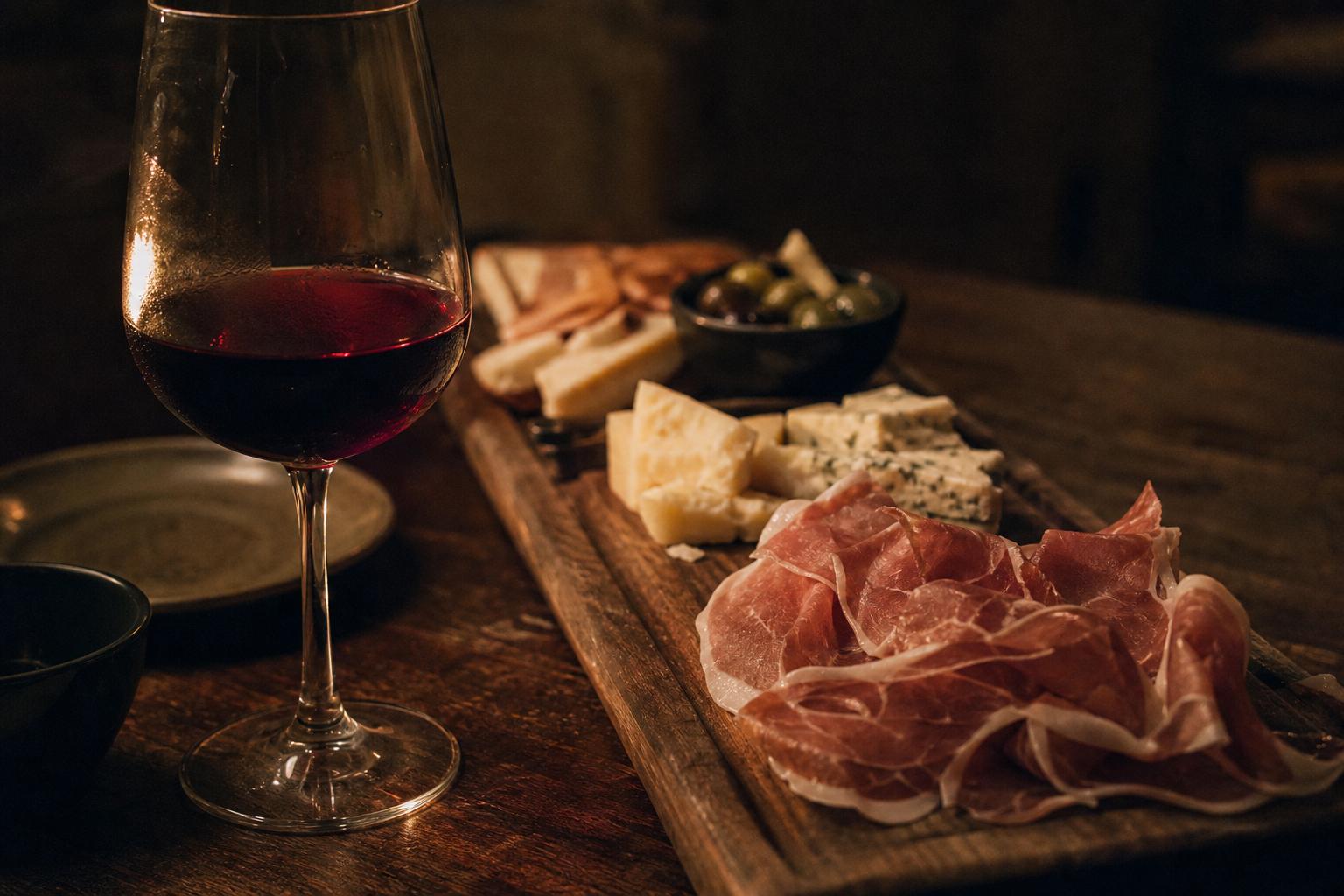
Your "random" rosacea flares may be a histamine bucket quietly overflowing.
Fermented food, aged cheese, cured meat, and wine add up across a day. When your combined histamine load tops your DAO enzyme threshold, the flare that feels random usually isn't.
The flare you can't pin on anything
Three days last week your skin stayed quiet. Then Friday night, after a dinner that looked a lot like Tuesday's, your cheeks lit up and you couldn't name one thing you'd done differently.
So you scroll back through your trigger diary. Nothing stands out. The wine was the same glass you always pour. The cheese board wasn't unusual. No sun, no stress spike, no new product on your face. And the flare gets filed under the one category a rosacea diary should never have to use: random.
Random is where triggers go to hide. When a flare has no single obvious cause, most people stop looking. But "no single cause" and "no cause" are not the same thing, and the gap between them is where a lot of dietary rosacea lives.
The histamine bucket
Picture a bucket. Every high-histamine food and drink you have in a day pours a little in. Fermented foods, aged cheese, cured meat, a glass of wine, leftover fish. Your body drains that bucket using an enzyme in your gut called DAO, short for diamine oxidase, which breaks down histamine before it reaches your bloodstream.
As long as you drain faster than you fill, nothing happens. The bucket has room. But everyone's bucket is a different size, and everyone's drain runs at a different speed. Cross the top and the overflow shows up where rosacea already runs hot: the flush, the warmth, the sting across the cheeks.
That's the model. Not "this one food is your enemy." It's the total for the day against a personal ceiling you can't see and haven't measured.
Why one-food-at-a-time diaries can't catch it
Standard trigger diaries are built on a clean assumption: each flare has a culprit, so log foods one by one and the guilty item reveals itself. It's a reasonable design. It's also the reason histamine load slips through.
When no single food crosses your threshold, item-by-item logging finds no correlation, because there isn't one to find at the item level. The wine alone was fine. The cheese alone was fine. It was the wine and the cheese and the salami and yesterday's carryover, together, on a day your bucket started closer to full. A diary that scores each entry in isolation is doing arithmetic on the wrong number.
This is a category problem, not a one-app problem. Most trigger-tracking tools inherit the single-cause model, so most of them sum nothing.
What DAO and the histamine literature actually say
Histamine intolerance is the working name for an imbalance between how much histamine you take in and how much your body can degrade, and DAO is the enzyme doing most of that degrading in the gut (Maintz & Bischoff 2007). When DAO activity is low, the same plate of food lands harder. That's the individual variable that sets your bucket size.
Why rosacea specifically? Mast cells, the immune cells that release histamine, are found at higher density in rosacea-affected skin than in unaffected skin Muto et al. identified mast cells as key mediators of cathelicidin-initiated skin inflammation in rosacea (J Invest Dermatol. 2014;134(11):2728-2736). ([source](https://pubmed.ncbi.nlm.nih.gov/24844861/)). So the skin of many rosacea patients is primed to react to a histamine surge, whether the histamine came from a mast cell in the skin or arrived through the gut.
Here's the honest boundary: a direct, rosacea-specific causal link between dietary histamine and flares has not been settled by a large controlled trial As of 2021, no RCTs existed for dietary recommendations in rosacea; the review explicitly called for 'further randomized, controlled trials' to guide them. ([source](https://jcadonline.com/rosacea-diet-new-2021/)). What the literature supports is a plausible mechanism and a documented pattern, not a proven universal cause. We're pointing at a variable worth logging, not a diagnosis.
Category
Common examples
Why it loads the bucket
Fermented foods
Sauerkraut, kimchi, kombucha, miso, soy sauce
Fermentation generates histamine as a bacterial byproduct
Aged cheeses
Parmesan, aged cheddar, blue, gouda
The longer the aging, the more histamine accumulates
Cured & processed meats
Salami, prosciutto, pepperoni, hot dogs
Curing and aging raise histamine content
Alcohol
Red wine, beer, champagne
Contains histamine and also suppresses DAO, a double hit
Certain fish
Tuna, mackerel, sardines, anchovies
Histamine climbs fast if the catch isn't kept cold
Histamine liberators
Tomatoes, citrus, chocolate, strawberries
Low in histamine themselves, but can prompt its release
High-histamine and histamine-liberating food categories per Maintz & Bischoff 2007. Individual tolerance varies widely.
Before you cut anything
A low-histamine diet is genuinely restrictive and hard to sustain, and cutting whole food groups on a hunch can hide other patterns or create new problems. DAO blood tests exist but are not a settled diagnostic. Map your load first, then take the pattern to a dermatologist or a registered dietitian before you overhaul your plate.
A Friday that overflows
Walk one day. Morning coffee, fine. Lunch is a leftover tuna salad, a modest pour into the bucket. Late afternoon, a square of dark chocolate, which doesn't carry much histamine but can nudge your body to release its own. Dinner out: a shared charcuterie board of aged cheese and prosciutto, then a glass of red wine that adds histamine and slows the very enzyme trying to clear it.
No single item on that list would flag in a trigger diary. Each one, logged alone, reads as tolerated. But stacked on a day that started with yesterday's carryover still draining, the total tipped over the edge sometime around the second half of the wine. The flush at 9pm wasn't the wine. It was the sum.
Same foods, spread across three separate days, and nothing happens. That's the tell of a load problem: the trigger is the timing and the total, not the ingredient.
No single food crossed the line. The day did.
The signal hiding in who responds to antihistamines
If the bucket model is right, a few things change. First, the fix for "random" isn't a better memory, it's a better unit of measurement. Log cumulative daily histamine load, not just the standout item, and days that looked identical start to separate.
Second, there's a subtype clue most people walk right past. Antihistamines don't help most rosacea, which is exactly why they're not a standard treatment. But some patients do notice a difference on them, and that responsiveness is worth paying attention to. It suggests histamine handling, plausibly reduced DAO activity, is doing more of the work in their particular case. For those patients, the histamine bucket isn't a side note. It may be the main lever. The literature hasn't drawn that line cleanly yet, so we hold it as a hypothesis worth testing against your own log, not a rule.
Logging the total, not the item
This is the difference between a diary that scores entries and one that sums exposure. A histamine-aware log doesn't just record "had wine and cheese." It tags each entry to a histamine category, carries a sense of the day's running total, and lets you see the flare against the load that preceded it rather than against a single suspect.
That's the shape we're building Skinframe around: capture the photo evidence of a flare, and capture the day that fed it as a total, not a list. When the pattern in your own data is cumulative, the tool has to add before it can show you anything true. Most don't. That's the gap we started here to close.
What we're tracking next
Two open threads we're watching. One, whether validated DAO testing gets reliable enough to move from research curiosity to something a dermatologist would actually order for a flushing patient. Two, whether the antihistamine-responsive subgroup can be characterized well enough to become a real phenotype flag rather than a bedside observation.
Until the evidence firms up, the practical move is unchanged: log the load, bring the pattern to your dermatologist, and let your own data, not a food list off the internet, decide what your bucket can hold.
Skinframe is coming to iPhone. Join the waitlist to be first in when histamine-aware trigger logging goes live.
We read the dermatology literature before we build, and we translate it instead of hyping it. Skinframe is a photo-and-pattern tracker for people mapping rosacea triggers, built to sum cumulative exposure like histamine load rather than score foods one at a time. Research-grounded, on-device, no skin-scanning gimmicks.