Your rosacea baseline is worth more before the first flare than after it.
Family history raises rosacea risk in the published genetics literature. Dermatology only starts documenting at symptom onset, which is exactly when the useful comparison point is already gone.
The question you can't answer at your first appointment
Every first rosacea appointment runs into the same wall. The dermatologist asks how long the face has looked like this, whether the redness comes and goes, whether it's worse than a year ago. Most people answer with a shrug and a rough guess.
That guess isn't a memory failure. Faces change slowly, and slow change is close to invisible from the inside. What would actually settle the question is a photo from eighteen months earlier, taken in the same light, before anything looked wrong. Almost nobody has one, because nobody photographs a face that seems fine.
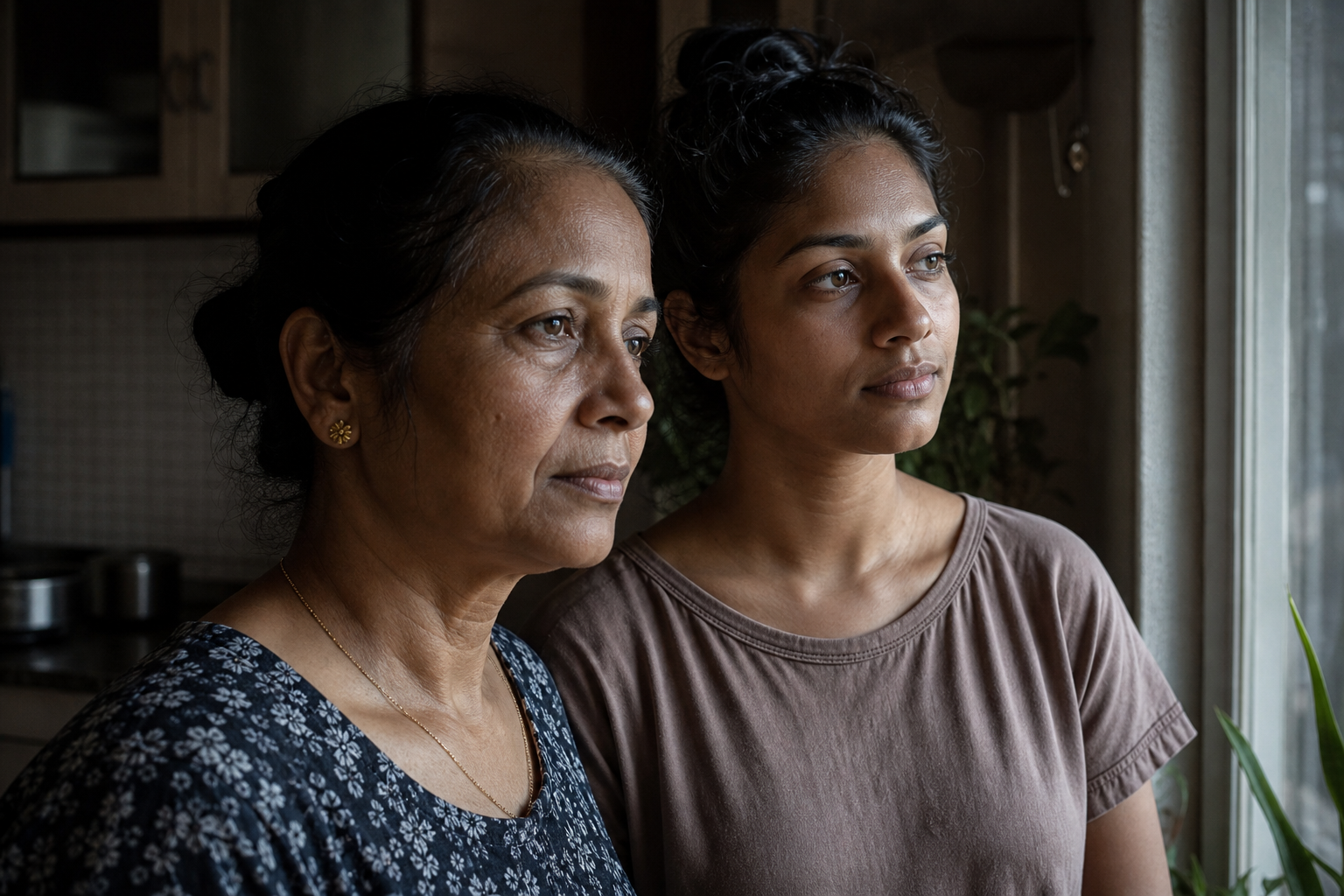
Now add one more detail to that appointment. The patient's mother has rosacea, and has had it since her thirties. That fact was sitting there for decades before the first flare, and nothing in the standard path did anything with it.
The compared-to-what problem
Rosacea is diagnosed by comparison. Persistent central facial redness, flushing that lasts longer than it should, visible vessels, papules and pustules without comedones: every one of those features is a judgment about a change from how a face used to look. So the diagnostic question is always compared to what.
And the comparison point disappears the moment the first flare arrives. After that, every photo in the camera roll is a photo of skin that already has the condition. The reference state you needed is the one you weren't collecting.
We'd put it this way: a face log started at elevated-risk awareness is worth more than one started at diagnosis, and family history is the cheapest, earliest, most ignored signal of elevated risk that most people already have in hand.
"Is rosacea hereditary" is being answered as trivia
Search that phrase and you get a yes, a sentence about genes and environment, and a pivot to sunscreen. The question gets treated as a fact to look up rather than a prompt to do something.
The clinical framing has the same shape from the other direction. Family history shows up on intake forms because it helps the clinician's differential, which is a reasonable use of it. But it arrives at the visit, and the visit happens after symptoms. By then the information has already spent its best years doing nothing.
So the person who gets the most out of knowing their parent has rosacea is currently the dermatologist, not them. That's backwards. The patient is the only one with access to the pre-symptom face.
What the genetics literature actually supports
The evidence here is real but narrower than the headlines suggest, and the honest version is more useful anyway.
A twin-cohort survey published in JAMA Dermatology (Aldrich et al., 2015) compared rosacea severity scores between identical and fraternal twin pairs and attributed roughly 46% of the variation to genetic factors. The first genome-wide association study for rosacea (Chang et al., Journal of Investigative Dermatology, 2015) found the strongest signal in the HLA region, between HLA-DRA and BTNL2, along with associations to specific HLA class II alleles. HLA class II genes govern how immune cells present antigens, which lines up with the innate-immune and inflammatory picture that the 2017 National Rosacea Society update built its phenotype model on (Gallo et al., JAAD 2018).
What none of that gives you is a gene that determines outcomes. These are common variants with small individual effects, and the same twin study that found a genetic contribution left the majority of the variation unexplained by genetics. Family history moves your prior. It doesn't close the question.
46%
of rosacea variation attributed to genetic factors in a twin-cohort surveyAldrich et al., JAMA Dermatology 2015
HLA-DRA / BTNL2
genomic region carrying the strongest association in the first rosacea genome-wide association studyChang et al., J Invest Dermatol 2015
2017
the year the National Rosacea Society replaced subtypes with phenotypes, moving diagnosis toward observed features tracked over timeGallo et al., JAAD 2018
The claim
What the literature supports
Source
Rosacea clusters in families
Supported. A twin-cohort survey found a substantial genetic contribution to rosacea severity scores.
Aldrich et al., JAMA Dermatology 2015
There is a rosacea gene
Not supported. The first GWAS found common variants of small individual effect, with the lead signal in the HLA region.
Chang et al., J Invest Dermatol 2015
Having an affected first-degree relative raises risk
Supported in case-control work, with effect size varying by study and population.
In the Estonian rosacea study, family history of rosacea had an odds ratio of 4.31 (95% CI, 2.34-7) ([source](https://www.sciencedirect.com/science/article/abs/pii/S0151963811700874))
A genetic test can tell you whether you'll develop rosacea
Not established. No society guidance recommends genetic testing for rosacea risk.
Both consensus frameworks Skinframe is built on, the ROSCO 2017 panel and the NRS 2017 expert-committee update (Gallo et al., JAAD 2018), define rosacea diagnosis purely through observable phenotypes (persistent redness, flushing, visible vessels, bumps, eye involvement, skin thickening); neither recommends or references genetic testing as part of diagnosis or classification.
Genes settle the outcome
Not supported. Most of the measured variation in the twin cohort was not explained by genetics.
Aldrich et al., JAMA Dermatology 2015
Rosacea genetics: what's established, what isn't. Sources named inline; unresolved cells are pending verification against the primary paper.
How this plays out over three years in one family
Say your father has had diagnosed rosacea for fifteen years. You're 31, your face looks normal to you, and you start taking one photo a week in the same bathroom light, plus a line about heat, alcohol, sleep, and whether anything burned or stung.
Year one gives you nothing interesting. That's the point. You now own a boring, dated record of what your baseline face looks like across a full cycle of seasons.
Year two, you notice the flush after a hot shower lasts twenty minutes instead of five. It's not visible in a mirror in any convincing way, but it's visible across fifty-two photos.
Year three, you're in a dermatologist's office with a dated sequence instead of a shrug. If it turns out to be rosacea, the clinician can see when it started and what preceded it. If it isn't, you've ruled something out with evidence rather than worry.
That sequence matters more, not less, on deeper skin tones. Rosacea is under-recognized in skin of color partly because erythema reads differently against more melanin, which is why the sensory phenotype, meaning what the skin feels like (burning, stinging, tightness) rather than only what it looks like, carries so much of the signal. Adamson & Smith (JAMA Dermatology 2018) and Daneshjou et al. (2022) both documented how badly image-based dermatology tools underperform on darker skin. A personal, dated, self-described log sidesteps that failure mode entirely, because the comparison is you against you.
What changes if the baseline exists
Three things get easier, and none of them require the log to be clever.
Onset dating stops being guesswork, which matters because the 2017 phenotype framework asks what features are present and how they behave over time rather than which subtype box to tick. Trigger work starts from real pre-symptom behavior instead of from a reconstruction assembled after the fact, when recall is already biased by knowing you have a condition. And the first appointment turns into a review of evidence rather than an interview about memory.
There's also a quieter benefit. Plenty of people with a family history spend years low-grade worried about every flush. A dated record either shows drift or it doesn't, and most of the time it doesn't. Being able to look at two years of nothing is its own answer.
Elevated risk is not a diagnosis, and it isn't destiny
Most of the variation in the twin survey was not explained by genetics (Aldrich et al., JAMA Dermatology 2015). There's no clinically indicated genetic test for rosacea risk, and nothing here is a reason to treat skin that has no symptoms. The only thing a family history justifies is paying attention earlier. Any decision about treatment belongs to you and your dermatologist.
Building a log that's useful before there's anything to log
A pre-symptom log has an odd requirement: it has to be worth keeping for years while returning nothing. That rules out anything that depends on a score going up.
What it needs is consistency of capture (same light, same angle, dated), per-feature notes rather than a single blended severity number, and a record of the sensory stuff (burning, stinging, dryness, eye grittiness) that doesn't photograph at all. Ocular symptoms are worth logging separately from the start, since eye involvement often shows up without matching skin severity.
We built Skinframe around that shape. Photos and notes stay on the device, features are tracked one at a time instead of collapsed into a composite score, and there's no diagnostic read-out, because no app should be telling you what you have. There's no published rosacea-specific trial showing that tracking apps improve outcomes; what exists is evidence from adjacent dermatology conditions that patient-reported tracking improves what happens in a visit, and that's the honest basis for the design.
If you have a first-degree relative with rosacea, start the log now and bring it to a dermatologist when something changes. The record is yours either way.
Start the log before there's anything to log. Skinframe keeps dated, light-consistent face photos and per-feature notes on your iPhone, and it works the same whether you have a diagnosis or just a parent who does. Lifetime is $29.99, or $4.99 a month with one-tap cancel and no rate hikes, after a 14-day trial with every feature unlocked.
Skinframe was built for the documentation phase, not the diagnosis phase. Photos and notes stay on your device, severity is recorded feature by feature rather than collapsed into one blended score, ocular symptoms get their own track, and nothing in the app tells you what condition you have. There's no published rosacea-specific trial on tracking-app efficacy; the design rests on evidence from adjacent dermatology conditions where patient-reported tracking improved visit outcomes.