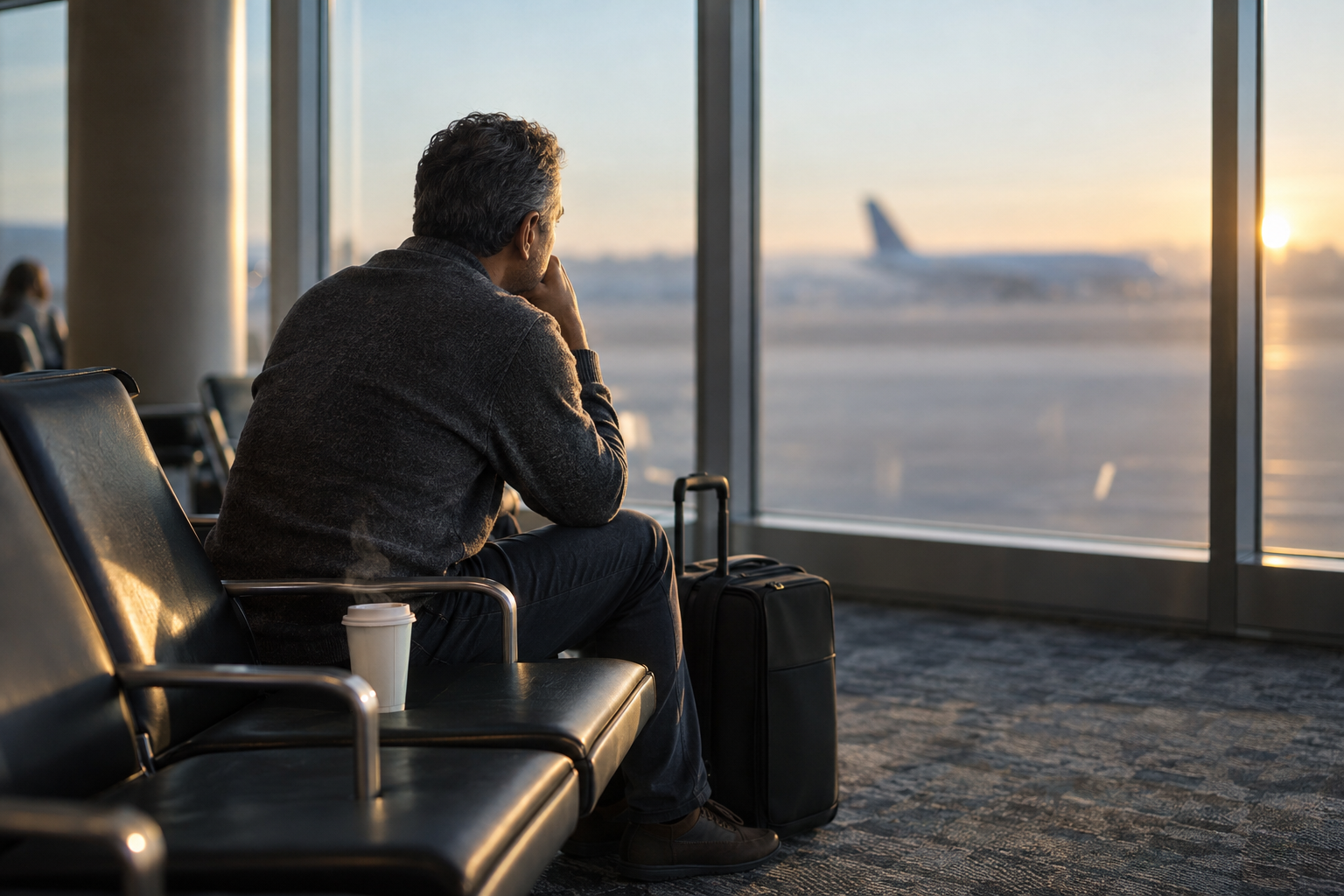
One flight, five rosacea triggers, and a diary that blames the wine.
A flight puts heat, alcohol, stress, sun and a strained skin barrier into one day. Log the trip as one exposure, then compare trips to find the layer that matters.
The flare that shows up on day two
You land, unpack, and wake up the next morning with your cheeks burning and a flush that won't settle. By lunch you've already decided what caused it: the glass of wine on the plane. So wine goes on the banned list. On the next trip you skip it and flare anyway.
Look at what that travel day actually held. An early alarm after a short night. A hot terminal and a stuffy jet bridge, then a cabin cold enough for a blanket. A large coffee at the gate, still steaming. Security lines and a gate change. Hours of dry, recirculated air. A window seat with sun on one side of your face. And a toiletry bag full of travel-size products that aren't quite your usual routine.
That's a lot of suspects for one flare. The wine was just the one you remembered.
The Stacked Trip: one flare, many inputs
We call this the Stacked Trip. A flight day piles several of the most commonly reported rosacea triggers on top of each other in a single day. Then the flare shows up later, when you're somewhere else with a different routine. Most of those exposures fall into five groups: heat, alcohol, stress and short sleep, sun, and a strained skin barrier (dry air plus unfamiliar products).
Rosacea doesn't hand you a receipt. When several inputs land together, the flare tells you the total crossed your line. It can't tell you which input pushed it over, so blaming the most memorable one is a guess dressed up as a finding.
And the guess costs you something. Ban wine for good and you may give up something that was never the problem, while the hot coffee and the gate stress keep coming along on every trip.
A flare tells you the total crossed your line. It can't tell you which input pushed it over.
Why a standard trigger diary gets travel wrong
Most rosacea diaries, paper or app, are built for ordinary days: one row per food, drink or event, and a severity score at the end. That works when your days look alike and only one thing changes. A trip breaks both assumptions. Everything changes at once. And the flare often arrives after you've stopped logging, because you're tired, busy, or finally on vacation.
Generic rosacea travel tips have the opposite problem. Lists that say pack sunscreen, skip the wine and drink water are reasonable, but they treat every trigger as equally likely for every person. They can't tell you which of the five layers matters for you. So you either follow all of them and learn nothing, or follow none and flare with no record of why.
The fix is unglamorous. Log the trip as one stacked exposure. Then pull the layers apart across trips.
What the evidence says about each layer
The most-cited patient-reported data on rosacea triggers comes from a National Rosacea Society survey of 1,066 people with rosacea, who reported which factors set off their flares. Nearly every layer of a flight day lands near the top. Sun exposure, emotional stress and hot weather lead the list. Alcohol comes in at roughly half of respondents, and heated beverages and skin-care products show up too. The table below maps a typical flight day onto those survey items.
Two caveats. Survey percentages count how many people report a trigger. They say nothing about how strongly that trigger acts on you. Some flight exposures also have no direct match in the survey, including short sleep and very dry cabin air. Cabin air at cruise runs at Airliner cabin relative humidity at cruise altitudes is typically 10–20%, below ASHRAE comfort guidelines, according to the National Research Council's 2002 report on the airliner cabin environment. ([source](https://www.ncbi.nlm.nih.gov/books/NBK207472/)). Log it even without a survey number behind it.
On the coffee: Wilkin's 1981 study in the Journal of Investigative Dermatology found that the heat of a hot drink, rather than its caffeine, provoked flushing in people with the flushing-and-visible-blood-vessels form of rosacea. So the gate coffee counts as a heat exposure, and so does the hot hotel shower.
Flight-day exposure
Closest NRS survey item
Share of respondents reporting it
Sun through the window seat, sun at the destination
Sun exposure
81%
Security lines, delays, gate changes
Emotional stress
79%
Hot terminal, stuffy jet bridge
Hot weather / indoor heat
75% / 41%
Wine or a drink at the gate
Alcohol consumption
52%
Long, hot hotel shower
Hot baths
51%
Cold cabin, cold destination
Cold weather
46%
Travel-size or hotel products
Certain skin-care products
41%
Coffee or tea served hot
Heated beverages
36%
Short night before an early flight
No direct survey match
Log it anyway
Dry recirculated cabin air
No direct survey match
Log it anyway
Source: National Rosacea Society patient trigger survey (n=1,066). In a National Rosacea Society survey of 1066 rosacea patients, 79% reported flare-ups following emotional stress; the NRS trigger list also gives sun exposure 81%, hot weather 75%, wind 57%. ([source](https://www.hmpgloballearningnetwork.com/site/thederm/article/reach-undiagnosed-patients-during-rosacea-awareness-month)). The mapping of flight exposures to survey items is ours.
How to log a trip as one exposure
Here's how it looks on a real travel day. The morning you leave, before coffee and before the car, take one baseline photo in the spot and light you use at home (window light, no flash). Note how your skin feels: burning, stinging, tightness, gritty eyes.
At the gate or on the plane, add one note that lists the whole stack. Something like: hot coffee at the gate, glass of white wine, window seat on the left with sun on that side, five hours of sleep, hotel cleanser this morning. Don't score each item. List them all under one entry with the trip date.
Then photograph again on landing, at 24 hours and at 72 hours, in matching light where you can manage it. The later photos are the ones people skip. Without them you're rebuilding the flare from memory a week later.
The next trip is where you start learning something. Keep the stack as close to the same as you can and remove one layer. Take layers away rather than adding new ones to test them. The plan below runs over four trips.
Trip
The one thing that changes
Everything else
Trip 1
Nothing. Log the full stack as your reference trip.
Your normal travel habits
Trip 2
Hot coffee swapped for iced
Held as close to Trip 1 as you can
Trip 3
Skip the gate drink OR take the aisle seat (one, not both)
Held the same
Trip 4
Your usual moisturizer applied before boarding, if Trip 1 went without
Held the same
One change per trip, and only ever removing an exposure. Same photo schedule every time: departure morning, landing, 24 hours, 72 hours.
What changes if the Stacked Trip is real
You stop handing out lifetime bans after one bad flight. A single trip can't convict any one trigger, so the wine, the coffee and the window seat all stay in the possible column until a trip-to-trip comparison moves one of them.
It also changes what counts as a useful record. Photos taken in matching light at the same intervals can be compared across trips. A memory of being pretty red, probably on Tuesday, can't. If you have darker skin, log sensation as carefully as color. Alexis et al.'s 2019 review in the Journal of the American Academy of Dermatology describes how redness is harder to see on darker skin tones, which contributes to rosacea being missed there. Your burning and stinging notes carry information a photo may not.
And it sets an honest ceiling on self-tracking. A few trips of careful logging gives you a pattern to show a dermatologist. Diagnosis and treatment stay with them.
When a travel flare needs a clinician
Gritty, burning or bloodshot eyes after travel can be ocular rosacea (rosacea affecting the eyes and eyelids), which you should raise with a clinician. Swelling, pain, or a rash that spreads or won't settle should be seen promptly. For flares that keep coming back after trips, bring your trip log to your dermatologist.
Where Skinframe fits on a travel day
Skinframe is a photo-plus-note rosacea log, and a trip is a good test of that setup: one baseline photo before you leave, one note holding the whole stack, then photos at landing, 24 and 72 hours, all in the same entry. When you look back at two trips, the one layer you changed should be the main difference between them.
We won't promise it finds your trigger. There's no rosacea-specific trial of tracking apps yet. Evidence in adjacent dermatology conditions (atopic dermatitis, psoriasis) shows patient-reported tracking improves visit outcomes, and Skinframe applies the same approach to rosacea. What you get is a clean, dated record of what the trip held and what your skin did afterward. Your dermatologist is the right person to tell you what it means.
Log your next trip as one entry. Take a baseline photo before you leave and follow up at 72 hours, then bring the record to your dermatologist. Get Skinframe for iPhone.
Skinframe is built by a small team that reads the rosacea literature before writing a line of copy. It's a photo-plus-note log, so a trip becomes one dated entry: a baseline photo, one note for the full stack, and follow-ups at landing, 24 and 72 hours. There's no rosacea-specific trial of tracking apps yet, but evidence in atopic dermatitis and psoriasis shows patient-reported tracking improves visit outcomes, and Skinframe applies the same approach to rosacea.