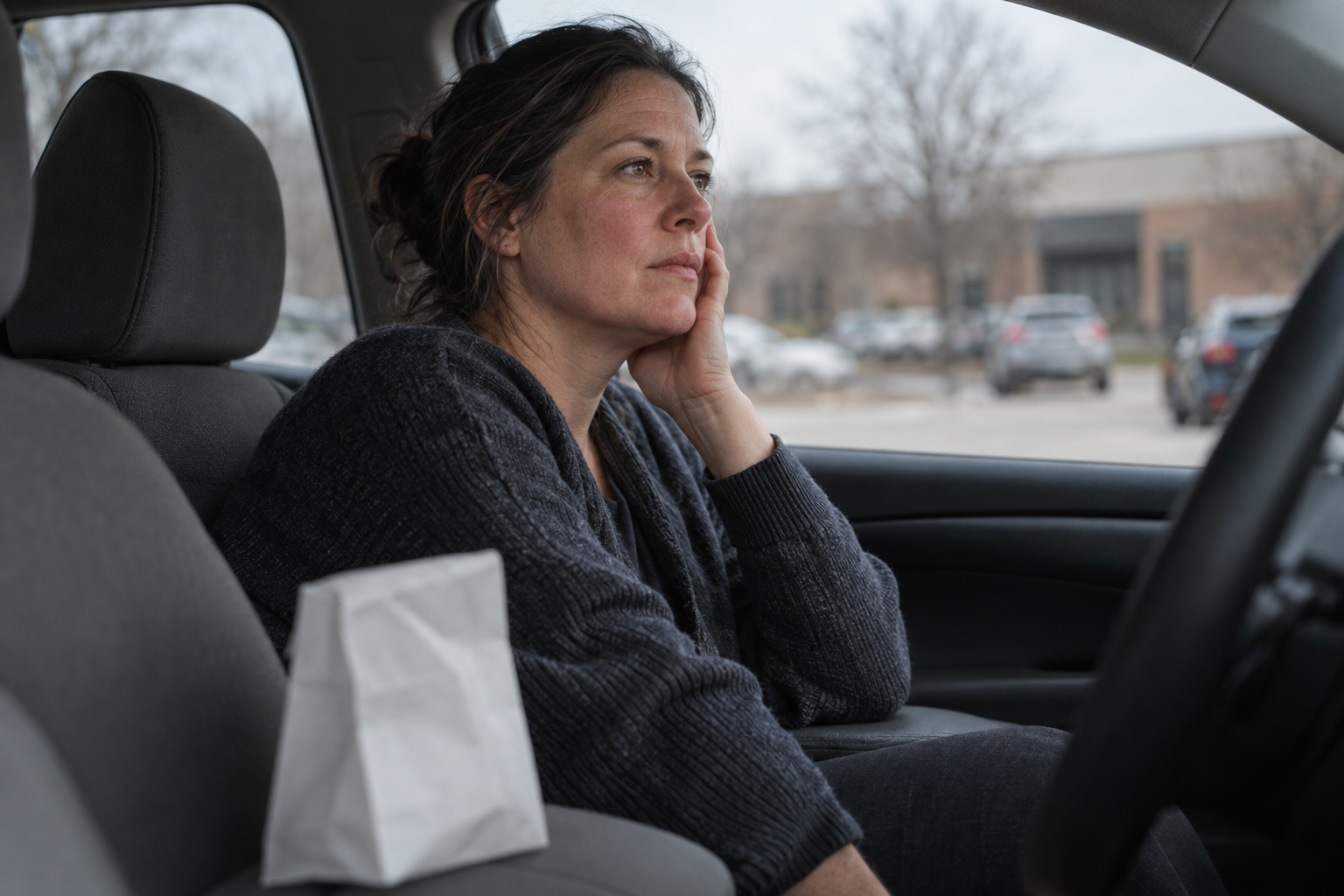
Your dental appointment stacks six possible rosacea triggers into one chair.
A dental visit stacks stress, heat, facial handling, anesthetic and medications into one day. Log each one separately, or the flare that follows can't be traced to anything.
The morning after the cleaning
A rosacea flare that shows up the morning after a dental appointment rarely has one obvious cause. Picture the day. You'd been dreading the visit since the reminder text came in. You spent most of an hour reclined with your jaw propped open and a bib on your chest, and there was a numbing shot. On the way out you got a prescription slip.
By the next morning your cheeks are hot and tight. The diary app asks its usual questions: food, weather, stress.
So you tick stress. Done.
And that one checkbox has just absorbed half a dozen separate exposures. Any one of them might be the real reason for the flare.
The procedure bundle
We call it the procedure bundle. A dental visit, a facial, a blood draw or a minor surgery puts several known and suspected exposures into the same few hours. There's the stress in the days beforehand. Your face and jaw get handled. Warmth gets trapped under masks and drapes. There's injected anesthetic, and often a medication course that starts that evening and runs for a week. Then the procedure causes its own local inflammation, and your diary will happily blame that on whatever you ate for dinner.
The hard part is attribution. Once five things change on the same day, the flare tells you almost nothing about which of them mattered. You can only separate them if each one was written down separately at the time.
A template with three fields can't do that. Neither can a free-text note that just says "dentist."
When five things change on the same day, the flare that follows tells you almost nothing, unless each one was written down separately.
Why "avoid your triggers" breaks down here
The standard rosacea advice is to find your triggers and avoid them. That works for a hot drink. It doesn't work for a root canal. Nobody should skip dental care, bloodwork or a needed procedure to protect their cheeks for a weekend, and we'd argue against anyone who suggests it.
So the goal shifts from avoidance to attribution. You want to find out which part of the bundle pushes you over the edge, because that part is often negotiable: how long the appointment runs, how warm the room is, whether there are breaks, when it falls relative to a heavy week. The appointment itself usually isn't.
Lumping causes a second problem. If "stress" absorbs every procedure flare, your stress field fills up with exposures that had nothing to do with stress, and your everyday stress pattern gets harder to read. We've covered that pattern in our earlier piece on the rosacea stress loop. The point here is narrower. Procedure days need their own event type so they stop contaminating everything else in the log.
What the evidence supports, component by component
The evidence is uneven across the bundle, and the gaps are part of the story. Two components, emotional stress and heat, sit on firm ground as patient-reported rosacea triggers. One has a documented worsening effect in a specific form (corticosteroids applied to the face). The rest range from plausible but unstudied to openly unknown.
The epinephrine question is the one patients ask about most. Many dental anesthetics include epinephrine, which narrows blood vessels. We found no rosacea-specific evidence that it causes flares, and none that it doesn't. Treat it as a hypothesis to test in your own log.
Antibiotics are trickier than they look. Some tetracycline-class antibiotics are used to treat rosacea, so a course started after a procedure could hide a flare as easily as cause one. That's why the start and stop dates matter as much as the drug name.
Component
What it looks like on the day
Evidence status
What to log
Anticipatory stress
Dread in the days before, arousal in the chair
Emotional stress is among the most commonly reported triggers in National Rosacea Society patient surveys The trigger evidence draws on the National Rosacea Society's Rosacea Triggers Survey, a 2002 patient survey of 1,066 people that ranked what they said aggravated their rosacea, with sun exposure and stress near the top.
Stress 0 to 10, day before and day of
Heat and occlusion
Reclined a long time, mask or dental dam, bib, warm room
Heat is a widely reported trigger in the same surveys. Occlusion specifically is not well studied
Time in the chair, whether the room felt warm, anything covering the face
Facial and jaw handling
Mouth propped open, cheek retraction, pressure
No rosacea-specific studies we can cite. Plausible, unproven
Which side was worked on, rough duration
Anesthetic with epinephrine
Numbing injection, often with a vasoconstrictor
Unproven in either direction. A hypothesis to test
Whether you had an injection, drug name if the office shares it
Antibiotics
Prophylactic or post-procedure course
Cuts both ways: tetracycline-class drugs such as doxycycline are an established rosacea treatment Modified-release doxycycline 40 mg capsules once daily were effective and safe as monotherapy for papulopustular rosacea. ([source](https://jddonline.com/articles/effectiveness-and-safety-of-modified-release-doxycycline-capsules-once-daily-for-papulopustular-rosa-S1545961612P0703X))
Drug name, start and stop dates
Steroids and pain relievers
Short oral steroid course, NSAIDs, creams near the mouth
Topical corticosteroids on the face are documented to worsen rosacea Steroid rosacea may become especially severe when the topical steroid cream is discontinued, a worsening known as a rebound flare. ([source](https://dermnetnz.org/topics/steroid-rosacea)). Short oral courses are less clear
Drug, form (pill or cream), dates, where any cream went
The procedure bundle, broken into loggable parts. Evidence status reflects what we can cite, not what feels likely.
Don't run experiments on prescribed care
If you suspect an antibiotic, steroid or anesthetic, bring your log to the prescriber or your dermatologist. Stopping a course early or refusing anesthesia to test a hunch isn't self-tracking. It's a risk to the procedure you needed.
One appointment, logged properly
Say you have a crown appointment on a Tuesday morning. On Monday evening you log a stress score. Tuesday, before you leave, you take a photo in the same spot, in the same light, from the same distance you always use.
At the office you note roughly how long you were in the chair, that you had an injection (the front desk tells you it was lidocaine with epinephrine), and that the room felt warm. That evening a seven-day antibiotic course starts, so you log the drug and the date. Then come the photos: Tuesday evening, and again at 24, 48 and 72 hours. Our piece on the 72-hour flare window (The article that centers on the 72-hour window is "Rosacea pre-appointment documentation protocol," published at https://skinframe.app/articles/rosacea-pre-appointment-documentation-protocol. It explains that flares often clear before exam day, so a dermatologist needs timestamped photos, a duration log, and trigger entries captured in the days leading up to the flare.) explains why that span matters. For procedures, it also covers the first days of any new medication.
One appointment won't settle anything. Three start to.
Suppose your next routine cleaning (short, no injection, no antibiotic) brings the same flare. Then the anesthetic and the antibiotic drop down the list, and stress or heat move up. If the cleanings stay quiet and only the injection visits flare, epinephrine stops being a hunch and becomes a specific question for your dentist. That's the confound-testing logic from our earlier piece, applied to events rare enough that most people never collect a comparison.
What changes when procedures get their own row
Practical things open up. You can ask your dentist for shorter appointments split over two visits, a break halfway through, or a cooler room. Whether a different anesthetic is appropriate is the dentist's call, but now you'd be asking with dates and photos rather than a vague worry. You can also avoid booking elective work in a week that's already loaded with your other known triggers.
Your dermatologist gets something better than "I always flare after the dentist." A sequence of paired photos tied to logged components is evidence they can actually read.
Photos have limits, though. On deeper skin tones (Fitzpatrick types IV to VI, the darker end of the standard skin-type scale), redness can be harder to see on camera. Many people's rosacea shows up more in the sensory phenotype, meaning burning, stinging or tightness, than in visible flushing. So rate those sensations 0 to 10 alongside every photo. A photo that looks calm next to a burning score of 7 is still a flare.
We think procedure days belong in every rosacea diary by default. Templates that leave them out are missing a whole category of triggers.
Where Skinframe fits
We built Skinframe's log so a procedure can be recorded as its own event type rather than squeezed into the stress field. The components from the table above sit as separate entries. The before photo is paired with the follow-ups at the same angle, so the comparison is ready when you need it. Sensation scores sit next to each photo, which matters most for skin where redness doesn't show well on camera.
We don't know of a rosacea-specific trial on tracking apps. In adjacent conditions such as atopic dermatitis and psoriasis, evidence shows that patient-reported tracking improves visit outcomes. Skinframe applies the same approach to rosacea.
Before your next procedure, log the day before, the day of and the three days after. Then take that log to your dermatologist and talk it through. They're the one who can tell you what it means.
What we're tracking next
In-office skin procedures such as chemical peels, laser sessions and professional facials carry the same bundle plus direct injury to the skin. We're reading that literature now. We'll write it up if the evidence supports more than a hunch, and we'll say so plainly if it doesn't.
Log your next appointment as its own event, with paired photos, in Skinframe
Skinframe treats a procedure as its own event type, with its components logged separately and a before photo paired to 24, 48 and 72-hour follow-ups. It records sensation scores next to every photo for skin where redness doesn't show well on camera. Evidence in adjacent dermatology conditions (atopic dermatitis, psoriasis) shows patient-reported tracking improves visit outcomes, and Skinframe applies the same approach to rosacea.