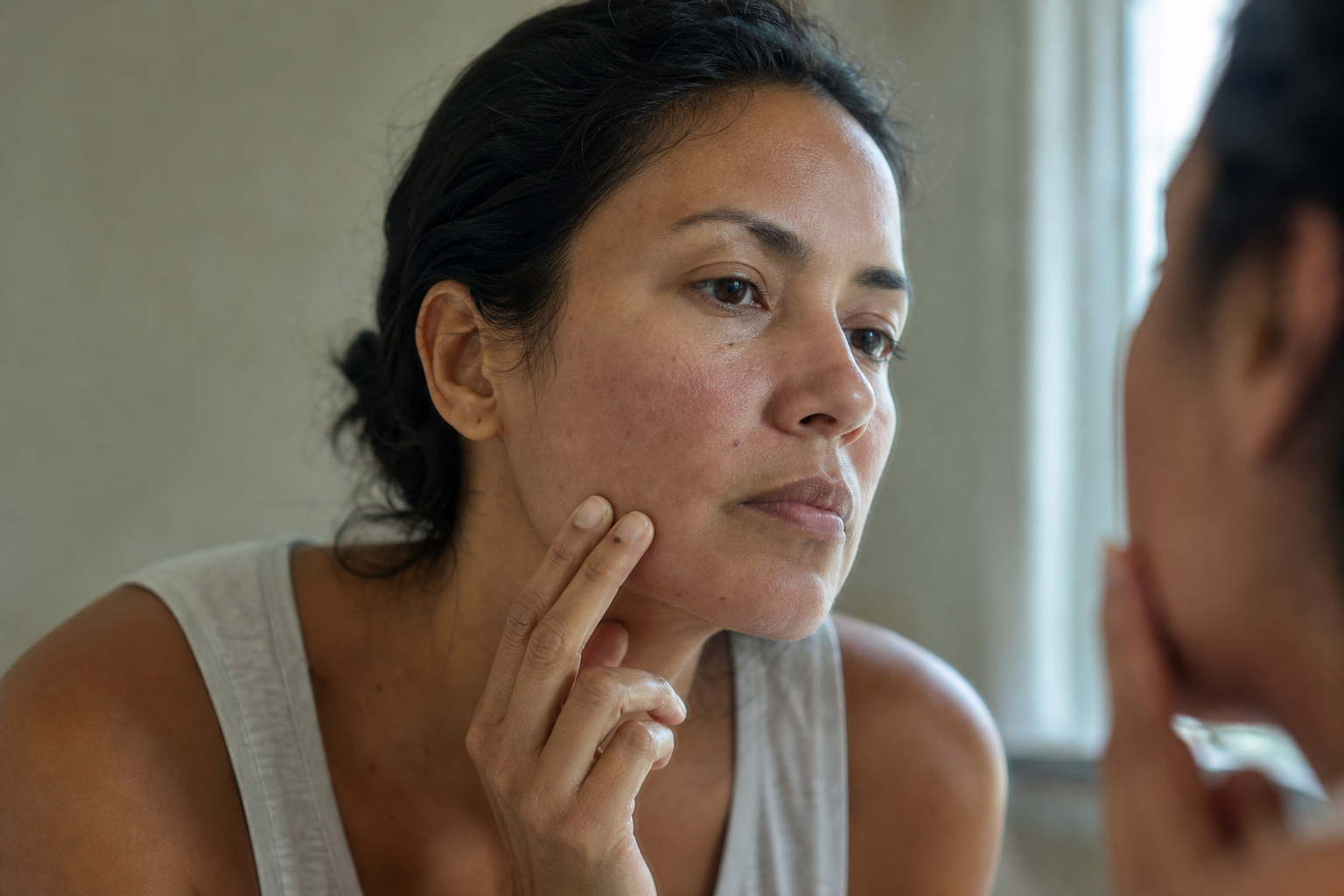
Your rosacea diary and your dermatologist speak two different languages.
You write 'really red, bad week.' Your dermatologist charts erythema grade and papule counts. The translation gap is where your best data disappears.
The most vivid line in your diary is the one your dermatologist can't use
A patient slides a notebook across the exam table. Tuesday: really red, awful, worst week in months. The dermatologist reads it, nods, and writes something completely different in the chart. Moderate centrofacial erythema. Roughly eight to ten papules across both cheeks. No pustules. No ocular complaint noted. Same face, same week, two records that barely touch. The line the patient underlined twice, the one that finally said out loud how bad it had been, is the line the chart has no slot for. This happens in rosacea appointments constantly, and almost nobody names it.
The vocabulary gap
Call it the vocabulary gap. Patients record rosacea in the language of sensation and mood: really red, a bad flare, my skin hated me this week. Dermatologists document it in graded, countable variables: erythema (the medical word for redness) on a fixed scale, a count of papules (small raised bumps) and pustules (bumps with a white head of pus), the spread of visible vessels, the minutes a flush lasted. Both descriptions are honest. Only one of them fits in the chart, drives the treatment decision, and gets compared at the next visit. The gap is not about who is paying attention. It is about which coordinate system the observation was written in.
Two records of the same face, written in two languages.
"Keep a diary" is advice that quietly fails at the door
The near-universal advice for anyone told to track their skin is keep a diary. Journal your flares. Write down what you eat. It sounds right, and it produces pages of text that feel like diligence. Then the appointment arrives and the derm has ten, maybe twelve minutes. A freeform paragraph optimized for the writer's memory is not searchable, not comparable week to week, and not phrased in anything the exam form asks for. The problem isn't effort; it's format. Freeform capture stores the feeling and loses the variable.
What a dermatologist actually records during a rosacea exam
Dermatology actually agreed on what to record, and it did so recently. In 2017 the global ROSacea COnsensus panel (ROSCO, published by Tan and colleagues) and then the National Rosacea Society's 2018 update (Gallo and colleagues) moved rosacea away from named subtypes toward a phenotype approach: you document the individual features that are present rather than sorting the patient into a box. That means a modern rosacea exam records a specific, finite set of things. Fixed central-face redness, graded on the Clinician Erythema Assessment scale (CEA, 0 for clear to 4 for severe). Papules and pustules, counted and located by facial zone. Telangiectasia, the fine visible vessels. Transient flushing, including how long it lasts and what set it off. Phymatous change, the skin-thickening usually seen around the nose. Ocular symptoms, the burning-gritty-dry eye that gets missed most often. Each of those is a clinical term. Each also has a plain-language observation a patient can make at home, if the tracking asks for it.
What the dermatologist records
The clinical term
What you can actually observe and log
Fixed facial redness, graded
Centrofacial erythema (CEA 0-4)
How red your central face looks today on a simple 0-to-4 scale, in consistent light
Bumps: how many, what kind, where
Papules and pustules, by distribution
Count of raised bumps; whether any have a white head; which zones (cheeks, chin, nose)
Visible vessels
Telangiectasia
Fine red or purple threads you can see up close, and where they are
Redness that comes and goes
Transient erythema / flushing
When a flush started, roughly how long it lasted, and what preceded it (heat, alcohol, stress)
Skin thickening
Phymatous change
Any coarsening or thickening, usually around the nose
Eye involvement
Ocular rosacea
Grittiness, burning, dryness, or a stye-like bump on the eyelid
Sensation you feel but they can't see
Sensory phenotype
Burning, stinging, tightness, or itch, rated day to day
How rosacea exam variables map to patient-observable data. Clinical framework: ROSCO 2017 (Tan et al.) and the NRS 2018 update (Gallo et al.).
Redness grades were built for lighter skin
Erythema, the redness clinicians grade, is harder to see on Fitzpatrick IV to VI skin, so a visual severity read can under-call how active rosacea really is on darker skin. That makes the sensory phenotype (the burning, stinging, and dryness you feel) load-bearing, not a footnote. The same visual bias compounds when skin assessment gets automated, which Adamson & Smith (2018) and Daneshjou et al. (2022) documented in dermatology algorithms.
Watch the translation fail in real time
Picture the appointment. The patient opens with it's been a bad week, really red. The dermatologist, working the phenotype checklist, asks the questions the chart needs: how many bumps, roughly, and where. When you flushed, how long did it last, a few minutes or an hour. Any grittiness in the eyes. The patient hesitates. The bumps were mostly last Thursday, but how many. The flushing after the wine felt long, but long is not minutes. The eyes have been dry, but that never seemed like part of the skin thing. The data existed. A week ago it was vivid. By appointment time it has collapsed into really red, and the exam has to rebuild from a redness the patient no longer has in front of them.
Structure the capture, not the recall
If the gap is a format problem, the fix lives at logging time, not at appointment time. Prompt for the clinical variable in plain language the moment it is observable, while the flush is still on the face and the bumps are still countable. A redness read on a consistent 0-to-4 scale. A quick count of raised bumps by zone. A flush timer. A sensory check for burning or stinging. An eye-irritation prompt so ocular rosacea stops going unmentioned. Do that for a few weeks and the appointment starts somewhere new: the patient is not translating a paragraph on the spot, they are handing over data already written in the exam's own coordinate system. The ten minutes get spent on the decision instead of the reconstruction.
Designing the log around the exam, not the notes box
This is the whole reason we built Skinframe's log the way we did. Not a blank notes box that quietly asks the patient to be their own medical scribe, but a structured prompt for each field a rosacea exam actually uses: a redness scale, a bump count by zone, a flush duration, a sensory-phenotype check, an ocular prompt. The fields come straight from the ROSCO phenotype framework, so what you record maps to what your dermatologist charts. Everything stays on your device, none of this is a diagnosis, and none of it replaces the exam. It is documentation, structured so the person with the prescription pad can use it. Whatever you track, bring it to your dermatologist and let them read the variables, not just the mood. That is the conversation the redness deserves.
Skinframe is coming to iPhone. Join the waitlist and we will tell you the day the structured rosacea log goes live, so your next appointment starts with data your dermatologist can actually chart.
Skinframe is a small team building a rosacea log around dermatology's own exam variables, not around wellness vibes. The prompts mirror the ROSCO 2017 phenotype framework, the data stays on your device, and it is documentation to bring to a clinician, never a diagnosis.