Rosacea burns minutes before it reddens, and most trackers miss it.
Burning is rosacea's most common symptom and its earliest signal, yet photo-first apps only catch the redness that arrives later. A flare log should start with a sensation, not a snapshot.
The moment nothing shows on camera
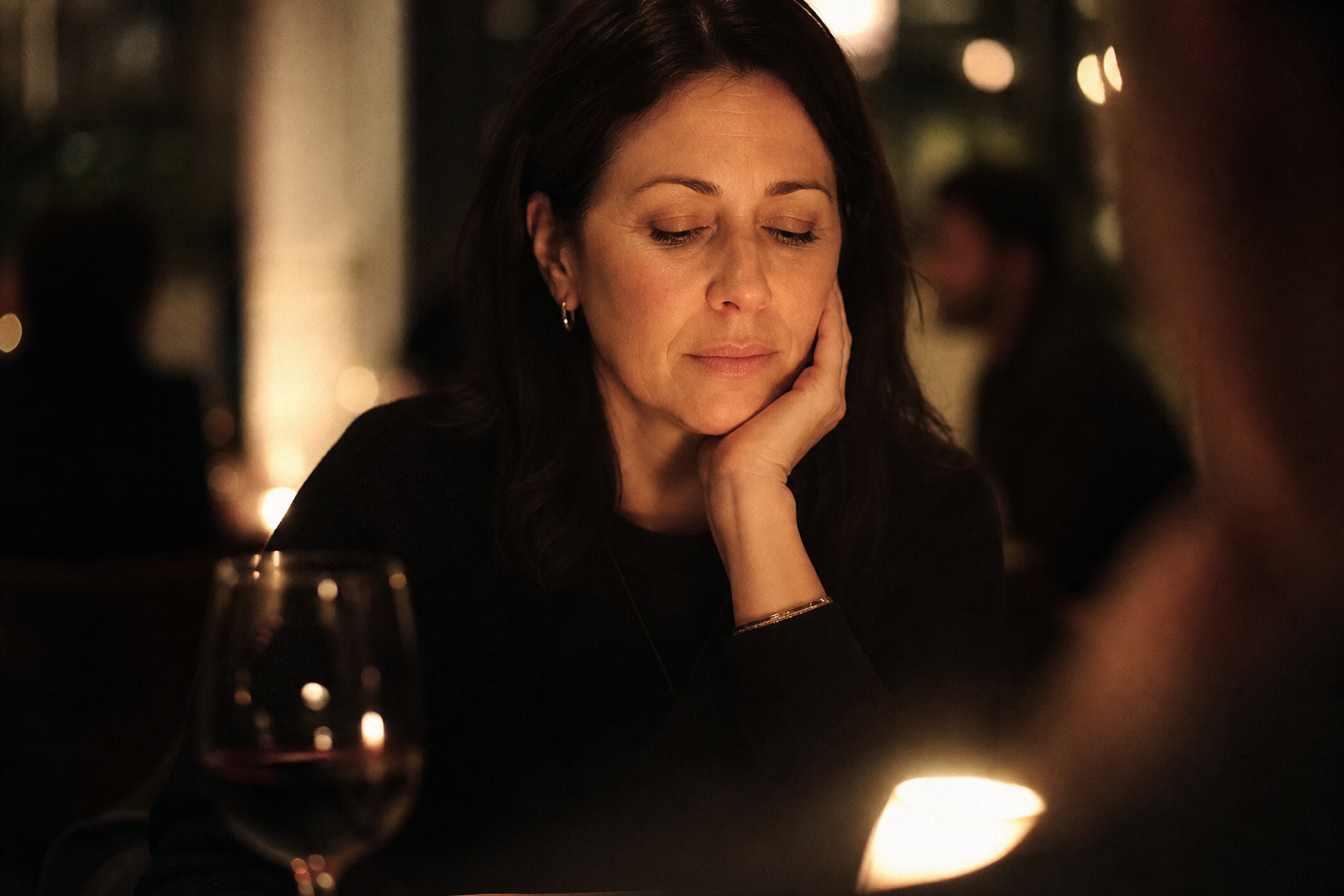
The dinner is warm, the wine is red, and your cheeks start to feel it before anyone can see it. A prickle, then heat, then that tight sting across the middle of your face. You open your phone camera to catch the flare, and the screen shows you a face that looks completely normal. Nothing to photograph. Not yet. So you close the camera and tell yourself you'll grab a picture when it 'actually' flares.
By the time the redness arrives, twenty minutes or two hours later, the trigger is long gone and the moment that mattered has already passed. The photo you eventually take documents the aftermath. The burning that started it went unlogged, because the app you're using has no field for a feeling.
Burning leads, redness lags
Call it the sensory lead. In a rosacea flare, the burning, stinging, and heat show up first, and the visible redness is the trailing artifact. Most tracking systems are built to capture the artifact.
That ordering isn't a footnote. It's the whole problem with photo-first logging. A photo can only record what light reflects off your skin right now, and in the opening window of a flare there's often nothing there to reflect. The signal your body is actually sending, the one that would connect this flare to what you ate or where you sat, is a sensation. And a camera can't feel.
Photo-first tracking optimizes for the wrong moment
Rosacea apps lead with the camera because redness is what a clinician looks at and what a photo can prove. Fair enough. But that choice quietly assumes the useful part of a flare is the part you can see, and the assumption breaks the timeline.
By the time erythema (the clinical word for visible redness) is photographable, you're documenting a lagging indicator. The heat spike that preceded it, the one tied to the actual trigger, has no home in the log. So the record fills up with after-the-fact snapshots and stays empty on the thing that would let you spot a pattern. You end up with an album of red faces and no idea what set them off.
A camera records what reflects off your skin. In the first minutes of a flare, nothing does.
What the literature actually measures
Here's where the numbers land. A 2025 analysis (PMC 2025, PMC12728489) reports burning as the primary patient-reported symptom of rosacea, present in 94.75% of the cohort. Not redness. Burning. The single most common thing patients feel is the thing photo-first tools were never built to capture.
Now line that up against clinical grading. The Rosacea Area and Severity Index (RASI), one of the standard tools for scoring rosacea severity, grades visible signs like erythema, papules, and pustules. It does not score the burning and stinging that patients report as their leading complaint. So the dominant clinical instrument and the dominant app design share the same blind spot, and it sits exactly where the patient's own experience is loudest.
The blind spot both share
RASI grades what a clinician can see, not what you feel. Burning affects 94.75% of patients (PMC 2025, PMC12728489) and goes unscored. A tool that only logs the visible is silent on the majority symptom.
A flare log that starts with a sensation
Walk it through with a real evening. You sit down near a space heater, order a hot coffee, and eight minutes in your cheeks start to sting. Under photo-first habits, you wait. Nothing looks wrong, so there's nothing to shoot. The moment slides by.
Under a sensory-first protocol, you do the opposite. The instant the burning starts, you log it: timestamp, intensity, and what's around you (heat source, hot drink, the coffee itself). That entry exists before a single pixel of redness appears. Then, when and if the flush arrives, you add the photo to the same entry as supporting evidence.
The order is the entire point. Note the burning first. Photograph second. One captures the trigger window while it's open; the other confirms the outcome after the fact. Reverse them and you've logged the echo instead of the sound.
Flare stage
Photo-first log
Sensory-first log
Burning onset (first minutes)
Nothing visible, no entry
Timestamped sensation plus context
Redness appears (later)
First and only entry
Photo added as evidence
Fitzpatrick IV to VI skin
Often no visible change to capture
Burning still logged in real time
How log timing changes what a flare record actually captures.
For darker skin, burning may be the only real-time signal
This matters most for the patients photo-first design already underserves. On Fitzpatrick IV to VI skin (the deeper skin tones on dermatology's classification scale), erythema is frequently muted or invisible to a standard camera. The redness a photo-first app treats as the core data point may never show up on screen at all.
That's not a small edge case. Adamson & Smith 2018 (JAMA Dermatology) documented that dermatology tools built and validated on lighter skin fail harder on darker skin, and Daneshjou 2022 found the image datasets behind many of these systems badly underrepresent Fitzpatrick V and VI. When the visible signal is unreliable, the sensory one carries the flare. Burning isn't a secondary symptom for these patients. It's the signal.
Logging the feeling, then the proof
This is the reasoning behind how we built Skinframe's flare entry. The first field isn't the camera. It's a fast sensory log: burning onset, intensity, and context, timestamped the moment you feel it, in a few seconds, because a flare doesn't wait for you to find good lighting. The photo attaches to that same entry when there's something to show, or not at all when your skin tone won't render it.
We're not diagnosing anything, and no tracking app should. What a good log does is hand your dermatologist a timeline that starts where the flare actually started, so the conversation isn't built on the aftermath.
What we're still watching
The open question is how tight the burning-to-redness gap really is, and whether it shifts by trigger. The literature gives us a minutes-to-hours range but no clean distribution, and that granularity is still missing from the research. A study pinning down that interval more precisely would sharpen the protocol further.
Until then, the rule holds: if you feel it, log it, and let the photo catch up. If you're mapping triggers before a dermatologist visit, bring the timeline and talk to your dermatologist about what it shows.
See what a flare log looks like when it starts with the sensation, not the snapshot. Skinframe puts a two-second sensory entry first, so the trigger window gets captured before the redness shows.
We're a small team reading the rosacea literature, not a wellness brand. The sensory-first flow follows the 94.75% burning-prevalence finding (PMC 2025) and the equity evidence in Adamson & Smith 2018, because a flare log that starts with a photo starts too late.