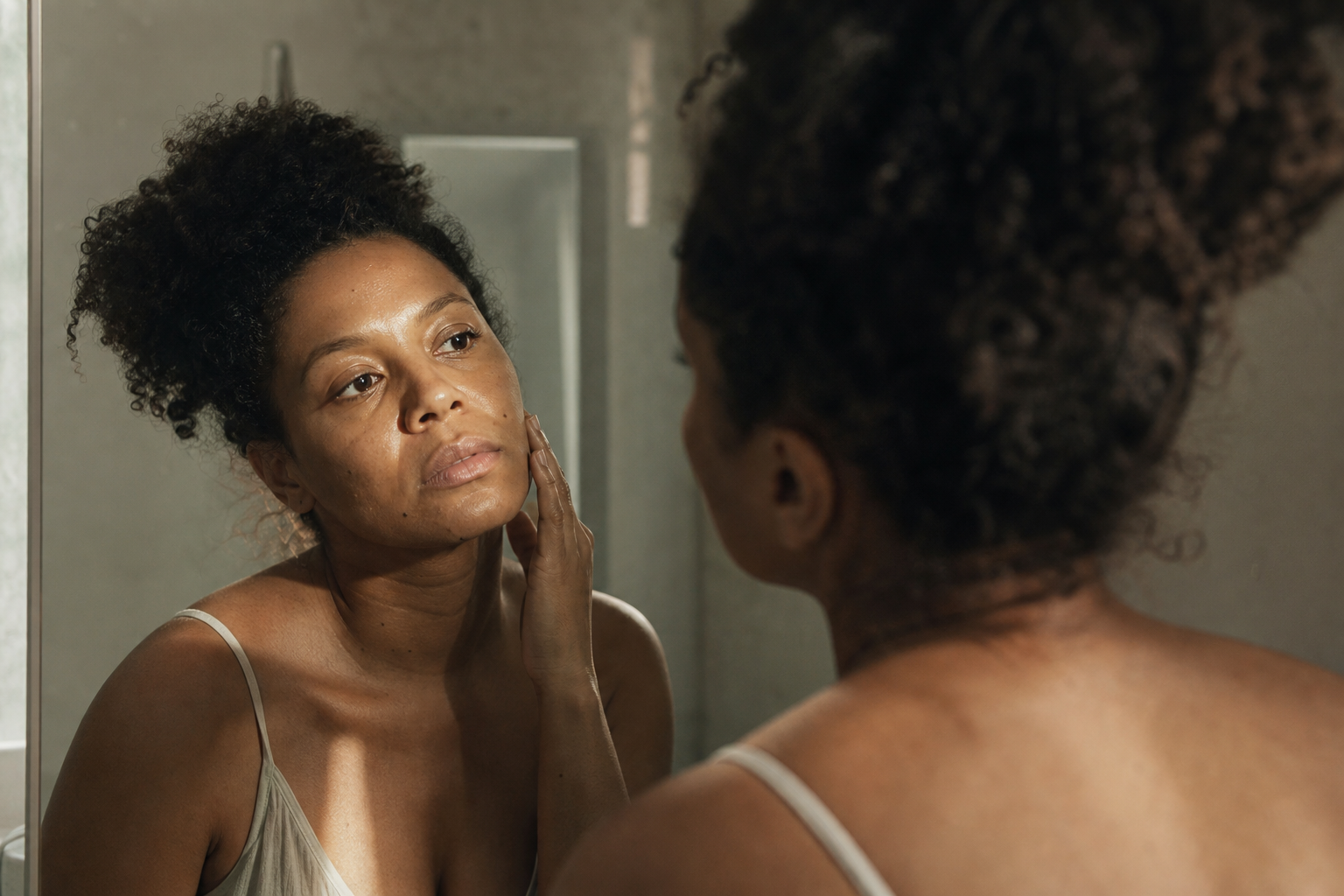
Rosacea on deeper skin: stop asking 'do I look red?'
The standard advice is to compare your face against rosacea photos online. For medium and deeper skin tones, that comparison quietly sends people away from a diagnosis they may need.
The face in the search results is not your face
Type rosacea into an image search and scroll. Nearly every result is the same face: fair skin, a bright flush, a red band spread across the cheeks and nose. If your own skin is olive, brown, or deep brown, you keep scrolling, find nothing that looks back at you, and close the tab. Probably not rosacea, you decide. A lot of missed rosacea starts right there, in that private moment of comparison, long before a dermatologist is ever in the room.
Baseline over benchmark
Here is the reframe we keep coming back to. The advice everyone gives for checking your own skin is a benchmark test: hold your face up against the reference photos and see if you match. That works reasonably well if your skin looks like the reference photos. For medium and deeper phototypes (the Fitzpatrick IV to VI range, the skin tones that tan readily and rarely burn), the benchmark is built from the wrong faces. The question 'do I look red?' quietly fails, because on deeper skin the redness that defines the textbook image may never be the thing you see. The question the clinical literature actually supports is different: do I look different from my own normal?
Why 'do I look red?' is the wrong test
Erythema, the clinical word for flushing and persistent redness, is a change in the visible color of the skin. The more melanin skin carries, the harder that particular change is to see. On deeper skin tones, rosacea more often shows up as a dusky brown or violaceous (purplish) shift rather than a bright red one, and the signals that carry the most weight are ones you feel: warmth, swelling, a burning or stinging sensitivity, small bumps called papules and pustules. Someone comparing against a fair-skinned reference image looks for a color that was never going to be obvious on their face, does not find it, and concludes they are fine. The comparison did not just fail. It pointed in the wrong direction.
What the literature actually tells clinicians
This is not a fringe observation. When the standard rosacea classification was updated in 2017, the field moved away from sorting patients into redness-based subtypes and toward a phenotype model that scores individual features (a flush here, bumps there, eye involvement), partly because the subtype-by-redness frame kept missing presentations that did not lead with visible red. More recently, a 2022 review of rosacea in skin of color (PMC9165629) advised clinicians examining deeper phototypes to hold a high index of suspicion and to weight patient-reported sensitivity over what the eye can see, and National Rosacea Society guidance updated in March 2023 reflects the same emphasis on features beyond color. Read those two together and the implication is sharp: for deeper skin tones, what the patient reports and records over time is not softer evidence than the visual exam. It often carries more.
What self-checks look for
How it can present on deeper skin tones
Bright red flushing across cheeks and nose
A dusky brown or violaceous (purplish) shift that can be hard to see
Visible redness (erythema)
Warmth and swelling you feel more than see
Red bumps
Papules and pustules (small, sometimes pus-filled bumps) on a darker base
Color as the main signal
Burning, stinging, and sensitivity you report yourself
Documented presentation patterns in deeper phototypes. Basis: PMC9165629 (2022).
How the wrong reference plays out
Picture a common version of this. A woman with deep brown skin has cheeks that feel hot after wine and hot showers, a stinging she notices when she puts on sunscreen, and a scatter of small bumps that come and go. She searches, sees a wall of fair, unmistakably red faces, and files it under sensitive skin. Two years later a dermatologist takes one look, asks about the burning, and names it: rosacea, plainly present, just never presenting as the color she was told to look for. The gap between those two moments was never about how visible her rosacea was. It was about the reference she was handed. A textbook face is a fixed benchmark. Her own cheeks six months ago would have been a far better comparison.
Your own history is the better reference
If the visual cue is unreliable on deeper skin, the thing that becomes reliable is change over time in the same face, under the same conditions. A single photo answers 'do I look red right now,' badly. A run of photos of your own skin answers 'is this different from my baseline, and does it track with the hot drinks, the heat, the flare days,' which is the question a dermatologist can actually use. That is also why reaching for an automated face-scan here is a mistake.
Why a face-scan verdict is the wrong tool here
Adamson & Smith (JAMA Dermatology, 2018) documented that dermatology algorithms trained largely on fair skin underperform on darker skin, and Daneshjou et al. (2022) found the same dataset gap persists. A model that already struggles to read erythema on deeper phototypes is not the thing to trust for a yes-or-no answer about your face.
On deeper skin, the most reliable reference image is one you took last month.
Why we built comparison around your baseline, not a library
We made a specific design choice with Skinframe, and this is the reasoning behind it. Skinframe does not sit you next to a reference library of other people's rosacea and ask you to match. It compares each photo against your own prior state, the same face over weeks and months, logged with the triggers and sensations that came with it. For a fair-skinned user that longitudinal record is useful. For a user with a medium or deeper phototype, who has spent years being told to look for a redness that was never the clearest sign on their skin, it is the part the textbook approach left out. Photos stay on your device; the baseline is yours. None of this is a diagnosis. If what you are tracking looks like rosacea, or looks like anything that is changing and bothering you, bring the record to a dermatologist and let it do its job in the room.
Skinframe is coming to iPhone. Join the waitlist and start with a baseline that's actually yours.
Every clinical claim here traces to a named source: the 2017 update to the standard rosacea classification, the 2022 skin-of-color review (PMC9165629), and National Rosacea Society guidance from March 2023. We build Skinframe the same way we write, grounded in the dermatology literature and honest about what it does and does not yet prove.