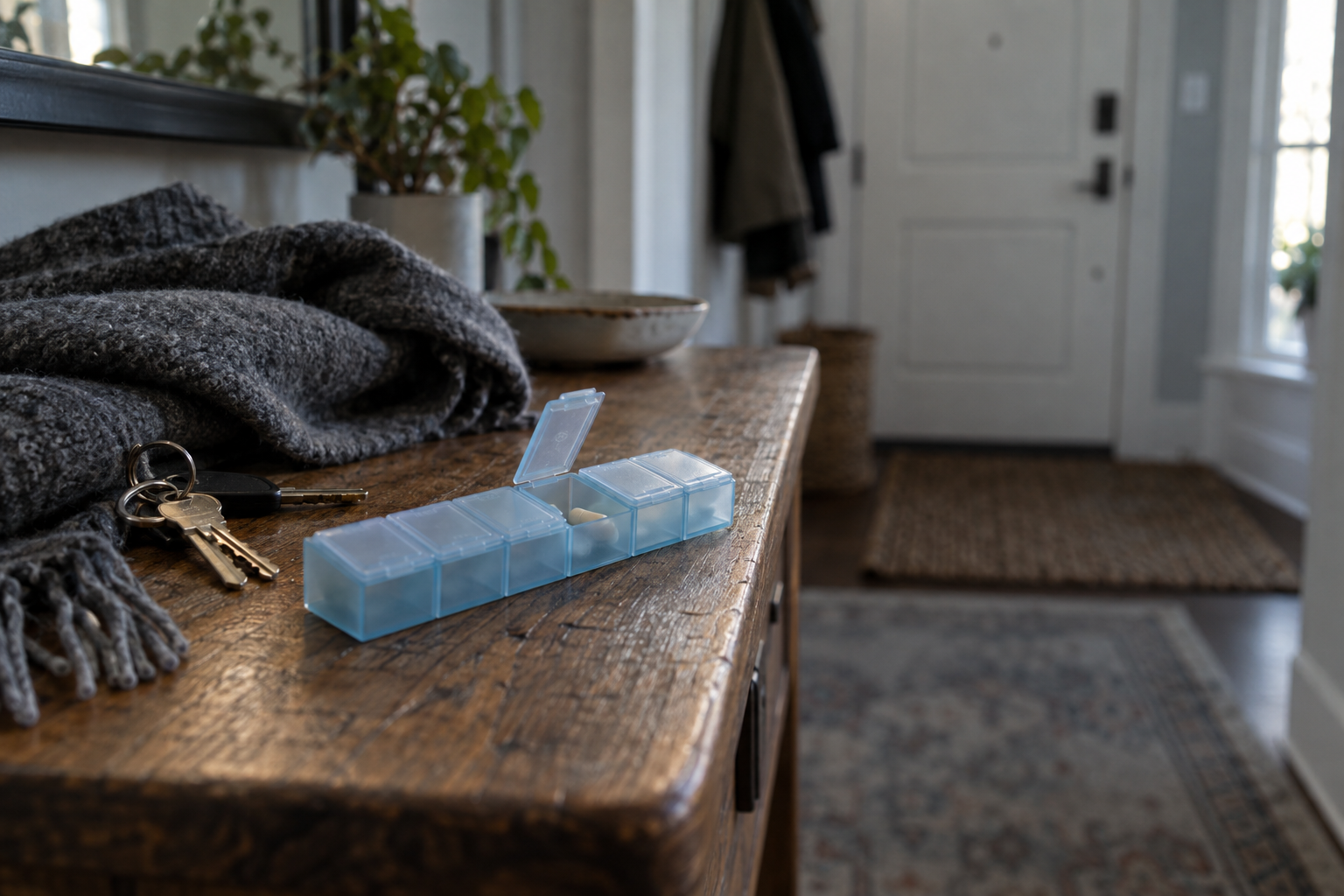
Rosacea doxycycline only works while your foot is on the brake.
Sub-antimicrobial doxycycline calms rosacea inflammation without trying to kill bacteria. Treating it like a regular antibiotic course is where adherence breaks down.
Week three, and the bumps are fading
Three weeks into a prescription for doxycycline 40 mg, the small red bumps along the cheekbones are finally flattening. The pharmacy label says antibiotic. And every antibiotic that's ever lived in the medicine cabinet came with some version of the same instructions: take it for a while, feel better, stop.
So the capsule gets skipped on Saturday. Then Sunday.
By the following Thursday the bumps are back, and the conclusion arrives on its own. The antibiotic didn't work. Or it worked and then stopped, because the bacteria adapted. Or the dose was too weak and a stronger one would finish the job.
Every one of those readings is wrong. And each one points toward a worse next conversation with the prescriber.
The brake-pedal dose
Doxycycline 40 mg modified-release (sold in the US as Oracea) was approved by the FDA in 2006 for one narrow job: the inflammatory bumps and pustules of rosacea in adults. Each capsule pairs 30 mg of immediate-release doxycycline with 10 mg of delayed-release beads, a design meant to keep blood levels below the concentration needed to kill or stall most bacteria. The FDA label says outright that this formulation hasn't been evaluated for treating infections.
We call this the brake-pedal dose. It dampens the inflammatory cascade in rosacea skin for as long as it's in your system, and there's nothing it's trying to clear out. No finish line is built into the mechanism.
When the pressure comes off, the process it was holding down is still there. Rosacea is chronic, and there was never an infection to cure.
40 mg
once-daily dose: 30 mg immediate-release plus 10 mg delayed-releaseOracea FDA label
2006
year the FDA approved it for inflammatory rosacea lesionsFDA
16 weeks
length of the two phase 3 trials behind the approvalDel Rosso et al., JAAD 2007
It only slows the car while your foot is on the pedal.
Why 'antibiotic' is the wrong mental model here
Most adults learned their antibiotic rules from strep throat and sinus infections. Take the full course. Don't save pills for later. Worry about resistance. Public health messaging spent years drilling in 'finish the course,' and even that rule has been challenged for true infections (Llewelyn et al., BMJ 2017, argued the evidence behind fixed courses is thin).
None of that script maps onto a sub-antimicrobial dose. A course has an end. The brake-pedal dose has a duration your dermatologist sets, and a stopping plan they should explain. Resistance anxiety points the wrong way too, since the whole reason the 40 mg formulation exists is to stay under the antibacterial threshold.
But the bottle doesn't say any of this. It says doxycycline, the same word printed on the 100 mg bottles prescribed for Lyme disease and chest infections. Patients reasonably apply the rules that go with the word.
The gap is in the explanation. Usually it's a five-minute conversation that never happened.
What the literature says doxycycline is doing
The mechanism story starts with Yamasaki et al. in Nature Medicine (2007). They found rosacea skin carries unusually high levels of cathelicidin, an antimicrobial peptide the skin makes on its own, along with high levels of kallikrein 5 (KLK5), an enzyme that cuts cathelicidin into fragments that drive redness and inflammation. In plain terms, the skin's own defense system is stuck on.
Kanada, Nakatsuji and Gallo followed up in the Journal of Investigative Dermatology (2012). They showed doxycycline blocks matrix metalloproteinases (MMPs, enzymes that break down tissue), which in turn keeps KLK5 from switching on. Less active KLK5 means fewer inflammatory cathelicidin fragments. No bacteria have to die for any of that to happen.
The clinical evidence lines up. Del Rosso et al. (JAAD 2007) ran two randomized phase 3 trials of 40 mg once daily against placebo over 16 weeks and found fewer inflammatory lesions in the doxycycline groups. A smaller head-to-head comparison against the older 100 mg dose reported similar lesion reduction with fewer stomach side effects at 40 mg (Del Rosso JQ, Schlessinger J, Werschler P, J Drugs Dermatol 2008; anti-inflammatory dose doxycycline caused GI symptoms in fewer patients than 26% on 100 mg dose ([source](https://www.oracea.com/sites/default/files/2021-11/anti-inflammatory-dose-doxycycline-comparison.pdf-min.pdf))).
Where the evidence is thinner: long-term resistance data at 40 mg specifically (Subantimicrobial dose doxycycline 40 mg once daily for 16 weeks had no ecological impact on oropharyngeal and intestinal microflora in healthy volunteers. ([source](https://www.sciencedirect.com/science/article/abs/pii/S0924857912004517))). We'd rather flag that than overstate it.
Player
Role in rosacea skin
What 40 mg doxycycline does
Source
Cathelicidin
Antimicrobial peptide the skin overproduces in rosacea; its fragments drive inflammation
Less of it gets cut into inflammatory fragments
Yamasaki et al., Nat Med 2007; Kanada et al., JID 2012
KLK5 (kallikrein 5)
Enzyme that cuts cathelicidin into those fragments; elevated in rosacea
Activation blocked indirectly, via MMPs
Kanada et al., JID 2012
MMPs (matrix metalloproteinases)
Tissue-degrading enzymes that help switch KLK5 on
Inhibited directly
Kanada et al., JID 2012
Skin bacteria
Not the mechanism this dose is aimed at
Dose designed to stay below antibacterial concentrations
Oracea FDA label
The anti-inflammatory pathway, step by step. Bacteria sit at the bottom for a reason.
Four moves that break the brake
The same misread shows up as four predictable behaviors. Each makes sense under antibiotic rules and backfires under the brake-pedal model.
Stopping when the bumps clear reads improvement as a cure, though it's usually the dose doing its job. Doubling up on a bad day assumes more is faster. But the phase 3 trials tested one 40 mg capsule a day, and higher doses move toward the antimicrobial territory the formulation was built to avoid. Skipping doses out of resistance worry swaps a risk the dose was designed around for patchy inflammation control. And asking for a 'stronger' script after a gap can mean escalating to an antibacterial dose to fix what was really a missed-week problem.
None of this means patients should stop asking questions. They should ask more of them. The table turns each move into one.
The move
The antibiotic logic behind it
What the brake-pedal model says
Question for your dermatologist
Stopping when the bumps clear
The course is done
Improvement may mean the dose is working, not that it's finished
How long should I stay on this, and what's the plan for stopping?
Taking two on a bad day
More is faster
Trials tested one 40 mg capsule daily; more moves toward antibacterial levels
What should I do differently on a flare day, if anything?
Skipping doses over resistance worry
Every pill breeds resistance
The dose was chosen to stay below antibacterial concentrations
Why this dose instead of 100 mg, and what's the resistance picture?
Asking for a stronger script
It failed, so escalate
Gaps in dosing can look like drug failure
Can we look at my dosing and photos before we change anything?
Four common behaviors, the logic that produces them, and a better question to bring instead.
What changes if the dose is a brake
The question patients bring to follow-up visits shifts. 'Did the antibiotic work?' is hard to answer from memory, especially after a patchy month. A better question has two halves: was the dose taken consistently, and what did the skin actually do across those weeks?
That's a record problem. The phase 3 trials judged the drug over 16 weeks, so a verdict at week three is early, and a verdict built on how the face felt last Tuesday is worse.
It also means separating features. The label indication covers inflammatory lesions (papules and pustules) only. Background redness and flushing may not move much on this drug, and a patient watching overall redness can decide it failed while the bump count quietly dropped.
Dermatology already thinks this way. The 2017 ROSCO panel (Tan et al., British Journal of Dermatology) moved rosacea away from subtypes and toward phenotypes, meaning the separate visible signs like papules, persistent redness or flushing, each assessed on its own. The brake-pedal dose is a textbook case for why that shift matters.
Don't adjust this one solo
Stopping, skipping or doubling doxycycline is a decision for you and your prescriber. It's still a tetracycline-class drug, so the label's warnings (including sun sensitivity and use in pregnancy) apply at 40 mg too. Bring the question to your dermatologist before changing anything.
Where a photo record fits
This is the gap we built Skinframe around. A consistent photo log, taken in similar light at a similar angle, plus severity scored feature by feature, gives you and your dermatologist something sturdier than memory. Bumps get their own score. Persistent redness gets its own. Flushing too.
So when the papules settle and the redness holds steady, the record shows exactly that, and nobody writes off a drug that was doing the one thing it's indicated for.
If doses got missed, that belongs in the conversation, next to the photos from the same week. Sixteen weeks of that makes for a very different follow-up than 'I think it helped at first?'
We're careful about what we claim here. There's no published rosacea-specific trial of tracking apps. Evidence from adjacent conditions like atopic dermatitis and psoriasis shows patient-reported tracking improves visit outcomes, and Skinframe applies the same approach to rosacea. It won't tell you how to dose. Your dermatologist will, and a clear record makes that conversation shorter and better.
Start a feature-by-feature photo record before your next follow-up.
Doxycycline 40 mg is indicated for inflammatory lesions only, so a single overall 'redness' impression can hide a drug that's working. Skinframe scores papules, persistent redness and flushing separately and keeps a photo record across weeks, the same phenotype-by-phenotype view the 2017 ROSCO panel moved dermatology toward. There's no rosacea-specific trial of tracking apps; evidence in atopic dermatitis and psoriasis shows patient-reported tracking improves visit outcomes, and Skinframe applies that approach to rosacea.