Every rosacea red-light before/after has the same fatal flaw
Red light devices are a mainstream rosacea purchase now, and the testimonials are everywhere. Here's why the before-and-after photos can't tell you whether they worked.
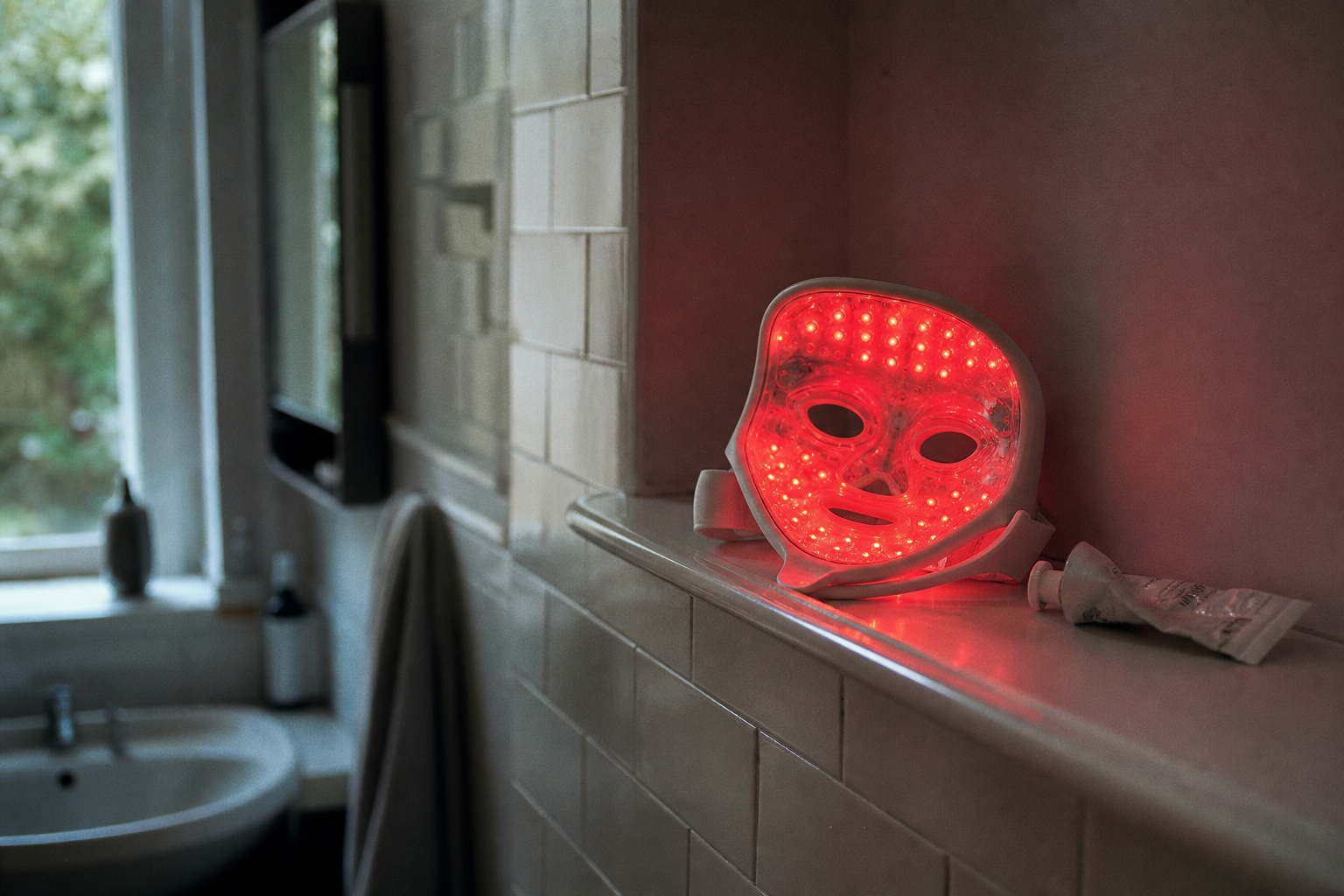
The $300 mask on the bathroom shelf
Scroll r/Rosacea on any given week and you will find them. The split-screen photos. Angry, flushed cheeks on the left, calm and even skin on the right, a red LED mask or a handheld wand credited in the caption. The devices run anywhere from $50 to $500 and they now sit on the same shelf as the azelaic acid.
Red light therapy, clinically called photobiomodulation, has walked out of the dermatology office and into the wellness aisle, and rosacea patients are a prime market. The pitch works because the mechanism is at least plausible. Specific wavelengths of red and near-infrared light, roughly 630 to 850 nanometers, do interact with skin tissue in measurable ways. So the question sitting in thousands of search bars is a fair one. Does it actually help rosacea? The honest answer starts somewhere uncomfortable. You cannot tell from the photos.
The uncontrolled-baseline problem
Every red-light before-and-after for rosacea shares one flaw, and it is the same flaw that quietly undermines every self-reported trigger diary. The two photos were not taken under the same conditions. Different lighting, different time of day, different point in the hormonal cycle, different baseline severity on the day the shutter clicked.
Rosacea is a fluctuating condition. Redness rises and falls with heat, stress, alcohol, weather, and time, sometimes swinging inside a single afternoon. So when the two frames you are comparing differ in the light that lit them, you have not measured a device. You have measured the difference between two rooms.
You have not measured a device. You have measured the difference between two rooms.
Why 'look at the photos' fails as evidence
A before-and-after is treated as proof, but a photo only becomes a measurement when its conditions are held fixed. Two other forces make the testimonial even weaker. Rosacea has genuine spontaneous remissions and flare cycles, so skin drifts toward its own average with no intervention at all. And people tend to buy a device at their worst, during a bad flare week, which means the next few weeks are statistically likely to look better whatever they do. Statisticians call that regression to the mean. It looks exactly like a treatment effect and it is not one.
Hold the confounds up side by side and the pattern is hard to unsee.
What shifts between shots
Effect on how red the skin looks
Held constant in a typical testimonial?
Light source (vanity bulb vs. window)
Can swing apparent redness dramatically
No
Time of day
Flushing varies from morning to night
No
Hormonal cycle phase
Erythema tracks the cycle for many patients
No
Recent triggers (alcohol, heat, stress)
Acute flush unrelated to any device
No
Camera, white balance, distance
Alters the recorded color and detail
No
The variables a red-light before/after almost never holds constant.
What the published trials actually measured
Most of the photobiomodulation evidence base sits in wound healing and acne, not rosacea. When you narrow to controlled rosacea trials specifically, the shelf gets thin fast, and the results that exist are mixed rather than decisive.
Even the more rigorous rosacea-specific trials that have been published have not produced findings strong enough to shift clinical consensus. That is the caliber of evidence a claim of "proven for rosacea" would need, and it largely has not been produced. The National Rosacea Society's published standard-management guidance does not list photobiomodulation among its recommended options. None of this is an argument that the light does nothing. It is an argument that the studies which would settle the question have mostly not been run in rosacea.
Absence of proof is not proof of absence
Sparse trial data does not mean red light therapy has been shown *not* to work for rosacea. It means the controlled studies that would answer the question have largely not been done in rosacea specifically. That is a reason to withhold both endorsement and dismissal, and a strong reason to document your own skin carefully if you decide to try it.
The same face, four weeks apart
Picture the most common version of this. Someone orders a mask during a rough stretch. On day one they photograph their face at night, under the hard vanity light over the bathroom sink, an hour after a glass of red wine. Four weeks later they take the after shot in soft morning window light, on a calm day, no alcohol the evening before, at a different point in their cycle. The skin looks noticeably calmer.
Was it the mask? Maybe. But look at everything else that moved. The light went from harsh and overhead to soft and lateral. The timing went from an evening flush to a morning baseline. The trigger load went from wine-adjacent to none. Any one of those changes could account for the difference on its own. Stacked together, they swamp whatever signal the device might carry. The photo is real. The conclusion drawn from it is not supported.
The baseline you need before you spend $300
If the thesis holds, the takeaway is not 'don't buy the device.' It is 'don't buy the answer the photos seem to give you.' Before spending $300 on a mask, a patient needs a documented photo baseline captured under fixed conditions. Same light, same time of day, same distance and angle, repeated across weeks that include both flare days and calm days. Only against that baseline does a later photo carry any weight, because only then is the device the one thing that changed.
This is the same argument we make about self-reported trigger diaries, about severity scores read off a single photo, about every tracking method that lets the conditions drift. Rosacea fools the eye. A method that does not control the conditions inherits that.
Consistency is the entire point
We built Skinframe around one unglamorous idea. A photo of rosacea skin is only worth comparing if the next photo is captured the same way, and human hands do not do that reliably from a bathroom mirror. So the app does the boring work, standardizing capture and keeping every image on-device and private, so the record you build is a record and not a mood board.
We are not going to tell you whether a red light mask works. We are not going to recommend a wavelength or a dose, because the published trials do not support a specific one. What a proper baseline does is turn a $300 impulse into an actual experiment, one where the after photo can finally answer the question the before photo posed. We are watching for the first rosacea-specific controlled trial that uses standardized photography, and for any FDA action on the flood of consumer LED devices. When those land, we will cover them the same way, with the study named. Until then, document your skin before you buy, and talk to your dermatologist about anything you are considering putting on your face.
Skinframe is coming to iPhone. Join the waitlist and you'll be first to set a fixed-condition photo baseline, so your next skincare experiment answers a real question instead of an accident of lighting.
We read the rosacea photobiomodulation literature before writing this, and we cite it inline rather than gesturing at 'studies.' That is the same documentation logic behind everything we build: if a change in your skin isn't captured under fixed conditions, no one, including you, can trust what the photo appears to show.