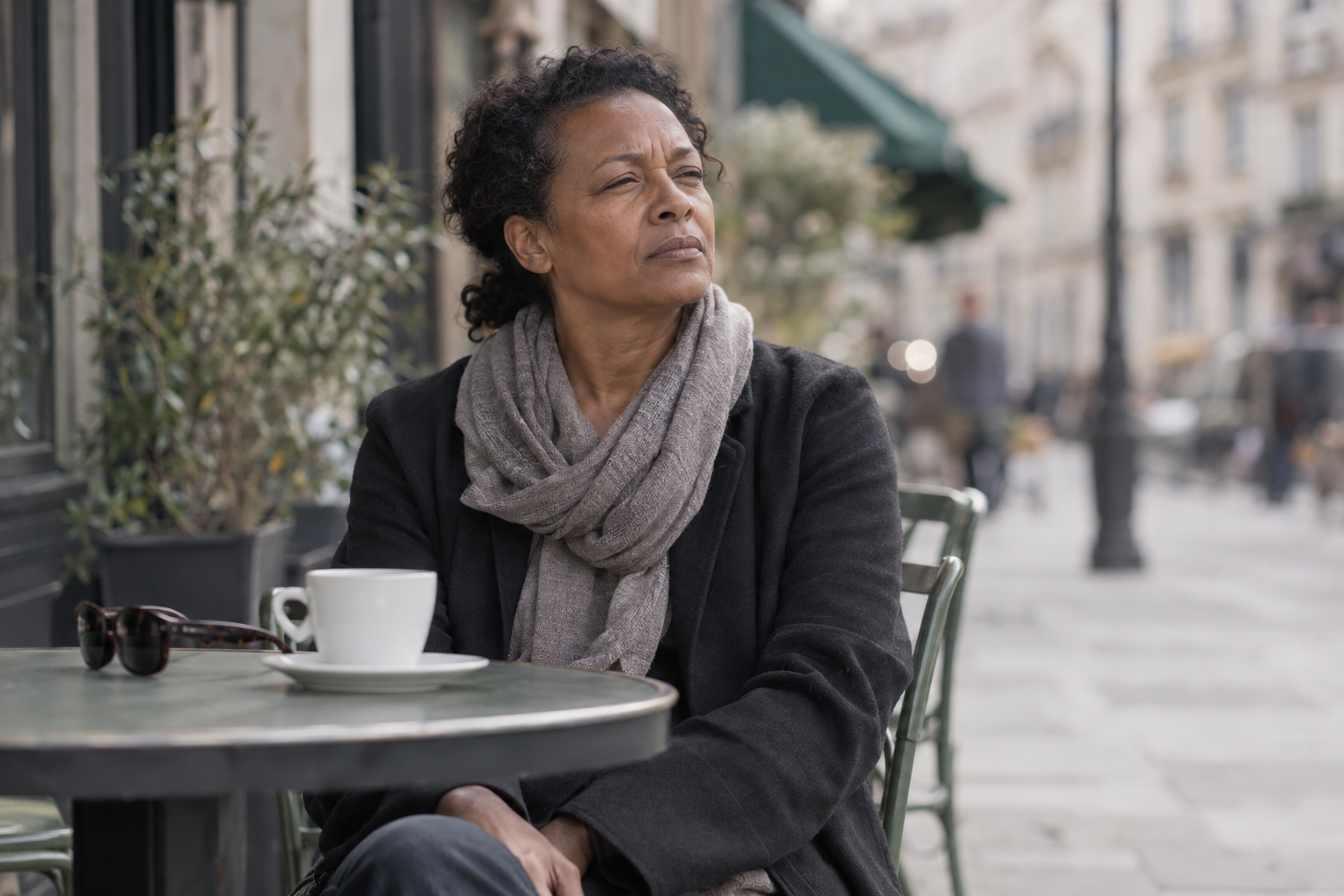
Ocular rosacea can show up while your face looks completely clear.
Eye symptoms can come before visible facial rosacea, or without it. That gap is why "why did I get this?" rarely gets a straight answer.
Yes. Ocular rosacea can appear while your face looks clear
Yes. Ocular rosacea, the form of rosacea that affects the eyes and eyelids, can turn up before any facial redness, at the same time as it, or in people whose skin shows very little. Mayo Clinic's rosacea page states that eye symptoms may show up before, after or at the same time as skin symptoms ([source](https://www.mayoclinic.org/diseases-conditions/rosacea/symptoms-causes/syc-20353815)). And the dermatology consensus updates from 2017 treat eye involvement as a feature in its own right. A clear face doesn't rule it out.
The order is what makes this hard. When the face flushes first, an eye doctor has context, and a known rosacea patient with burning, gritty eyes is an easy connection to make. When the eyes go first, that context is missing.
Exactly how often the eyes lead varies from study to study, but it is a recognized pattern, not a rare oddity. That is reason enough to take persistent eye irritation seriously even when the skin looks fine.
The clear-skin gap: why 'why did I get this?' has no tidy answer
Call it the clear-skin gap. Rosacea is usually diagnosed from the face, by a dermatologist who can see flushing, persistent redness, bumps or small visible vessels. That facial diagnosis is what gives eye symptoms a name and a likely cause.
Take the face away and the same eye findings get filed under whatever fits at the eye exam. Dry eye. Blepharitis, meaning inflamed eyelid margins. Meibomian gland dysfunction, where the oil glands along the lid edge stop working properly. Those labels are often accurate about the lid itself. But they describe the eye and stay silent on why, so people leave with drops and warm compresses and no explanation.
That's a big part of why "why did I get ocular rosacea?" sits among the top questions people search about the condition.
And the honest answer, even with a full diagnosis, is that the cause isn't settled. A 2025 review led by Mohamed-Noriega describes ocular rosacea as complex, multifactorial and not fully understood. It points to immune dysregulation, vascular hyperreactivity, neurogenic inflammation and microbial factors all playing a part ([source](https://www.jfophth.com/ocular-rosacea-a-comprehensive-review/)).
A dry-eye label describes the eye. It says nothing about why.
Why 'your skin looks fine' stopped settling the question in 2017
For years dermatology used a subtype model. The National Rosacea Society's 2002 classification (Wilkin et al., JAAD 2002) sorted patients into four subtypes, with ocular rosacea as subtype 4. In practice, subtypes pushed a yes-or-no question: does this person look like a rosacea patient?
In 2017 two expert groups moved off that model. The Global ROSacea COnsensus panel (Tan et al., British Journal of Dermatology 2017) and the NRS Expert Committee (Gallo et al., JAAD 2018) shifted to phenotypes, meaning individual features assessed one at a time. Ocular manifestations are one of those features Under the 2017 ROSCO consensus and the National Rosacea Society's 2017 update (Gallo 2018), ocular manifestations count as a major phenotype. They sit alongside cutaneous features such as flushing, telangiectasia and papules/pustules, and the old 'ocular subtype' bucket was dropped. Skinframe follows this by tracking eye symptoms as their own feature in the daily entry, never gated on a subtype. Note that the repo paraphrases these sources and has no verbatim quotes, so exact wording would need checking against the papers..
Skin tone gives a second reason clear-looking skin can mislead. Redness is harder to see on Fitzpatrick IV to VI skin (medium brown to deeply pigmented), and Alexis et al. (JAAD 2019) describe rosacea in skin of color as underrecognized. On darker skin, the facial signs worth noting may be sensory, like burning or stinging, with little to see. So "no redness" and "no rosacea" are different claims.
What to log when the skin stays quiet
Clear skin still leaves plenty to record. These are the details an eye doctor or dermatologist would want to see over weeks, and they're hard to recall accurately once you're in the chair.
None of this is a symptom checklist for diagnosing yourself. It's a record of your own pattern, kept in a form a clinician can read quickly.
What to log
What to note
Why it helps
Lid margin
Redness along the lash line, tiny visible vessels, crusting or flaking at the lash base, puffy lids
Clinicians examine the lid edge directly; a dated record shows whether changes come and go
Sensation type
Stinging or burning versus a gritty, sandy, something-in-my-eye feeling
"Irritated" alone loses the detail a clinician will ask about
Time of day
Worse on waking, worse by evening, or steady all day
Timing is easier to show from a log than to reconstruct during a short visit
Same-day exposures
Heat, hot showers, alcohol, spicy food, sun, wind, dry or air-conditioned rooms
Lets you check a suspected trigger against your own record instead of guessing
Facial sensations
Flushing episodes, warmth or burning on the cheeks, even with nothing visible
Can be the skin side of rosacea showing up before it's easy to see, especially on darker skin
What you used
Drops, warm compresses, lid cleansers, and how the next day went
Gives your clinician a record of what's already been tried
Lid photo
Window daylight, no flash, same distance each time, both eyes, dated
One photo shows a moment; a dated series shows change
A logging checklist for eye symptoms without visible facial rosacea. Observation prompts only, not a diagnostic tool.
How the gap plays out: a walked-through example
Take a hypothetical, not anyone's real case. Someone in their late thirties wakes up most mornings with sandy, sore eyes. Their face looks clear in the mirror. An optometrist sees inflamed lid margins, calls it blepharitis with dry eye, and suggests warm compresses and artificial tears. Months later it's still cycling.
So they start logging.
After three weeks the notes show something no single appointment could. The bad mornings cluster after evenings with wine or a long hot bath. On those days the sensation is stinging, and on the others it's grit. The photos show the lower lid edge redder on the bad mornings than the quiet ones. And there's a line they almost didn't bother writing down: their cheeks feel warm after the same triggers, with nothing visible.
A clinician reading that log has a reason to ask about rosacea, and evidence a clear face couldn't supply. The diagnosis stays with them.
Will it ever go away? What changes if the gap is real
Ocular rosacea is generally described as chronic. Mayo Clinic says there's no cure, though treatment and a steady eyelid-care routine can control the signs and symptoms Mayo Clinic states there's no cure for rosacea, but it may be controlled with medicine, gentle skin care and avoiding things that cause flare-ups. ([source](https://www.mayoclinic.org/diseases-conditions/rosacea/symptoms-causes/syc-20353815)). That makes the cause question feel less urgent and the pattern question more useful. You may never get a single reason you developed it. You can get a much clearer picture of what makes it worse for you.
The practical shift is in what you bring to appointments. Mention the eyes and the face together, even when the face looks fine. Bring up any flushing history and any family history of rosacea. Ask directly whether rosacea is on the table.
If you're still sorting out whether something else explains your symptoms, our piece on conditions mistaken for ocular rosacea (The existing article that separates ocular rosacea from lookalike conditions like dry eye is "Ocular Rosacea vs. Dry Eye: The Symptom List That Tells Them Apart", at /articles/ocular-rosacea-vs-dry-eye-symptom-list (https://skinframe.app/articles/ocular-rosacea-vs-dry-eye-symptom-list).) covers that, and our guide to which doctor to see (Skinframe already has a published article on routing ocular rosacea between a dermatologist and an eye doctor, titled "Ocular Rosacea: What Doctor to See, and Why It Splits". Its internal path is /articles/ocular-rosacea-routing-wrong-doctor/. Two related ocular articles also exist: /articles/ocular-rosacea-vs-dry-eye-symptom-list/ and /articles/ocular-rosacea-chronicity-vs-skin-rosacea/.) covers the next step.
Get same-day eye care for these
Eye pain, vision that blurs and doesn't clear with blinking, strong light sensitivity, or a white spot on the clear front of the eye can mean the cornea is involved. Don't wait for a scheduled visit or a few more days of logging.
Where Skinframe fits for people with clear skin
We built Skinframe around the 2017 phenotype model, so features get logged one at a time instead of getting rolled into one redness score. That matters most for people in the clear-skin gap. Eye symptoms get their own entry, and a quiet face doesn't pull the record toward "nothing happening." Skinframe includes a dedicated eye-involvement entry in its daily check-in, where you can log symptoms such as burning, stinging, grittiness, dryness, blurred vision and lid-margin irritation. It does not have a separate lid-photo capture. Photos are face selfies, so the paragraph should say eye symptoms are tracked by self-report and drop any mention of lid photos. Photos are dated and stay on your phone.
We can't tell you whether you have ocular rosacea, and no app can. There's no published rosacea-specific trial of tracking apps yet. Evidence in adjacent dermatology conditions (atopic dermatitis, psoriasis) shows patient-reported tracking improves visit outcomes, and Skinframe applies the same approach to rosacea.
Whatever you log, take it to your dermatologist and your eye doctor. They're the ones who can put the eyes and the skin together.
Log your eyes and skin side by side. Try every feature free for 14 days.
Skinframe logs rosacea feature by feature, following the 2017 ROSCO and NRS phenotype consensus, so eye symptoms are recorded on their own terms even when facial skin looks clear. Photos are dated and stay on your phone. We make no diagnostic claims: evidence in adjacent dermatology conditions (atopic dermatitis, psoriasis) shows patient-reported tracking improves visit outcomes, and Skinframe applies the same approach to rosacea.