Ocular rosacea or dry eye? Check the eyelid edge first.
Burning, gritty eyes during a flare often get treated as dry eye or allergies for months. Six checks, from the eyelid edge to your flare calendar, help sort them out.
When the eye drops stop working
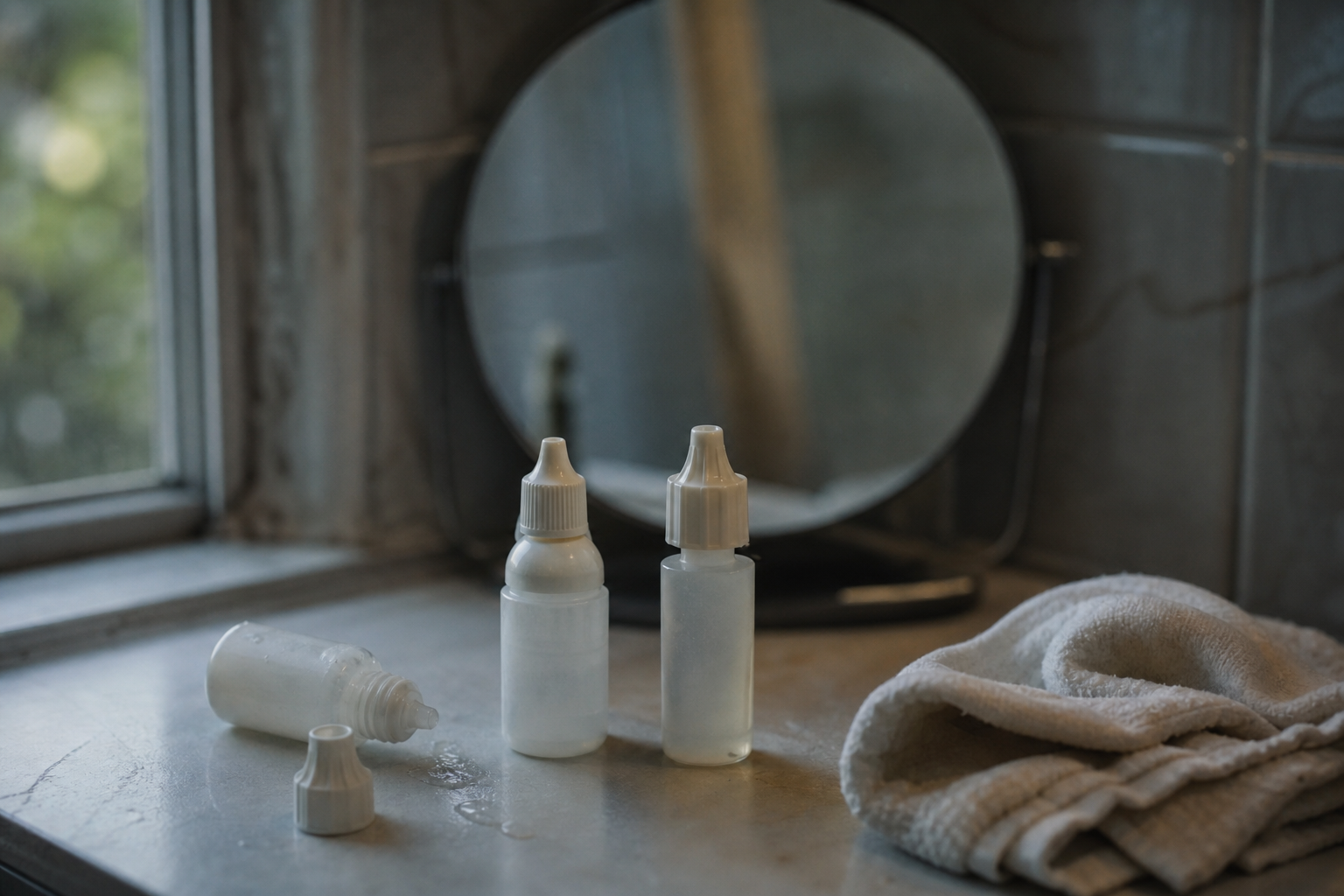
The bottle on the bathroom counter is the third brand you've tried. Artificial tears in the morning, allergy drops when things feel irritated, a different formula when the burning comes back after dinner. The relief doesn't last. Then the grit returns, the lids feel heavy, and your eyes look tired in a way sleep doesn't fix.
Plenty of people with rosacea spend a season or two like this. They call it dry eye, or allergies, or screen fatigue, because those are the explanations the drugstore aisle offers. And the aisle isn't wrong, exactly. Those conditions are common and they feel similar.
But if your cheeks flush after a hot shower and your eyes sting on the same evenings, the pattern deserves a closer look. Ocular rosacea (rosacea affecting the eyes and eyelids) can feel almost identical to ordinary dry eye from the inside. From the outside, and on a calendar, it usually leaves clues.
The eyelid-edge rule
The fastest sort takes two places to look. The edge of the eyelid, and the calendar.
Ordinary dry eye is mostly felt on the eye's surface. Allergy is mostly itch and swelling. Ocular rosacea tends to announce itself at the lid margin, the thin rim where your lashes grow, with redness, tiny visible blood vessels, crusting at the lash base, or styes that keep coming back. And its bad days tend to line up with your skin's bad days.
We call this the eyelid-edge rule.
Neither clue proves anything on its own. Together, they're the difference between another month of trial-and-error drops and a useful conversation with a clinician who can actually examine your eyes.
Why 'is it dry eye or rosacea?' is the wrong question
Most people start by treating these as rival diagnoses. Pick one, buy the matching bottle.
That setup misreads how the eye works. Dry eye describes what you feel: a tear film that isn't keeping the surface comfortable. It has several possible drivers. One of the most common is meibomian gland dysfunction, meaning the oil glands along the lid margin stop producing the healthy oil that keeps tears from evaporating too fast. Rosacea is one of the conditions known to inflame those glands.
So a person can have ocular rosacea and dry eye at the same time, with the first feeding the second. Lubricating drops can ease the surface symptom while the inflamed lid margin underneath carries on. That's one plausible reason drops seem to help a little and then stop.
The better question is what's driving the dryness. Your eyelids and your flare calendar answer that far better than a drugstore label does.
What the clinical sources list, and where the real differences hide
The symptom lists from major clinical sources overlap heavily with dry eye, which is exactly why self-diagnosis goes sideways. Mayo Clinic's ocular rosacea page includes burning, grittiness, dryness, itching, watering, light sensitivity, and blurred vision. The American Academy of Ophthalmology and Cleveland Clinic describe the same kind of irritation. Mayo Clinic lists recurrent eye or eyelid infections as a symptom of ocular rosacea ([source](https://www.mayoclinic.org/diseases-conditions/ocular-rosacea/symptoms-causes/syc-20375798))
The distinguishing features sit elsewhere. The global ROSCO consensus panel (Tan et al., British Journal of Dermatology, 2017) lists the ocular manifestations of rosacea as lid margin telangiectasia (small dilated blood vessels along the lid edge), blepharitis (inflamed eyelids), and keratitis, conjunctivitis, or sclerokeratitis (inflammation of the cornea, the eye's lining, or the white of the eye). Mayo Clinic also notes that eye symptoms can show up before skin symptoms, at the same time, or later.
That last point matters a lot. Clear cheeks don't rule ocular rosacea out.
How common eye involvement is among people with rosacea is genuinely unsettled, and published estimates vary widely between studies. There's no single lab test for it either. It's diagnosed on examination. The table sorts the overlap into the questions that separate the three most common explanations.
What to check
Leans ocular rosacea
Leans ordinary dry eye
Leans eye allergy
Where it looks worst
Eyelid edge: redness, fine visible vessels, crusting at the lash base
Surface discomfort without obvious lid-edge vessels or crusting
Puffy lids, pink and watery whites of the eyes
Strongest sensation
Burning, grit, a something-in-my-eye feeling
Dryness, grit, tired eyes late in the day
Itch, often the main complaint
Timing
Worse on the same days your face flushes or flares
Worse with screens, wind, dry indoor heat or air conditioning
Worse in pollen season or around pets and dust
Recurring lid bumps
Styes or chalazia (firm lid bumps) that keep returning
Not a typical feature
Not a typical feature
What usual first-line care targets
The lid margin and oil glands (warm compresses, lid hygiene, as a clinician advises)
The tear film (lubricating drops)
Histamine-driven itch (antihistamine drops)
Link to your face
Flushing, persistent central redness, or bumps, though eyes can come first
No link to facial flares
No link to facial flares; may come with sneezing or a runny nose
Leans, not proves. The conditions frequently overlap, and itching can occur in ocular rosacea too. Based on Mayo Clinic, Cleveland Clinic, American Academy of Ophthalmology, and the ROSCO consensus (Tan et al. 2017).
How the list plays out over three weeks
Picture a hypothetical reader who's had rosacea on their cheeks for a few years. Every winter, their eyes start burning. They blame the radiator. Allergy drops do nothing, which tracks, because nothing really itches. Lubricating drops take the edge off for a while.
Now run the list. In the bathroom mirror, in good light, the rim along the lashes looks redder than the rest of the lid, with a few fine threadlike vessels. They had a stye in the spring and another in the fall. And when they jot down three weeks of evenings, the worst eye nights are the ones with a hot bath, a glass of wine, or a long stretch over a steaming stove. Those are also the nights their face flushes.
Four of the six rows lean the same way.
That isn't a diagnosis. It's a strong reason to book an eye exam and mention rosacea by name, instead of buying a fourth bottle.
What changes when you track your eyes alongside your skin
If the eyelid-edge rule holds, the most useful thing you can bring to an appointment is a record of overlap.
Ocular rosacea sits between two specialties, so either clinician may only see half of it. A dermatologist looking at your face may not ask about grit in your eyes. An eye doctor examining your lids may not know your cheeks flush after a hot coffee. When both halves show up on the same page, with dates, the connection gets much easier to spot.
Useful notes are short: the date, eye symptoms (burning, grit, itch, watering, light sensitivity), whether your face flared that day, and any likely trigger. A clear photo of the lid edge on a bad day helps too, because redness has a way of fading by the time the appointment arrives.
For readers with darker skin (Fitzpatrick types IV to VI), facial redness can be harder to see in a mirror or a photo. The sensory side of rosacea, meaning stinging, burning, and eye irritation, is often the more dependable thing to log.
Where Skinframe fits
We built Skinframe around this kind of record. Flare-day photos, triggers logged in a few taps, and the symptoms you can't photograph, like burning or eye irritation, noted on the same entry as your skin. Skinframe lets users log eye-related symptoms (burning, stinging, grittiness, dryness, blurred vision, and lid-margin irritation) as part of the same daily entry where they record skin severity, photos, and triggers, so ocular involvement is tracked alongside the rest of a flare.
The goal is a timeline you can hand to a clinician, so 'do my eyes get worse when my face flares?' has an answer with dates attached. Evidence in adjacent dermatology conditions like atopic dermatitis and psoriasis shows patient-reported tracking improves visit outcomes, and we apply the same approach to rosacea, including the parts of it that show up in your eyes.
We don't diagnose. A log won't tell you what you have. It will make the exam that does a lot more specific.
When not to wait on a checklist
A self-check is for sorting nagging, recurring discomfort. Some eye symptoms need same-day attention instead.
Ocular rosacea can involve the cornea, the clear front window of the eye, and corneal inflammation can threaten vision if it's left untreated. Eye pain, strong light sensitivity, or any change in your vision should go to an eye doctor promptly. Log it afterward.
For everything else, talk to your dermatologist, and ask whether an eye exam makes sense too. Bring the list. Bring the dates.
Get seen the same day if you notice
Eye pain, new or strong sensitivity to light, blurred or reduced vision, or a red eye that keeps getting worse. These can signal involvement of the cornea. Contact an eye doctor or urgent care promptly rather than trying another drop.
Put your eyes and your skin on the same timeline. Start tracking with Skinframe.
Ocular rosacea is diagnosed on examination, and the clinician doing that exam works faster with dates. Skinframe keeps flare photos, triggers, and symptoms like burning or eye irritation on one timeline, built on the ROSCO 2017 consensus that treats eye involvement as part of rosacea rather than a separate problem. It doesn't diagnose; it makes the overlap between your eyes and your skin visible.