Your skin clears between flares. Your eyes keep the damage.
Skin rosacea recedes between flares. Ocular rosacea leaves meibomian gland damage that accumulates whether you're flaring or not, and that changes what's worth logging.
Calm skin, unhappy eyes, same face
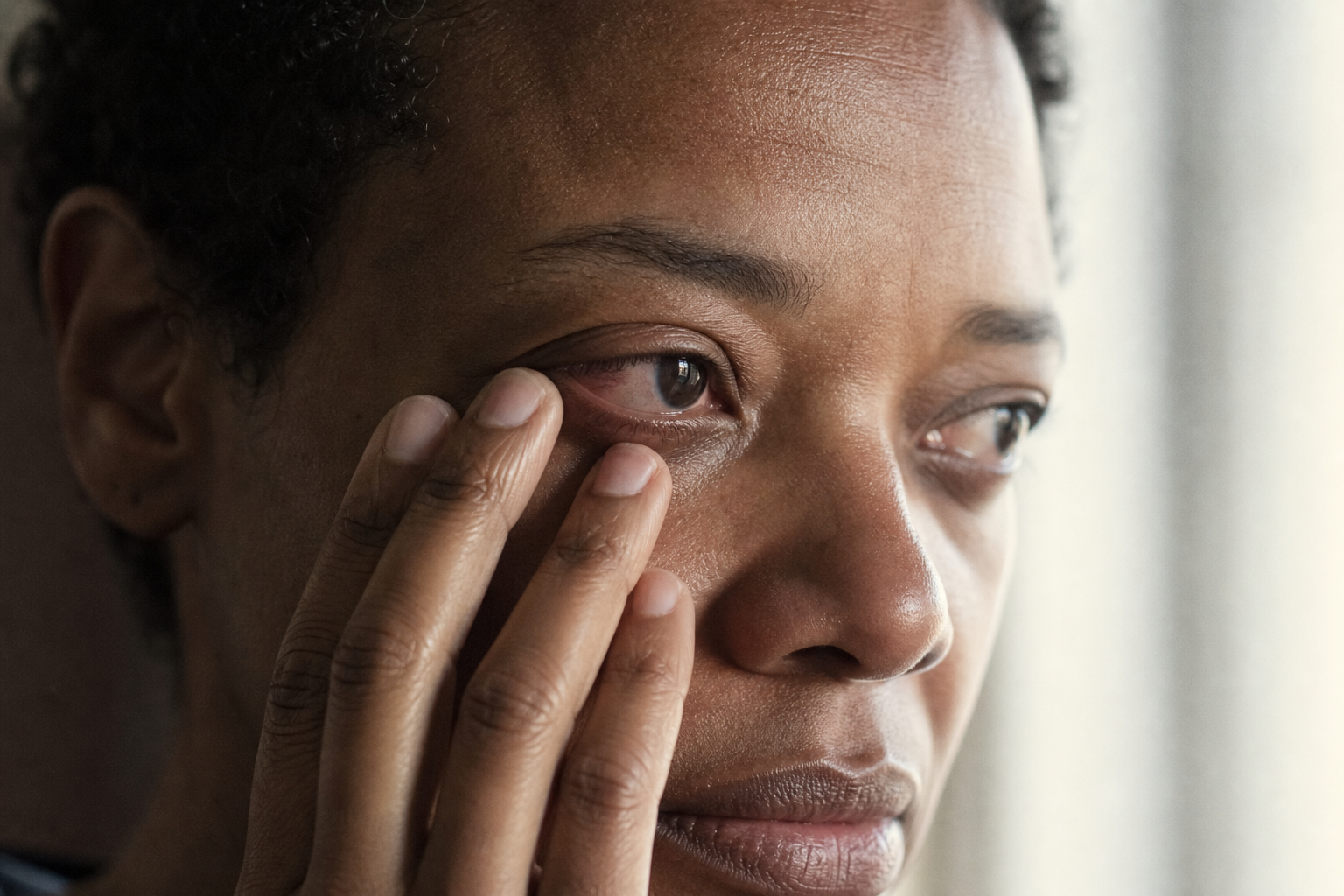
Your cheeks look almost normal this morning. Last month's flare has faded, the flush has settled, and a photo would call your rosacea quiet. Your eyes didn't get the memo. There's a gritty, sand-under-the-lid feeling near the lash line, and by afternoon it'll sting and bright light will feel like too much. Calm skin and unhappy eyes, same face, same day. That gap is the whole story, and it's the reason the usual rosacea advice quietly fails at the eyes.
The baseline that doesn't reset
The question people actually type is blunt: does ocular rosacea go away? The honest answer is that the symptoms come and go, but the damage underneath doesn't reset the way flushed skin does. Skin rosacea is largely a surface event, so between flares the visible signs recede and your baseline returns close to normal. Ocular rosacea runs on a different clock. The inflammation targets the meibomian glands (the tiny oil glands lining your eyelid margins that keep tears from evaporating too fast), and that damage stacks up whether or not you're mid-flare. Call it the baseline that doesn't reset. Every quiet stretch where your eyes still feel off is a stretch where the structural part can keep moving.
Meibomian gland dropout doesn't grow back
Meibomian glands are the oil glands lining your eyelid margins that keep tears from evaporating too fast. When chronic inflammation makes them atrophy, imaging shows the loss is structural and doesn't reverse with current treatment. Symptoms can be managed. Lost glands don't regenerate, which is why timing matters.
Why 'manage it when it flares' breaks at the eyes
Skin rosacea trains everyone, patients and plenty of clinicians, into flare logic. Something sets off a flare, you calm it down, you wait for the next one, and in between you get to forget about it. That model works reasonably well for cheeks. Point it at the eyes and it breaks, because the meibomian glands keep dropping out during the calm periods, silently, with no flush to announce it. So the between-flare weeks feel like nothing is wrong right when the slow structural loss is doing its work. Manage-it-when-it-flares isn't lazy advice. It's the right advice for the wrong tissue.
The flare is the loud part. The damage is the quiet part.
What meibography actually shows
Meibography, an imaging technique that photographs the meibomian glands through the eyelid, is where this stops being theory. In chronic ocular rosacea it shows gland dropout: shortening, thinning, and outright loss of the glands. Mohamed-Noriega et al. 2025 (PMC) is the recent work mapping this structural damage in rosacea eyes, and it drew heavy citation almost immediately Cutaneous rosacea affects approximately 5.5% of the global population, with up to 72% of patients developing ocular involvement. ([source](https://www.researchgate.net/publication/388007356_Ocular_Rosacea_An_Updated_Review)). The tear-film science backs the mechanism: meibomian gland dysfunction is the leading driver of evaporative dry eye (TFOS DEWS II, 2017). And the clinical read matches. Ophthalmologists describe ocular rosacea as one of the most underdiagnosed forms of dry eye they see, in part because the eye symptoms don't line up with how bad the skin looks. The load-bearing fact is simple: once those glands atrophy, they don't grow back.
Between flares
Skin rosacea
Ocular rosacea
What you see or feel
Flushing and papules recede; skin looks near-normal
Grittiness, stinging, and light sensitivity often persist
What's happening underneath
Inflammation quiets; the visible signs are reversible
Meibomian glands can keep atrophying (dropout)
Does the baseline reset?
Largely yes, between flares
No; gland loss accumulates
What a flare-only log captures
Most of the meaningful signal
Misses the between-flare progression
Qualitative comparison. Meibomian gland dropout is documented on meibography (Mohamed-Noriega et al. 2025); MGD as the driver of evaporative dry eye is TFOS DEWS II, 2017.
The flare-day log that hides the trend
Picture the log that only fills in on flare days. Cheeks flare in March, you note the eye grittiness that came with it. Quiet April, quiet May, nothing recorded. July flare, another eye entry. Six months later the record shows two bad eye days and looks basically stable. Meanwhile the daily low-grade grittiness through April, May, and June, the part that never made it into a flare-day entry, was the actual signal. At the specialist visit, meibography shows real dropout. The person is surprised, because their notes said the eyes were fine. Their notes were just built to miss it. A between-flares symptom that shows up most days is exactly the pattern a flare-triggered log is designed not to see.
Reactive when it hurts, or preventive before it drops out
If the damage accrues between flares, then the flare snapshots are close to the least useful data you can bring a clinician. The valuable thing is the continuous baseline: how often, most days, do the eyes burn, sting, feel gritty, catch on bright light. Plotted over months, that low-grade series is what tells an eye doctor whether your meibomian involvement is holding steady or creeping upward. And that single distinction, stable versus progressing, is often what moves the plan from reactive warm-compress-when-it-hurts to earlier, preventive management. This matters more, not less, for people with deeper skin tones, where facial redness is harder to read and the sensory phenotype (what the eyes feel, rather than how the face looks) may be the only early flag anyone gets.
Why we log eyes every day, not just flare days
This is the reasoning behind logging eyes every day in Skinframe, not only when the skin acts up. A quick daily note on grittiness, stinging, and light sensitivity builds the trend line a flare-day log can't. We don't diagnose anything and we don't run any skin-scanning gimmicks; the app's job is to hand your clinician a clean, dated record they'd otherwise have to reconstruct from memory. There's no rosacea-specific trial proving an app changes eye outcomes, and we won't pretend there is. What the adjacent evidence in dermatology shows, in conditions like atopic dermatitis and psoriasis, is that structured patient-reported tracking sharpens what happens in the visit, and here it all stays on your device. If your eyes have been off while your skin looks fine, that's worth raising with a dermatologist or an eye doctor, with a record in hand.
What we're watching next
We're following the meibography literature as the Mohamed-Noriega line of work gets replicated, and the slow spread of gland imaging beyond specialist clinics, because the cheapest version of this problem is that the tissue most likely to scar is the one almost nobody photographs early. When there's something specific to report, we'll write it up.
Log your eye symptoms every day, not just on flare days, and bring the trend line to your next appointment. Skinframe keeps the record on your phone.
No published rosacea-specific trial proves a tracking app changes ocular outcomes, and we say so plainly. What the adjacent dermatology evidence shows, in atopic dermatitis and psoriasis, is that structured patient-reported tracking improves what a clinician can see in the room. Skinframe applies that approach to rosacea, keeps every photo and log on your device, and never runs a skin-scan.