Niacinamide didn't cause your flare. Your log blamed the wrong molecule.
Niacinamide and niacin share a name and a vitamin family, not a flushing pathway. When your trigger log blames one, it usually caught the other.
The serum in the bin
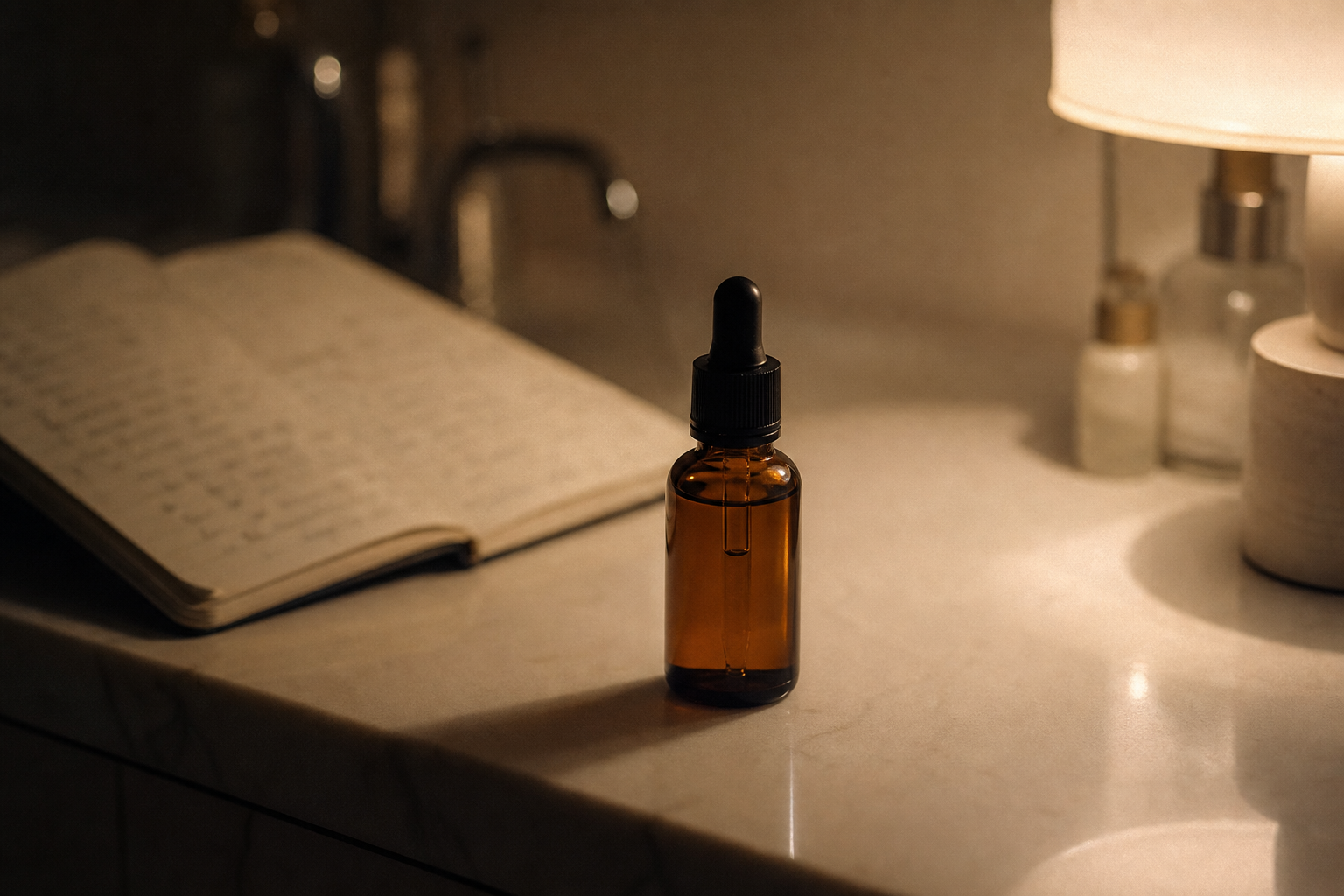
The niacinamide serum goes in the bathroom bin at 11pm, three days after a flare that left both cheeks hot and mottled for a full evening. The log entry is already written: niacinamide, avoid. Weeks of reading reviews went into buying that bottle. One bad night undid it, because the serum was the newest thing in the routine, and new things are guilty until proven innocent when your face is burning.
That entry will now sit in the log as fact. Every future decision, every elimination round, every appointment recap will treat niacinamide as a confirmed trigger. It probably wasn't. The reaction the reader is picturing belongs to a different molecule with an almost identical name.
One name, two molecules, two pathways
Call it the wrong-molecule confound. Niacinamide (nicotinamide) and niacin (nicotinic acid) are both forms of vitamin B3, which is exactly why the confusion survives. They read as interchangeable on a supplement shelf. In the body they do different things, and only one of them produces the sudden, prickling facial flush that rosacea patients have learned to dread.
Niacin is the flusher. Nicotinamide, the ingredient in the serum, is not. The flush is not a B3 reaction in general. It is a specific receptor event that nicotinamide does not set off at the concentrations used in skincare. When a rosacea patient says niacinamide flushed them, the mechanism they are describing is real, well documented, and pointed at the wrong bottle.
Why 'niacinamide broke me out' keeps spreading
The narrative is durable because the mechanism sounds plausible. Niacin flushing is real and dramatic, anyone who has taken a high-dose B3 supplement remembers it, and the two ingredient names are one syllable apart. A rosacea patient reads that B3 causes flushing, sees niacinamide on their serum, and connects a dot that was never there.
Community threads then reinforce it. Search r/Rosacea or r/SkincareAddiction for niacinamide and the flush stories stack up, each one plausible, almost none of them separating nicotinamide from nicotinic acid. Nobody explains the structural distinction, so the confusion propagates as folk knowledge. The result is a broadly tolerated topical ingredient carrying a reputation it inherited from its cholesterol-supplement cousin.
What the receptor pharmacology actually shows
The niacin flush has a mapped pathway. Nicotinic acid binds a receptor called GPR109A (also written HCA2), which sits on immune cells in the skin. Activating it triggers the release of prostaglandins, chiefly prostaglandin D2, signaling molecules that dilate blood vessels and produce the warm, red, tingling flush. Benyo et al. 2005 (Journal of Clinical Investigation) demonstrated that GPR109A is the receptor responsible, and that blocking prostaglandin production with aspirin blunts the flush, confirming the mechanism.
Nicotinamide does not meaningfully activate GPR109A. Same vitamin family, no receptor agonism, no prostaglandin cascade of the kind niacin sets off. That is the structural fork the community discourse skips. The flush a rosacea patient fears is a receptor their niacinamide serum does not reach.
Property
Niacin (nicotinic acid)
Niacinamide (nicotinamide)
Vitamin B3 form
Yes
Yes
Activates GPR109A receptor
Yes
No (not at cosmetic use)
Prostaglandin-mediated flush
Yes, well documented
Not a recognized effect
Typical use
Oral cholesterol supplement
Topical skincare ingredient
Receptor and pathway distinction per Benyo et al. 2005 (J Clin Invest). The two B3 forms diverge at GPR109A.
The flush a rosacea patient fears is a receptor their niacinamide serum does not reach.
How the false positive gets baked in
Follow the flare that started this. The cheeks flushed on a Tuesday evening. The niacinamide serum was applied that morning, yes, but so was a hot shower before work, an afternoon walk in August heat, and a glass of red wine at dinner, each a documented rosacea trigger with far more supporting evidence than nicotinamide. Recall compresses all of that. By the time the log gets written, the newest and most suspicious variable wins, and the four other candidates fade.
Now the log carries a false positive. The next round of elimination drops niacinamide, the flares continue because the real driver was heat or alcohol or something else entirely, and the reader concludes their rosacea is unpredictable. It isn't unpredictable. The baseline was corrupted at the first entry, and every comparison built on top of it inherits the error.
A corrupted baseline compounds
A single misattributed entry is not a small error. Trigger mapping works by comparison across time, so a false positive at entry one skews every downstream elimination round. The cost is not one wrong bottle. It is a log you can no longer trust.
What changes if the confound is real
If the wrong-molecule confound is common, then a meaningful share of rosacea trigger logs contain at least one entry that captured the confound, not the cause. That reframes the whole exercise. The value of a trigger log was never the list of suspected ingredients. It was the fidelity of the timeline underneath, the thing that lets you separate what co-occurred from what actually preceded the flare.
Memory does not preserve that timeline. It edits it, and it edits in favor of whatever felt guiltiest. A log built from evening recall is a log built from the same cognitive bias that put niacinamide in the bin. The fix is not more suspicion of ingredients. It is a record made at the moment of application, before recall has a chance to rewrite the order of events.
Timestamps beat memory
This is the case for logging the application, not reconstructing it. When each ingredient goes into the record with its own timestamp, and each flare gets logged with its onset window, the pairing is mechanical instead of emotional. You can see whether the niacinamide serum actually fell inside the flare window or whether it was simply the newest name in a routine that also included a hot shower and a walk in the heat.
We built Skinframe around that discipline. A per-application ingredient log paired with photo-dated flare entries does not tell you what triggered you, and it should not. What it does is preserve the sequence your memory overwrites, so that when you and your dermatologist review the pattern, you are reading a record instead of a reconstruction. The wrong-molecule confound is a lot harder to bake in when the timeline is written down before the flare, not after.
The concentration question we're still watching
One honest gap remains. The claim that nicotinamide is inert at cosmetic use is well supported for the GPR109A flush pathway, but the dose-response question, whether any topical concentration reaches a threshold that matters for reactive skin, is thinner in the literature than the confident takes on either side of the debate suggest. Topical 0.25% 1-methylnicotinamide applied twice daily for 4 weeks alleviated rosacea in clinical trials. ([source](https://pmc.ncbi.nlm.nih.gov/articles/PMC8389214/)) We would rather flag that than overstate it.
If niacinamide genuinely irritates your skin, that is worth logging and worth raising. Just log it as what you observed, an irritation with a timestamp, not as a confirmed prostaglandin flush borrowed from a different molecule. If flares persist after any change, talk to your dermatologist. The point of a good log is to bring them a timeline they can trust, not a verdict written the night the serum went in the bin.
Skinframe is coming to iPhone. Join the waitlist and log your ingredients with timestamps, so the next flare gets paired against a record instead of a guess.
Skinframe is built by a small team that reads the dermatology literature before it writes UI. We don't run skin-scan diagnostics and we don't tell you what triggered you. We keep the record honest: per-application ingredient entries, photo-dated flares, and a timeline your memory can't quietly rewrite.