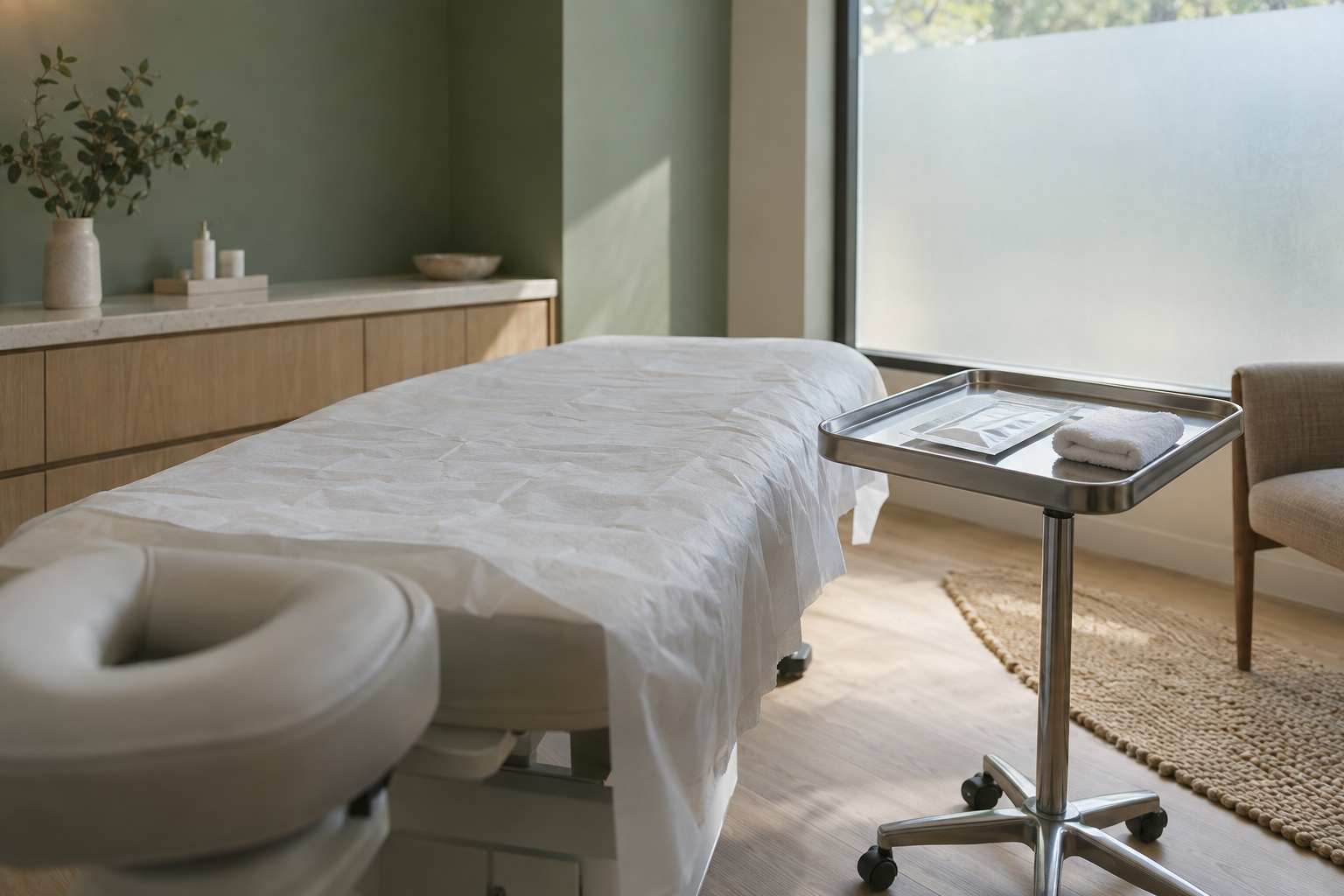
Microneedling runs on inflammation, which rosacea skin struggles to switch off.
The micro-injury that gives typical skin its 'glow' hits rosacea's weakest points: the barrier, innate immunity and heat-sensing nerves. Here's the evidence and the nuance.
The aftercare sheet says the redness will fade
Somewhere this week, a person with rosacea is reading a med-spa aftercare sheet that tells them the redness is normal and will pass. For most faces, that's true. Microneedling drives a dense grid of tiny controlled punctures into the skin, the skin reads them as a wound, and the repair process is the whole point.
But nobody on that sheet asked about rosacea. The intake form might have had a checkbox for 'sensitive skin,' which isn't a diagnosis. And the at-home dermaroller ordered after a trending video didn't ask anything at all.
So when people type 'is microneedling safe for rosacea' into a search bar, they land in a pile of salon marketing and one-off forum stories. We think the question deserves a straighter answer than either.
The wound-response mismatch
Microneedling works by deliberate injury. The dermatology literature calls it percutaneous collagen induction: small punctures set off inflammation, then tissue remodeling, then new collagen. The inflammation step isn't a side effect. It's the engine.
Rosacea, at its core, is skin that over-responds to exactly that kind of signal. We call this the wound-response mismatch. The same controlled injury that ends in 'glow' on typical skin can end in a longer, hotter inflammatory cascade on rosacea skin, because the machinery that's supposed to calm the response down is already miscalibrated.
That's the thesis. And it's specific enough to test against what's actually known about rosacea biology.
Why 'is it OK for sensitive skin?' is the wrong question
Most advice online sorts faces into normal and sensitive, then tells the sensitive group to go gentle. That framing treats rosacea as a comfort level, something you manage with a lighter hand and a soothing serum afterward.
Dermatology moved past that years ago. The ROSCO panel (Tan et al., Br J Dermatol 2017) and the National Rosacea Society's 2017 update (Gallo et al., JAAD 2018) shifted to a phenotype model, meaning clinicians describe the specific features a person has (persistent redness, flushing, bumps, eye involvement) instead of sorting them into a subtype. Several of those features are vascular and nerve-driven. A lighter hand doesn't change the biology of a flush.
The 'downtime' framing causes the second problem. Salon aftercare treats redness as a cost you pay for results. For someone whose main feature is persistent centrofacial erythema (redness across the middle of the face), extra redness for an unknown stretch of days works directly against the thing they most want to reduce.
A procedure that runs on inflammation is being sold to people whose condition is inflammation.
What the literature actually says
Three well-studied features of rosacea skin line up against microneedling's mechanism.
The barrier first. Rosacea-affected skin tends to show impaired barrier function, including higher transepidermal water loss, which is water escaping through the skin's outer layer Clinical studies in rosacea patients have shown increased transepidermal water loss (TEWL), reduced skin hydration, and elevated skin surface pH (Dirschka's TEWL result itself is not shown in the snippet). ([source](https://jddonline.com/wp-content/themes/jdd-salient-child/download.php?pii=S1545961622SSF3595563X&download=1)). Microneedling breaches that barrier on purpose.
Then innate immunity. Yamasaki et al. (Nature Medicine 2007) found elevated cathelicidin, an antimicrobial peptide, and the enzyme KLK5 in rosacea skin, and showed that the cathelicidin fragments found in rosacea produced redness and blood-vessel changes when injected into mouse skin. Wound signaling runs through the same innate-immune system.
And the nerves. Heat- and pain-sensing TRP channels, including TRPV1, are expressed differently in rosacea skin Sulk et al. (J Invest Dermatol, Apr 2012) found dysregulated non-neuronal TRPV channel expression in rosacea; in phymatous rosacea, dermal TRPV3/TRPV4 staining and TRPV1/TRPV3 gene expression rose, while epidermal TRPV2 staining fell. ([source](https://www.sciencedirect.com/science/article/pii/S0022202X15356906)), which helps explain why heat, friction and spice set off flushing and burning. Radiofrequency (RF) microneedling adds heat to the injury.
Now the complication. A small set of clinical studies has tested fractional microneedle radiofrequency on rosacea and reported reduced redness in some patients Park et al. 2016 found fractional microneedling radiofrequency produced modest clinical and histologic improvement of rosacea; clinical improvement occurred in 17 (81%) of patients on the treated side. ([source](https://mdedge.com/edermatologynews/article/119691/rosacea/rosacea-improved-fractional-microneedling-radiofrequency)). Those were dermatologist-run protocols on selected patients, with controlled depth and energy, and they were small. They don't validate an at-home roller or a spa 'glow' session. They also can't tell any one reader how their own phenotype will respond.
Variable
Lower-risk end
Higher-risk end
Why it matters for rosacea
Needle depth
Superficial
Deep dermal
Deeper channels mean a bigger wound signal to an already over-active immune response
Heat
No energy added
Radiofrequency delivered through the needles
Heat is a classic flush trigger via heat-sensing nerve channels
Who performs it
Dermatologist, rosacea under active treatment
Salon or at-home roller, no rosacea screening
Only a clinician can judge phenotype, disease activity and stop criteria
Disease state
Stable, controlled
Active flare, bumps or eye symptoms
Wounding inflamed skin stacks one inflammatory response on another
Aftercare
Bland barrier repair, sun protection
Acids, retinoids, heat, hot yoga
Irritants reach deeper through fresh channels in an already leaky barrier
Qualitative, derived from the mechanism literature above. Not a safety rating; discuss any procedure with your dermatologist.
How a procedure flare disappears from the record
Here's a composite case, not a real patient. Someone with persistent redness and flushing has been stable for months on a prescription topical. They book a microneedling session before a wedding. The skin is red that evening, which the aftercare sheet predicted. It's still red on day three.
By the end of the first week, flushing is easier to set off: a hot shower, a coffee, a warm room. By the second week a few bumps appear along the cheeks. None of it gets written down as connected, because the procedure was a one-off and the flushing looks like every other flare.
So at the dermatology follow-up weeks later, the story has compressed into "I've been flaring more lately." The dermatologist sees a flare with no clear trigger. They may reasonably consider changing a treatment that had actually been working.
On darker skin (Fitzpatrick types IV to VI), the visible part is harder to read, since redness shows less in the mirror and on camera. Burning, stinging and heat are often the more reliable signal, which is why the sensory phenotype matters. Darker skin also tends to be more prone to post-inflammatory hyperpigmentation after any procedure that irritates it, and that discoloration can outlast the flare.
Procedures are baseline events, so log them like one
If the mismatch is real, the practical move is less about banning a procedure and more about making its consequences visible. A cosmetic or dermatologic procedure belongs in the same category as changing your birth control or getting COVID: a dated event that shifts the baseline, after which the next few weeks have to be read in context. We cover the first of those in "Birth Control and Rosacea: The Baseline You Forgot to Log" (https://skinframe.app/articles/hormonal-contraceptives-rosacea-baseline-reset).
Before booking, the useful questions are narrow ones. Is the person doing it a dermatologist, or supervised by one? Does the device add radiofrequency heat? How deep will the needles go? Should the session wait until your rosacea is quiet? What would make you stop after one session?
Our view is plain. For most people with rosacea, a trend-driven session at a spa or with an at-home roller is a poor bet: the upside is cosmetic and uncertain, and the downside lands on the exact pathways that drive the condition. Dermatologist-run protocols are a separate conversation, one to have with your dermatologist, with your own history in hand.
Before any needling
If you're mid-flare, have broken or bumpy skin, or have eye symptoms (burning, grittiness, redness of the lids), talk to your dermatologist before any microneedling or energy-based procedure. This article is not medical advice and can't assess your skin.
Where Skinframe fits
We built Skinframe so the weeks after an event like this don't blur together. You log a dated baseline event, take consistent photos, and score each feature on its own (redness, flushing, bumps, burning) instead of collapsing everything into one number. When a flare follows something that changed your skin, the timeline shows it.
Skinframe won't tell you whether microneedling is right for you. That call belongs to you and your dermatologist. What it can do is make sure that, if you try it, the result becomes evidence your dermatologist can read, not a vague memory of "flaring more lately."
Talk to your dermatologist before booking, and bring the log to the appointment after.
Put your next procedure on the timeline. Start your rosacea log with Skinframe.
Skinframe is built around the phenotype model dermatology adopted in 2017 (ROSCO; NRS update), so it scores redness, flushing, bumps and burning separately and puts dated events like procedures, medication changes and illness on the same timeline. It doesn't diagnose or recommend treatments. It gives you and your dermatologist the sequence of what happened. Evidence from adjacent conditions (atopic dermatitis, psoriasis) shows patient-reported tracking improves visit outcomes, and Skinframe applies the same approach to rosacea.