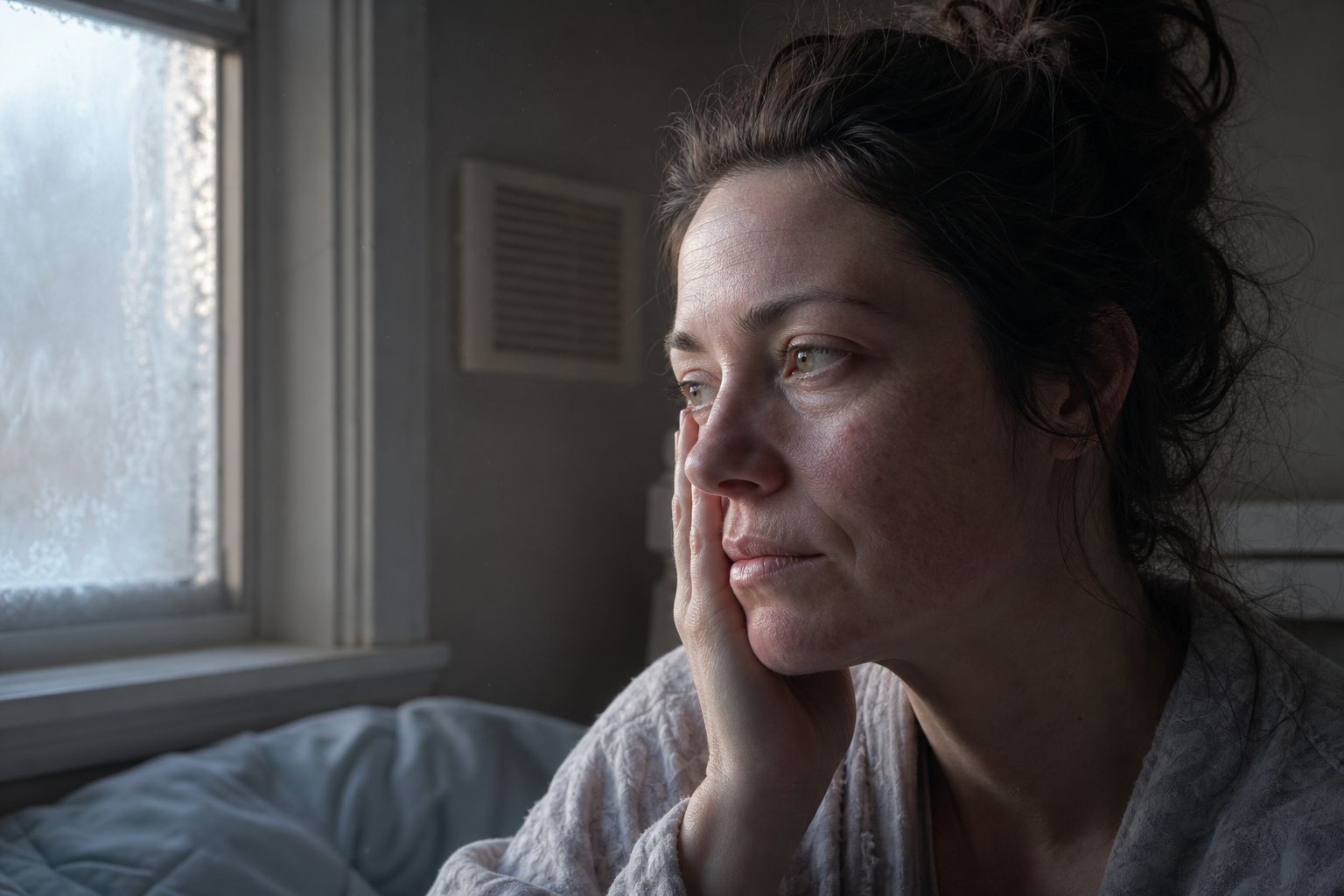
The rosacea trigger that resets every winter is the air in your house.
Forced-air heating drops indoor humidity below 30% for months, and it damages the rosacea barrier through water loss, not flushing. Most diaries never log it.
The February flare your food diary can't explain
It's the second week of February, the cheeks are tight and hot again, and the food diary is useless. You went back through it twice. Nothing new on the plate. The wine was the same wine you drank all summer without a problem. The moisturizer is the one that's worked for two years. So the blame lands where blame always lands during a flare: the new serum, the holiday sugar, the one stressful week at work. Here's what didn't make the diary. The furnace has been running since November, and the air in the bedroom has been sitting under 30% relative humidity for eleven weeks straight. That's the variable. It's not on your plate, and it's not something you did. It's the room.
The humidity floor: a trigger that's on all winter
Call it the humidity floor: the ambient moisture level of the air your skin sits in all day, which forced-air heating quietly drags down and holds down for the entire heating season. Outdoor winter air is already dry. Run it through a furnace and heat it, and the relative humidity of that air drops further, often into the 10 to 30% range indoors while it can sit comfortably above 40% in summer (In winter with forced-air heating, target indoor RH is 30–40%; in summer, 50–60% is typical. ([source](https://saveonenergy.ca/en/For-Your-Home/Advice-and-Tips/Home-humidity-levels))). Rosacea skin feels that drop through a different door than it feels heat. Heat triggers work through blood vessels and the flushing nerve pathway, the mechanism we covered in our earlier piece on temperature and thermoregulation. Low humidity doesn't touch the vasculature first. It pulls water straight out of the skin barrier, and rosacea barriers are the ones least equipped to hold it.
Why diaries miss the air you're breathing
Standard trigger diaries are built to catch events. You log the glass of red, the hot shower, the spicy meal, the afternoon in the sun. Every prompt in a typical rosacea diary assumes the trigger is a thing that happens, then stops. Low indoor humidity breaks that assumption completely. There's no event to log because nothing happens: the air is just dry, all day, every day, for months. A variable that never spikes and never resolves has no obvious slot in a diary that only knows how to record spikes. So it stays invisible. And because it's invisible, it gets misattributed. The flare is real, the diary needs a cause, and the only causes it can see are the foods and products used during the same eleven weeks. The furnace never enters the frame.
What low humidity does to a rosacea barrier
The mechanism is transepidermal water loss, usually shortened to TEWL: the water that evaporates out through the skin barrier into the air around it. The drier the air, the steeper the gradient, and the more water the barrier loses. In healthy skin that's manageable. In rosacea skin it isn't, because the barrier runs leakier at baseline. Studies of rosacea skin document elevated TEWL and reduced stratum corneum hydration even between flares (Dirschka (2004) measured TEWL in rosacea patients across three facial regions and found TEWL was significantly increased. ([source](https://onlinelibrary.wiley.com/doi/abs/10.1111/j.1365-2133.2004.05985.x))). A barrier that's already losing more water than it should, dropped into air that's pulling harder than usual, tips into the symptoms rosacea patients describe every winter: tightness, stinging, the burn when a product that was fine in August suddenly isn't. Notice those are sensory symptoms first. On deeper skin tones, where visible redness (erythema) is harder to read, the sting and the tightness may be the only signal the barrier is under load (In richly pigmented Fitzpatrick type VI skin, the erythema of rosacea can be masked, contributing to underdiagnosis. ([source](https://www.aerolase.com/blogs/clues-rosacea-patients-skin-color))).
Heat / flushing trigger
Low-humidity trigger
Primary mechanism
Blood vessels and the flushing nerve pathway (vascular)
Water loss through the barrier (TEWL)
Timing
Episodic: spikes, then resolves
Ambient: constant for months
What it feels like
Warmth, visible flushing
Tightness, stinging, dryness
Shows up in a standard diary?
Yes, as a logged event
No, there's no event to log
What actually helps
Cooling, avoiding the spike
Raising indoor RH, barrier repair
Two trigger classes rosacea diaries tend to collapse into one 'winter' bucket.
The misattribution trap
A winter flare with no logged event still needs a cause, so it gets pinned on the foods and products used that season. Getting the cause wrong sends the fix wrong: elimination diets and product swaps won't fix a barrier that's dehydrated by the air.
How the compounding actually plays out
Take the same trigger and watch it behave differently across two seasons. July: a glass of red wine on a 45% humidity evening. Your barrier is holding water fine, so the wine's vascular hit flushes you for twenty minutes and fades. You log wine, mild. January: same glass, same you, but the bedroom has been at 22% humidity for a month and the barrier is already depleted. Now the wine lands on skin that was stinging before you poured it. The flush is worse, it lasts longer, and the next morning the tightness hasn't reset. You log wine, severe, and you conclude your wine tolerance changed. It didn't. The wine did exactly what it did in July. What changed was the baseline it landed on. Low humidity rarely acts alone. It lowers the floor every other trigger falls onto.
If the baseline moves, the log has to move with it
When the baseline shifts with the season, a diary that only tracks events is measuring flares against a ruler that keeps shrinking. The same food, the same product, the same weather reads as more severe in a dry month for reasons that have nothing to do with the food, the product, or the weather. That's not a small correction. It means a whole class of winter flares that get pinned on diet or a new purchase are actually barrier events, and barrier events respond to barrier interventions (an occlusive moisturizer, raising indoor RH) rather than to the elimination diets people reach for first. Get the cause wrong and the fix points in the wrong direction for months, which in a heating season is most of the year the skin is struggling.
Logging the number, not just the flare
This is why we treat indoor humidity as a daily loggable number in Skinframe, not a footnote. Relative humidity is one of the few triggers you can actually measure. A cheap hygrometer or a smart-home sensor gives you a real RH% reading, and logging that number next to a dated photo turns an invisible ambient variable into a line you can see. Over a winter, that line does something a food column can't: it shows the flares clustering under a threshold rather than after a meal. We built the log to hold the constants, not only the spikes, because the constants are where the winter answers have been hiding.
What we're still working out
Where the personal threshold sits. The barrier literature points at roughly 30% RH as an inflection point (Even a 30% difference in relative humidity can affect skin properties within just 30 minutes, impacting skin conductance, elasticity, and fine lines. ([source](https://www.ovid.com/journals/jeadv/fulltext/10.1111/jdv.13707~ambient-humidity-and-the-skin-the-impact-of-air-humidity-in))), but rosacea skin varies, and the honest answer is that your own logged data will find your number faster than any published average. If your skin is flaring through a dry winter and the diary keeps blaming your plate, the air is worth measuring. Bring the readings, and the photos, to your dermatologist.
Log your indoor humidity next to your skin this winter, and watch where the flares actually cluster.
We build for people a dermatologist has told to document patterns before treatment, and the pattern that resets every winter is exactly the one standard diaries were never built to catch. Skinframe logs the ambient constants (indoor RH, barrier symptoms) next to dated photos, so the winter cause stops hiding behind the food column.