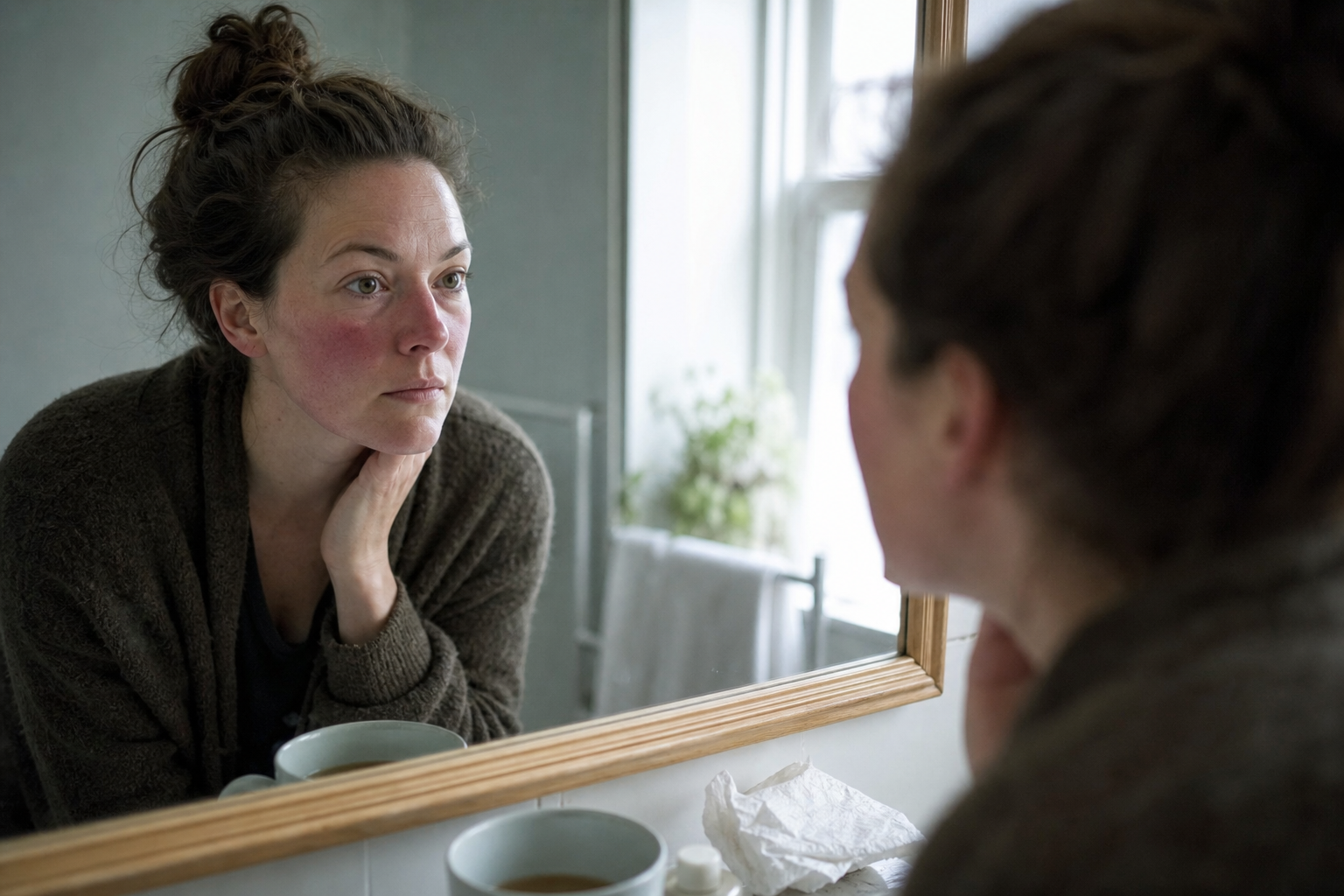
Immune events trigger rosacea, and most logs have nowhere to put them.
A 34% post-COVID flare rate and a 2025 patient brief say infection and vaccination belong in your rosacea log. Almost none have the field.
The month her skin flared, nothing in the log had changed
Two weeks after the fever finally broke, the flushing came back worse than it had looked in a year. The cheeks, the nose, a burning that hadn't shown up since the last bad summer. So she did the responsible thing, the thing her dermatologist had asked for: she opened her tracking app to log it. Red wine, there was a field for that. Sun exposure, spicy food, stress, a slider for each. She scrolled. Nowhere to write down the only thing that had actually changed that month, which was that her body had just spent ten days fighting off a virus.
The immune-event blind spot
We call this the immune-event blind spot, and it runs through the way most rosacea logs are built. Trigger tracking, as it exists today, is built around things you consume or encounter: what you ate, what touched your skin, what the weather did. It has no category for what your immune system does. And a major immune event, an infection, a vaccination, a systemic inflammatory episode, is exactly the kind of thing rosacea appears to respond to.
The standard trigger list is a food-and-weather document
The standard trigger list is a food-and-weather document. The National Rosacea Society's long-running survey work gave us the canonical categories, sun, heat, stress, alcohol, spicy food, and those are real. But the framing carries a hidden assumption: that a trigger is something external you can avoid. That assumption quietly writes off an entire class of triggers that come from inside. Your immune system mounting a response to a virus is not something you ate. It doesn't fit the avoidance model, so the log leaves it out, and the pattern stays invisible.
Trigger class
Typical examples
In standard trigger lists?
Dietary
Hot drinks, alcohol, spicy food
Yes
Environmental
Sun, heat, wind, cold
Yes
Emotional
Stress, embarrassment
Yes
Topical / skincare
Harsh actives, fragrance
Yes
Hormonal shifts
Cycle, menopause
Sometimes
Immune events
Infection, vaccination
No
Trigger categories drawn from National Rosacea Society survey work; the last row is the class most logs omit.
What the data says, and why the mechanism isn't a mystery
For years, the immune-event link was arguable. COVID ended the argument. A study indexed as PMC10581019 found that 34.25% of rosacea patients reported exacerbation following COVID infection, roughly one in three. The pattern of post-infection and post-vaccination flares has since moved from scattered anecdote to recognized clinical territory, with patient advocacy groups including the National Rosacea Society addressing it directly. The mechanism isn't mysterious. Rosacea sits on a dysregulated innate immune response: elevated cathelicidin (LL-37, an antimicrobial peptide that turns inflammatory in rosacea skin) and the enzyme kallikrein-5 that activates it (LL-37 is among the most common cathelicidins found in rosacea, as established by Yamasaki et al., 2007. ([source](https://www.sciencedirect.com/science/article/pii/S0022202X15526870))). Known triggers like UV and heat work partly by revving that same cascade. A systemic immune event revs it from the other direction. Same fire, different match.
What cathelicidin is, in plain terms
Cathelicidin (LL-37) is a defense protein your skin makes to fight microbes. In rosacea skin it gets over-produced and mis-processed, so instead of just defending, it drives redness and inflammation. That's the pathway triggers push on. An infection or vaccine pushes on it too, from the immune system's side.
The pattern, walked through
Picture a log that already has the field. A patient we'll imagine, call her a composite of the r/Rosacea threads, gets COVID in early March. She logs it, not as a symptom, but as a baseline event, one timestamp: infection onset, March 3. Nothing flares for a week. Then around day ten the burning starts and her cheeks light up. In a food-and-weather log, that flare floats free, and she blames the espresso she had that morning. In a log with an immune-event field, the flare has a candidate ten days upstream, sitting on the same timeline as her hormone cycle and the topical she started in February. The espresso stops looking guilty. The infection comes into view.
What changes if immune events are a trigger class
If immune events are a trigger class, a few things change. Triggers stop being only about restriction. You can't avoid getting sick, and you shouldn't skip a vaccine to spare your skin, so the value isn't in dodging the trigger, it's in reading the timeline correctly afterward. It also means immune events belong where medication starts and hormone shifts already live: as timestamped baseline events, not daily symptom checkboxes. An infection is a single dated moment with a long tail, and it needs to be logged like one. Treat it as a symptom and you'll miss it. Treat it as an anchor and the flares around it start to make sense.
You can't avoid getting sick, and you shouldn't skip a vaccine to spare your skin. The value is in reading the timeline afterward.
Where the field lives in Skinframe
We built the immune-event field for exactly this gap. Skinframe keeps a separate layer for baseline events, medication starts, hormonal changes, and now immune events like an infection or a vaccine dose, each a single timestamp that anchors the daily flare log around it. When you look back at a bad stretch, those anchors sit on the same timeline as your photos, so a flare that trails an infection by a week reads as a pattern instead of a coincidence. We didn't invent the trigger. The literature did. We just gave it somewhere to live in your log. If a flare has you tracing it back to an illness or a shot, that's a conversation for your dermatologist, and a documented timeline is the thing that makes that conversation useful.
What we're tracking next
We're watching two things. Whether the next NRS or ROSCO consensus update folds immune events into the formal trigger taxonomy, and whether the post-COVID exacerbation figure holds up as more cohorts report (28.8% of rosacea patients experienced exacerbation after COVID-19 infection and 15.4% after vaccination, per a 2025 cohort study (PMC12427583). ([source](https://pmc.ncbi.nlm.nih.gov/articles/PMC12427583/))). Until the taxonomy catches up, the log can move first. The field is cheap to add. The pattern it captures is not.
See how Skinframe logs an infection or a vaccine as a baseline event, so the flares that follow it finally have somewhere to point.
No published trial has tested a tracking app against rosacea specifically. What the literature does show, in adjacent conditions like atopic dermatitis and psoriasis, is that patient-kept records improve what happens in the exam room. Skinframe applies that same documented approach to rosacea, and adds the one field the post-COVID data says was missing.