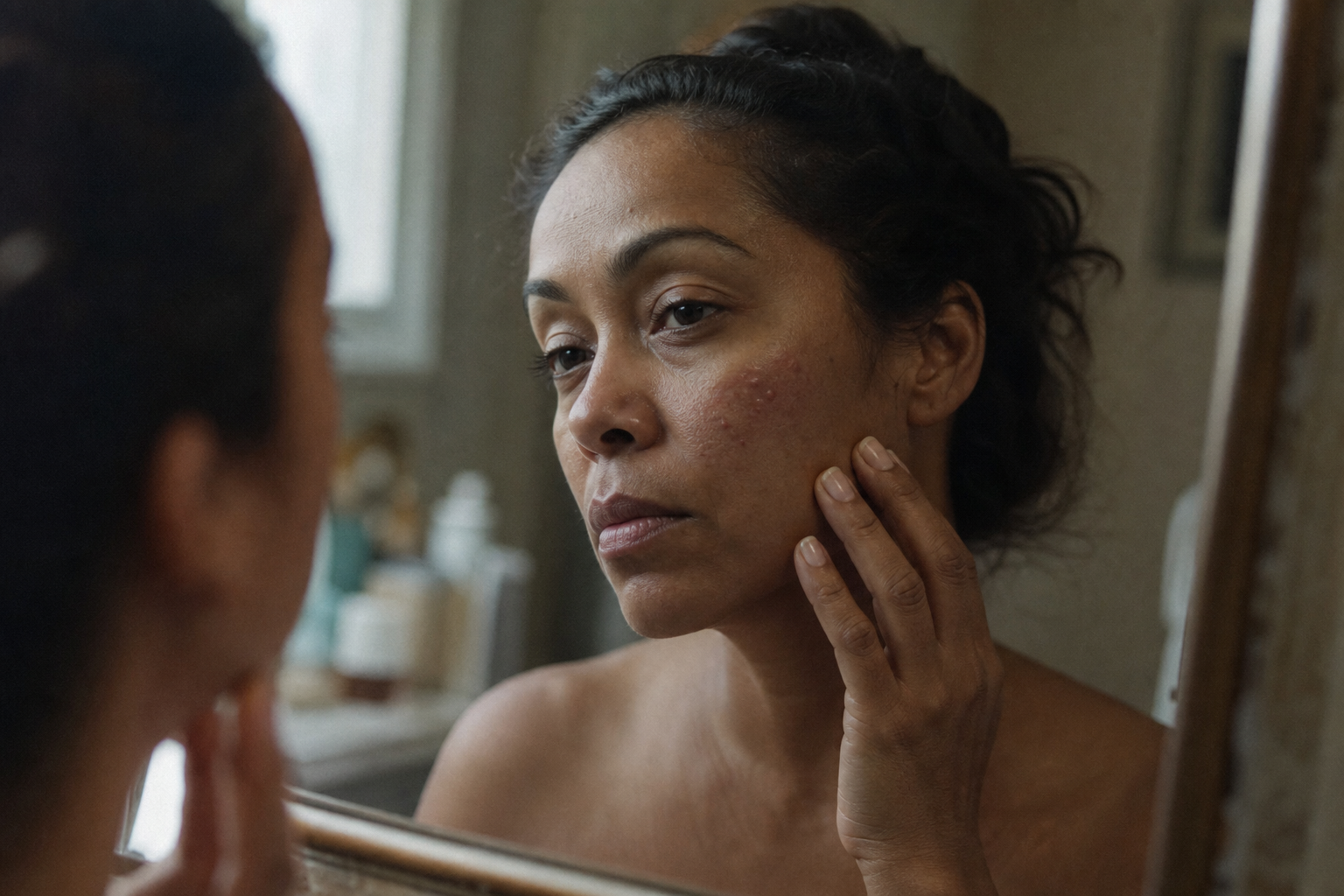
Your rosacea trigger list can't measure what already lives on your face.
Standard rosacea management assumes a flare is a response to something you did. Demodex density is a biological variable already resident on the skin, and no avoidance protocol lowers it.
Six weeks of clean logs and the papules came back anyway
Six weeks of clean logs. No wine, no hot showers, sunscreen every morning, the handout list followed exactly. Then the papules come back on a mild indoor Tuesday with nothing on the log to blame.
Some version of this shows up in r/Rosacea most weeks, usually written as a confession. One thread put it plainly: "I feel like I was going about treatment all wrong." The person hadn't been sloppy. They'd been rigorous, and the rigor produced a spreadsheet full of non-events.
Most people read that as a discipline failure, or as proof the diary was pointless, and throw it away. A trigger diary that comes back empty after six honest weeks has produced a real finding. It's just a finding about the model, not about the week.
The resident variable
Rosacea management, as most patients receive it, runs on one assumption: a flare is a response to something that happened. Heat happened. Wine happened. A deadline happened. Remove the input, reduce the output. It's a reasonable model and it works well for a lot of people.
Demodex folliculorum sits outside it. Demodex is a microscopic mite that lives in human facial follicles, concentrated around the nose, cheeks and eyelids. Nearly every adult carries some. What varies person to person is density, how many mites per square centimeter of skin, and density isn't an event. There's no Tuesday when it happened.
Call it the resident variable: a driver that's already on your face when you wake up, that doesn't spike with the weather, and that avoidance can't reduce. A trigger list measures exposures well. Density sits outside what a list of exposures can measure at all.
The trigger list is an artifact of how it was collected
The canonical rosacea trigger list came from asking patients what they'd noticed. The National Rosacea Society's patient survey produced the ranking most dermatology handouts still print: sun exposure first, emotional stress close behind, then hot weather, alcohol, hot baths, spicy food, down through the tail. Real data, collected honestly. Also a very particular kind of data, because a survey of what people noticed can only return things that are noticeable.
Nobody notices mite density. It has no smell, no moment, no timestamp.
That inheritance runs through the whole category. Nearly every rosacea tracking app in the App Store ships the same environmental checklist: heat, alcohol, sun, stress, spicy food, skincare products. Each one is a faithful copy of the survey, and each one is blind in the same place the survey was blind. It's a category-wide modeling assumption, not any single company's oversight.
81%
of rosacea patients named sun exposure as a flare triggerNational Rosacea Society patient survey
79%
named emotional stressNational Rosacea Society patient survey
What the density literature actually supports
The Demodex research has sharpened in the last two years. A 2025 cross-sectional study by Gitifard and colleagues (PMC12780819) examined mite density against symptom severity in rosacea patients: Demodex mite density was higher in rosacea patients than the normal benchmark of <5 mites/cm2. ([source](https://pmc.ncbi.nlm.nih.gov/articles/PMC12780819/)). A 2024 review by Wei and colleagues, published with Karger, pulled the evidence base together and landed on a careful conclusion: elevated Demodex density is consistently associated with rosacea, especially the papulopustular presentation (the one with bumps and pustules rather than flushing alone), and the direction of causation is not established.
That caveat is load-bearing. Elevated density might drive inflammation. Inflammation and altered sebum might make the follicle a more hospitable place to live. Both could be true at once, in the same face.
Measurement, meanwhile, has been possible for three decades. Forton and Seys (British Journal of Dermatology, 1993) established the standardized skin surface biopsy still used for this, and proposed a density above five mites per square centimeter as the abnormal threshold. That's a clinic procedure: a small adhesive sample read under a microscope, in an office, by a clinician. It is not a field a patient can fill in at home.
Association, not causation
The 2024 Wei review frames elevated Demodex density as associated with rosacea, not proven to cause it. Nothing on this page says mites cause rosacea, and nothing here is treatment guidance. Density is a measurement a dermatologist orders, performs and interprets.
Reading a log that found nothing
Picture the log that comes back clean. Twelve flare days across six weeks. Two line up with a hot yoga class. The other ten have no proximate exposure at all: an office day, a normal night's sleep, a mild forecast, nothing on the checklist ticked. Three of the twelve start with burning or stinging before anything is visible in the mirror. The lesions are papules and pustules, they cluster across the cheeks and nose, and they've held roughly steady through a full course of the first thing the dermatologist prescribed.
Read as a trigger hunt, that's six wasted weeks. Read as a document, it's precise: exposure-linked flares account for 2 of 12. Ten occurred with no proximate exposure. Sensation preceded visible change three times. Lesion type is papulopustular and persistent.
A patient who walks in saying "it's still flaring" gets a different fifteen minutes than a patient who walks in with ten dated, photographed, exposure-free flare days. The second version narrows the field. It doesn't answer the question, and it isn't supposed to.
Variable
A trigger diary records it?
How it's actually measured
Heat, hot drinks, hot baths
Yes, same-day self-report
Patient recall
Alcohol
Yes, same-day self-report
Patient recall
Sun and UV exposure
Yes, self-report or forecast-derived
Patient recall, weather data
Emotional stress
Yes, self-rated scale
Patient recall
Demodex folliculorum density
No
Standardized skin surface biopsy, read under a microscope in clinic
Density is a clinic measurement, not a diary field. Forton and Seys (Br J Dermatol, 1993) established the standardized skin surface biopsy method still used for it.
If the driver is resident, the log's job changes
Shift the assumption and the purpose of tracking moves with it. Under a pure exposure model, the goal is to catch the culprit and remove it, so a log with no correlations is a dead end and a wasted month. Under a model that leaves room for resident biological load, that same log is evidence, because it rules out the environmental explanation with dates attached.
That changes what's worth recording. Sensory events become primary data rather than margin notes, since burning or stinging with no proximate trigger event is one of the patterns clinicians can act on. Lesion type gets tracked apart from redness, because persistent papules and reactive flushing are different signals with different implications. Ocular symptoms get their own line, since grittiness and lid irritation travel with this territory and get dropped from most skin-only logs. Photographs get taken at consistent distance and lighting, because "is this the same lesion or a new one" is only answerable with comparable images.
None of that diagnoses anything. What it does is move a patient from recollection to record, which is the only part of the appointment they control.
Why we track features separately
Skinframe logs each rosacea feature on its own line instead of collapsing them into one severity number: papules and pustules, flushing, telangiectasia (the visible surface vessels), burning, stinging, ocular symptoms. That decision came out of this exact problem. A composite score of 6 out of 10 can't tell you the papules held steady while the flushing dropped, and in a treatment-resistant case that difference is the entire signal.
The environmental checklist is still in there, because exposures are real and worth capturing. What sits beside it is the null view: how many flare days carried no logged exposure, and how many opened with sensation instead of visible change.
We don't ship an automated face scan, and the literature is why. Adamson and Smith (JAMA Dermatology, 2018) argued that dermatology algorithms trained on largely light-skinned image sets would carry that gap into practice; Daneshjou and colleagues (2022) then measured degraded performance on darker skin tones in a curated, diverse clinical image set. For Fitzpatrick IV to VI skin, where erythema often reads dusky, warm or violaceous rather than pink, the sensory phenotype (what the skin feels like) carries documentation weight a camera-based redness score would flatten. Photos and entries stay on the device. Interpretation belongs to a clinician.
If your protocol is precise and your face is still flaring, bring the record and ask your dermatologist whether Demodex density is worth measuring in your case. That isn't a conversation an app can have for you. It's one a good log makes possible.
Log the flare days your trigger list can't explain. Skinframe records papules, flushing, burning and ocular symptoms as separate signals, with dated photos, on your iPhone. Bring the record to your next appointment.
Skinframe is built by a small team that reads the dermatology literature before it writes a feature: per-feature severity instead of a composite score, fixed-distance photo capture, ocular symptoms as first-class entries, everything stored on the device. We won't claim a tracking app changes rosacea outcomes, because no rosacea-specific trial has shown that. Evidence in adjacent dermatology conditions like atopic dermatitis and psoriasis shows patient-reported tracking improves what happens inside the visit, and that's the standard we build to.