The flare days you cover up are the ones your dermatologist needs to see.
Rosacea patients usually cover up on flare days, and those are the days a dermatologist needs to see. Here's what a corrected photo hides, feature by feature, and how to log around it.
The morning you'd most want a photo of
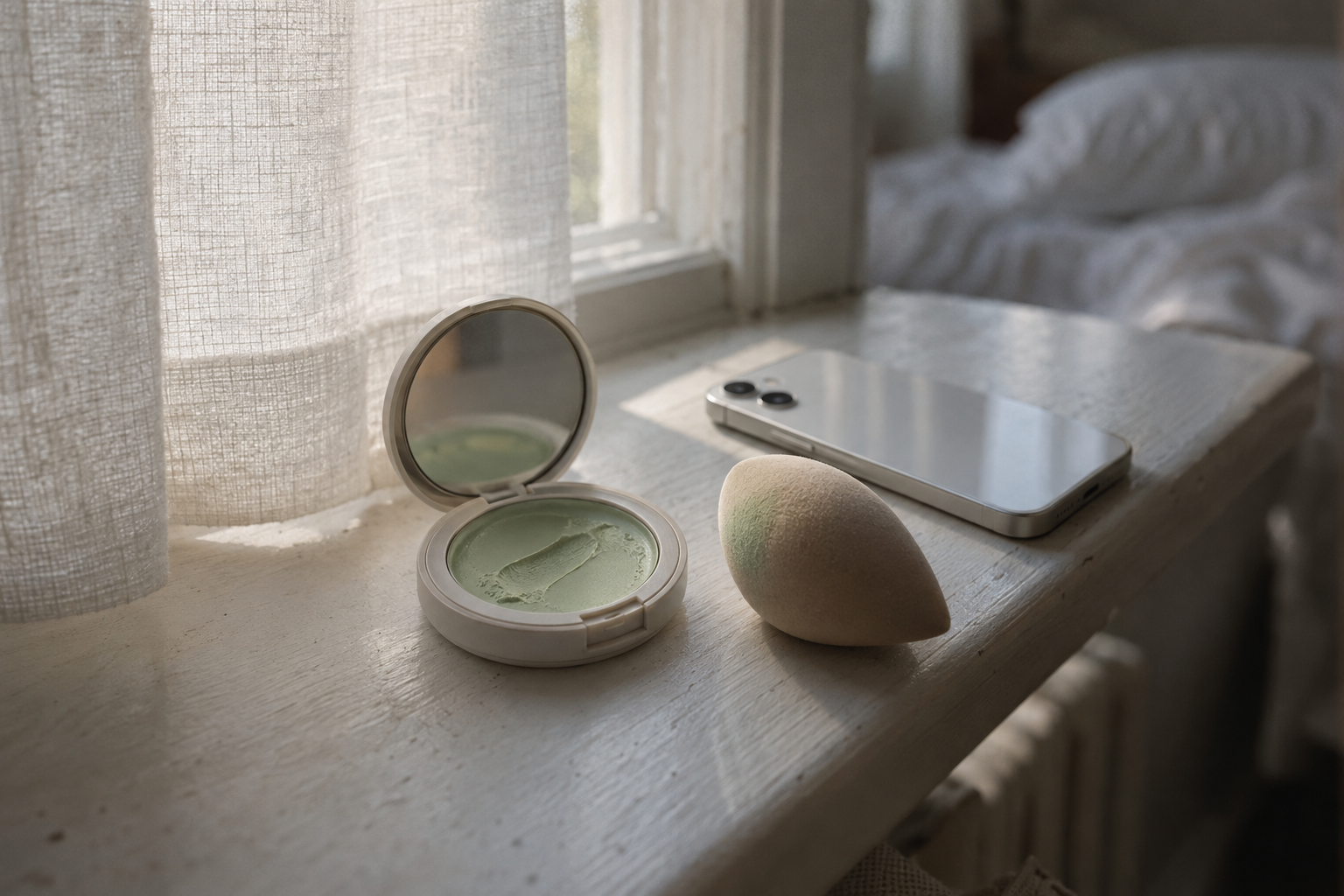
A flare starts on a Tuesday. By the time you're dressed, your cheeks are hot, the redness has crept toward your nose, and you have a meeting at nine. So the green corrector goes on first, then foundation, and maybe the phone's softening mode for the one picture you take that day.
Three weeks later your dermatologist asks what a bad day looks like. You scroll back. Every photo from that week shows calm, even skin.
You did nothing careless that morning. Covering a flare is a reasonable thing to do when you feel exposed, and research backs it: patients with visible, disfiguring skin conditions reported better quality of life after a corrective-cosmetics intervention (Boehncke et al., Eur J Dermatol 2002 The caffeine finding comes from a 2018 JAMA Dermatology study of 82,737 women. It was a large general-population cohort, not a group of rosacea patients, and it looked at who later developed rosacea. Caffeinated coffee was associated with a lower incidence of rosacea. The temperature-trigger finding (flushing from hot drinks at about 60°C) comes from separate research, not from this cohort.). The problem is smaller and odder than that. You were asked to keep a record, and the record quietly filled up with your best-looking days.
The cover-up gap
We call it the cover-up gap. The days worth documenting and the days you're most likely to cover up are the same days.
Nearly every instruction to photograph your rosacea, from clinic handouts to symptom diaries to the appointment checklists we've published ourselves, assumes the skin in the picture is bare. Nobody writes that down because it seems too obvious to say. But people reach for camouflage when they feel least presentable, and that usually means a flare. So the photos with the most clinical value are the ones most likely to be edited, by a sponge or a filter, before you take them.
The result is a diary that looks steadier than the skin it's supposed to record. Good weeks show up bare. Bad weeks show up covered.
Both read as fine.
Does color-correcting concealer work for rosacea redness?
Yes, at what it's built to do, which is change how your skin looks. Green sits opposite red on the color wheel. A thin layer of green pigment over a red patch cancels the red your eye picks up, and a skin-tone layer on top finishes the job. All of that happens in the light bouncing off your face.
Rosacea's redness comes from underneath. The 2017 National Rosacea Society update lists persistent centrofacial erythema (lasting redness across the center of the face) that intensifies periodically as one of the two diagnostic signs, and ties it to changes in the superficial blood vessels plus nerve and inflammatory signaling (Gallo et al., JAAD 2018). A corrector changes what light leaves your skin. The vessels, the heat and the sting stay exactly as they were.
So "cover it if it bothers you" and "photograph it for your dermatologist" are both good advice on their own. They collide on the same morning, and most guidance gives you one without mentioning the other.
The table below runs through the 2017 feature list and shows where a corrected photo goes blind.
Rosacea feature (2017 NRS tier)
What correction or a beauty filter does to it in a photo
What to log next to the photo
Persistent centrofacial erythema (diagnostic)
Neutralized or softened, so the main signal fades
A bare-skin photo, or a note that makeup was on
Flushing (major)
Hidden if covered, and often gone before a photo is taken
When it started, how long it lasted, what came before it
Papules and pustules (major)
Color masked; some texture may still show
Rough count or area, per side of the face
Telangiectasia, the small visible vessels (major)
Often concealed completely
A bare close-up in the same light as earlier entries
Ocular involvement (major)
Eye makeup can hide lid redness
Grittiness, dryness, irritation that day
Burning, stinging (secondary)
Never visible in any photo, covered or bare
A sensory rating that day
Feature tiers from the 2017 National Rosacea Society classification update (Gallo et al., JAAD 2018). The logging column is our recommendation.
Why the gap is wider on deeper skin
On lighter skin, a flare is a loud red signal. Covering it hides part of that signal, but plenty usually survives.
On Fitzpatrick IV to VI skin (the darker half of the standard six-type skin scale), erythema is already harder to see. It can look darker brown or violet-tinged instead of pink, and rosacea gets under-recognized as a result (Alexis et al., JAAD 2019). When the visible signal starts faint, a layer of coverage can wipe out what little the camera had. The patient then arrives with a photo record that looks like nothing. That's the under-diagnosis problem dermatology already has, now backed up by the evidence the patient brought in.
Software compounds it. Adamson & Smith (JAMA Dermatology, 2018) warned that skin-image algorithms trained mostly on lighter skin would underperform on darker skin. Daneshjou et al. (Science Advances, 2022) then tested leading dermatology models on a diverse, curated image set and found their accuracy dropped on Fitzpatrick V and VI images. Put a corrected photo of deeper skin through a tool like that and you've stacked a masked signal on a reader that already struggles with that skin.
This is also why sensory symptoms carry so much weight. Burning, stinging and dryness are part of the 2017 classification, they occur on every skin tone, and concealer can't hide them from a log.
When the visible signal starts faint, a layer of coverage can erase what little the camera had to work with.
Six weeks of photos, logged two ways
Take a hypothetical patient with medium-deep skin whose dermatologist has asked them to keep a log for six weeks before a follow-up. They photograph most mornings. On calm days they skip makeup, so those photos are bare. On the handful of flare days, the corrector and foundation go on first, because those are also the days with a meeting or a dinner they can't skip.
In a grid, the six weeks look flat. The dermatologist sees a mild, stable picture and has no clear reason to change the plan.
Now run the same six weeks with two small changes. On flare days, they take one bare photo before any product goes on, and nobody else ever has to see it. On any covered day, they add a one-line note: makeup on, plus a burning or stinging rating. The grid now has peaks. The bare flare shots stand out against the calm ones, and the sensory notes show what the camera can barely pick up on their skin tone.
Their routine didn't change. They still wore the corrector to the meeting, and the record finally showed what happened.
What changes once you know the record is skewed
If the cover-up gap is real, a diary's value has less to do with how many photos it holds and more to do with whether the worst days are in it bare. A few honest flare photos are worth more than a full month of corrected ones.
In practice that comes down to a few habits:
Photograph before product. It takes seconds, and the photo never has to leave your phone.
Mark covered days. A corrected photo labeled as corrected is still useful. An unlabeled one misleads anyone who reads it, including you in three months.
Skip portrait and beauty modes for log photos. They exist to smooth and even out skin tone, which is the opposite of what a record needs.
Log what a camera can't capture: heat, burning, stinging, eye irritation.
And tell your dermatologist which photos had makeup on. They can work with that sentence.
This isn't an argument against makeup
Keep wearing whatever makes a flare day easier to get through. The fix is one bare photo before the corrector goes on, plus a note on days you couldn't manage it. If a product itself burns or stings, stop using it and bring that up with your dermatologist.
Where Skinframe fits
We built Skinframe on the view that a photo is one piece of evidence in a bigger case. Each entry pairs the picture with per-feature ratings instead of a single composite score, and with sensory symptoms like burning and stinging. That way a day when you covered up still carries real data, and a flare on deeper skin doesn't depend on the camera alone.
Your photos stay on your device. We don't run skin-reading software on them, in part for the reasons Daneshjou et al. documented: that kind of software reads darker skin poorly, and it would read a corrected face as calm.
Closing the cover-up gap takes one bare photo before the corrector goes on and a quick note when you skip it. Bring the whole log to your dermatologist and talk through what it shows. They're the right person to decide what it means.
Log your flare days, bare or covered, and bring the whole picture to your next appointment. Get Skinframe for iPhone.
Evidence from neighboring dermatology conditions (atopic dermatitis, psoriasis) shows that patient-reported tracking improves visit outcomes, and Skinframe applies the same approach to rosacea. Every entry pairs a photo with per-feature ratings and burning or stinging symptoms, so covered days and deeper skin tones still leave a usable record. Photos stay on your phone, and we don't run skin-reading software on them.