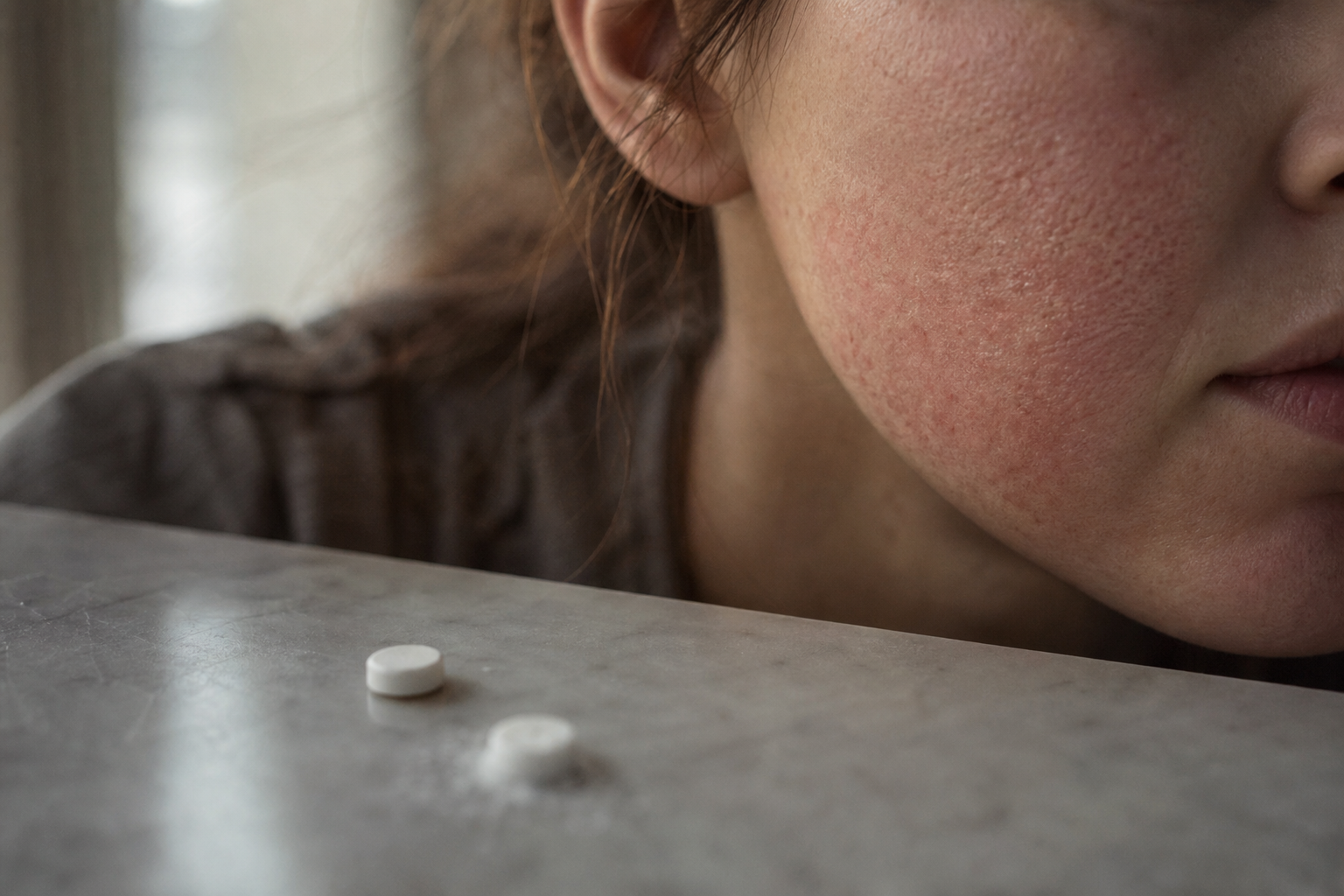
Whether antihistamines clear your rosacea is an accidental subtype test.
Two people with the same rosacea diagnosis and the same severity score can respond to cetirizine completely differently. That gap is diagnostic.
Same chart, opposite results
Two people leave the same dermatology clinic with the same three words on the chart: papulopustular rosacea, moderate. Same flushing across the cheeks, same small bumps, near-identical trigger lists (heat, wine, a hot shower). A month later one of them picks up a box of cetirizine for hay fever and notices, almost by accident, that the redness quiets down within a couple of days. The other tries the exact same tablet and nothing shifts at all. Neither difference made it into a file, because nothing in either visit was built to catch it. And that quiet, unrecorded fork is the most useful piece of information either of them has.
The antihistamine split
Here is the claim: rosacea is not one disease with one engine. It runs on at least two separate mechanisms that can look identical on the surface, and whether your skin responds to an antihistamine is one of the few naturalistic experiments that tells the two apart. We call it the antihistamine split. On one branch, flushing is driven by histamine released from mast cells (immune cells packed with inflammatory mediators), which dilates the small vessels in the skin. Block the histamine receptor with an over-the-counter antihistamine and that branch calms. On the other branch, the flushing is neurogenic: it comes from sensory nerves and irritant-sensing channels in the skin firing directly, a pathway an antihistamine barely touches. Same red face. Different wiring underneath.
Why the labels and the scores both miss it
The tools clinicians reach for describe how rosacea looks, not what drives it. In 2017 the global ROSCO panel and the National Rosacea Society moved diagnosis away from the old subtype buckets (erythematotelangiectatic, papulopustular, phymatous, ocular) toward a phenotype approach (Tan et al 2017; Gallo et al 2018). That was progress, but a phenotype still catalogues visible features. An Investigator Global Assessment score, the 0-to-4 severity grade used in most trials, does the same thing at a coarser resolution. Two people can land on identical scores and identical phenotypes while sitting on opposite mechanisms, because redness graded by eye cannot see whether histamine or a nerve channel produced it. The split hides in a dimension neither instrument measures: response.
What the biopsies and the channels actually show
The mechanistic evidence for both branches exists in the literature, it just never reaches patient education. Biopsies of rosacea-affected skin show elevated mast cell counts compared with unaffected skin (Mast cell density is significantly increased in rosacea lesions, correlating positively with disease duration. ([source](https://www.frontiersin.org/journals/immunology/articles/10.3389/fimmu.2025.1672021/full))), and mast cells are the main reservoir of histamine, which acts on H1 receptors to widen vessels and redden skin. That is the histaminergic branch, and it is the one an antihistamine can quiet. The neurogenic branch runs on different hardware: Sulk et al 2012 mapped altered expression of transient receptor potential (TRP) channels, the heat- and irritant-sensing channels that, together with substance P from sensory nerves, drive flushing without needing histamine as a middleman. Trigger a TRP channel with a hot drink and no H1 blocker will stop it. Both mechanisms can run in the same face at once, which is why the answer for many people is 'partly.'
Histaminergic branch
Neurogenic branch
Main driver
Mast cell histamine, H1 vasodilation
TRP channel activation, substance P from nerves
Overlapping triggers
Heat, alcohol, some foods
Heat, spicy food, temperature swings, stress
Antihistamine response
Often eases
Little to no change
Shows up on IGA / NRS phenotype?
No
No
Two mechanisms that share a diagnosis. Only treatment response separates them. Mechanisms per Sulk et al 2012 and mast-cell literature; response pattern is patient-observable, not a treatment recommendation.
This is documentation, not a prescription
An antihistamine response is a clue about mechanism, not instructions to start, stop, or dose any medication. Don't self-treat rosacea off this. The value is in noticing and recording what your skin already did, then bringing that record to a clinician.
What this looks like in a real log
Picture how the split surfaces when someone actually writes it down. For three weeks a person logs each day: a quick photo, the flush level, what set it off, and whether they took an antihistamine that morning (many people already take one for allergies). A pattern emerges that no single flare could show. On antihistamine days, the baseline redness sits a notch lower and the wine-triggered flush is milder, but the sauna still lights the face up regardless. That is a mixed picture pointing mostly at the histaminergic branch, with a neurogenic component that heat drives independently. Someone else runs the same three weeks and sees no relationship at all: antihistamine or not, the flush tracks purely with temperature and emotion. Their branch is neurogenic. Neither person diagnosed themselves. They just made an invisible experiment legible.
Your over-the-counter history is data your dermatologist hasn't seen
If the split is real, it changes what counts as a productive dermatology visit. Most people arrive with a story shaped by memory, which flattens exactly the signal that matters. What their skin did on the antihistamine days versus the days without is precisely the naturalistic experiment a clinician cannot run in a ten-minute appointment, and it is sitting in the patient's own recent past, unrecorded. Bring a clean record of it and you hand over evidence, not a hunch. A dermatologist deciding between treatments that target vascular reactivity and treatments that target neurogenic flushing is making a mechanism call, and a mechanism clue is the thing patient reports almost never contain.
Where a log earns its keep
This is the exact gap Skinframe is built around: a symptom log that holds the pieces a mechanism read needs, together, over time. A daily photo for the visible evidence, the flush level for severity drift, the trigger, and a simple tag for whether an antihistamine was on board that day. On their own those are four scattered facts. Lined up across a few weeks they become the response curve that the IGA score, the phenotype label, and the patient's own recollection all leave out. The point is not that the app tells you which branch you are on. It is that the app keeps the record honest enough that you and your dermatologist can see the branch for yourselves.
What we're tracking next
The open question is whether antihistamine responders cluster with specific trigger profiles, and whether the mixed cases (partial response plus a heat-driven neurogenic tail) are the majority rather than the exception. The literature on mast cells and TRP channels supports two branches; it does not yet tell patients how often both run at once in the same face. That is the kind of thing a large body of ordinary logs could show that a clinic cannot. As always with anything mechanism-adjacent, the antihistamine question is one to bring to your dermatologist, not to answer alone at the pharmacy counter.
Same red face. Different wiring underneath. Only your response to the tablet tells them apart.
Skinframe is coming to iPhone. Join the waitlist and start capturing what you've already tried over the counter, so the pattern is ready the next time your dermatologist asks.
We build for the trigger-mapping phase specifically: the stretch where a dermatologist has told you to document patterns before treatment, and memory is doing a worse job than you think. Skinframe keeps the photo, the flush level, the trigger, and the medication tag in one place, on your device, so the pattern that matters is intact when someone qualified is looking at it.