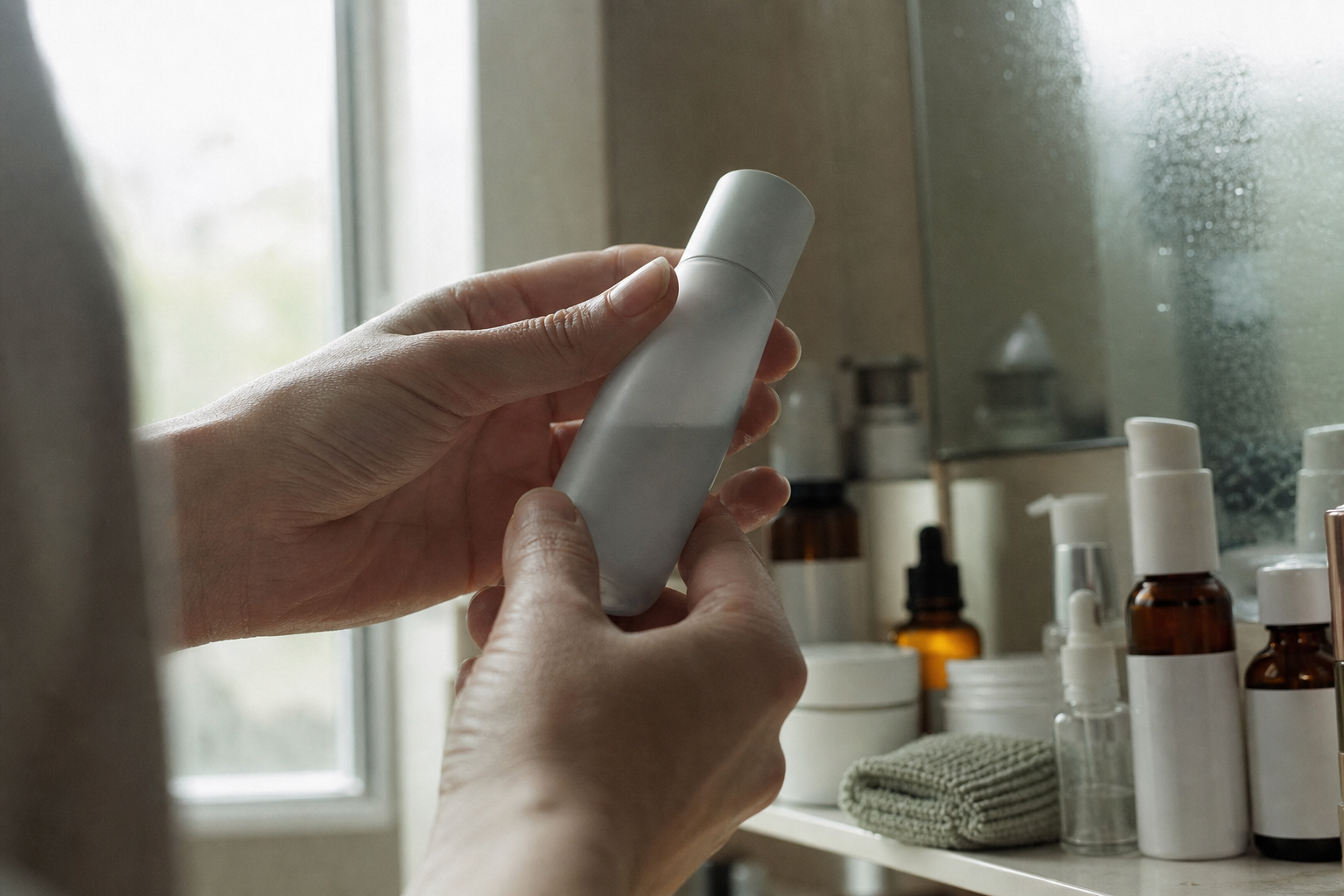
Sold as soothing, listed as a trigger: read the top five ingredients.
Denatured alcohol, witch hazel and menthol keep turning up in the first five ingredients of products sold as soothing. The labeling rules guarantee less than most patients assume.
Turn the bottle around
Pick up almost any drugstore toner sold for reactive or sensitive skin and turn it around. Somewhere in the first five ingredients, just past water and glycerin, you'll often find Alcohol Denat., or Hamamelis Virginiana (Witch Hazel) Water, or Menthol. The front of the bottle says soothing. The back says something else, in Latin, in six-point type, in an order almost nobody has been taught how to read.
All of that is legal. It's also, for a lot of people documenting rosacea flares, the reason six careful weeks of diet elimination and weather logging produce nothing but noise.
The top-five test
Two labeling facts do most of the work. First, US cosmetic ingredients must be listed in descending order of predominance down to 1 percent; below that threshold, a company may list them in any order it likes (FDA, 21 CFR 701.3). Second, the words on the front of the box aren't defined by anyone. FDA has said plainly that "hypoallergenic" has no federal standard and means whatever a given company wants it to mean, and the same holds for "soothing," "calming," and "for sensitive skin." The Modernization of Cosmetics Regulation Act of 2022 added facility registration, product listing and adverse-event reporting duties. It didn't create pre-market approval, and it didn't define a single one of those words.
So the front of the pack is a claim and the back of the pack is a disclosure. Call it the top-five test. The first five ingredients are the only part of that package with a rule behind them, and they're exactly where a vasodilator or a sensory irritant has to appear if the formula leans on one.
Trigger advice written for the kitchen
Standard rosacea trigger advice is a grocery list. Red wine, spicy food, hot coffee, sun, heat, stress: things you eat, drink, or walk outside into. Skin care usually gets one line near the bottom, and that line is "use gentle products," which tells a patient nothing they can act on in a store aisle.
Patients' own reports don't match that ranking. In the National Rosacea Society's patient survey (n=1,066), skin-care products sat near the top of the reported trigger list, above several of the foods that dominate the popular advice. NRS survey of 1,066 rosacea patients found 41% cited certain skin-care products and 27% cited certain cosmetics as triggers. ([source](http://www.rosacea.org/patients/skin-care-and-cosmetics))
The feedback signal patients are handed is shaky too. "Did it make me red" assumes visible erythema is the readout. The image base dermatology teaches and trains from skews light, which Adamson and Smith documented for machine learning in JAMA Dermatology in 2018 and Daneshjou and colleagues quantified on diverse skin images in 2022. For a patient with Fitzpatrick IV to VI skin, flushing may not read visibly at all, and the first honest signal is burning, stinging, tightness or eye irritation, what dermatology calls the sensory phenotype.
Patients aren't failing to avoid their triggers. A share of them are buying their triggers, in a bottle that says calming.
41%
of rosacea patients named skin-care products as a flare triggerNational Rosacea Society patient survey, n=1,066
27%
named certain cosmeticsNational Rosacea Society patient survey, n=1,066
1%
concentration below which US rules let ingredients be listed in any orderFDA, 21 CFR 701.3
The four families that keep showing up
Three irritant families and one look-alike account for most of the confusion. Denatured alcohol (Alcohol Denat., SD Alcohol 40) is ethanol treated to make it undrinkable, used as a fast-drying solvent and to give a matte, non-greasy finish that reads as "light" in a review. At working concentrations it's a lipid solvent, and the barrier it dissolves into is one the 2017 update from the National Rosacea Society Expert Committee (Gallo et al., Journal of the American Academy of Dermatology, 2018) describes as already compromised in rosacea, alongside neurovascular dysregulation.
Witch hazel gets a pass because it sounds botanical. Commercial witch hazel water is a distillate that carries astringent tannins and is typically preserved in ethanol USP specifies Witch Hazel alcohol content (Method I) must be between 14.0% and 15.0% of C2H5OH ([source](http://www.pharmacopeia.cn/v29240/usp29nf24s0_m89070.html)). Menthol, menthyl lactate, peppermint oil and camphor are counterirritants: the cooling is nerve activation, not sedation. Sulk and colleagues (Journal of Investigative Dermatology, 2012) documented altered expression of transient receptor potential channels, the nerve-ending sensors that register heat, cold and burn, in rosacea skin.
And then the look-alike. Cetyl, cetearyl and stearyl alcohol are fatty alcohols, waxy emollients with no chemical relationship to ethanol. They're often the thing holding a barrier cream together. Avoiding them because the word "alcohol" appears is the single most common self-inflicted mistake in this whole exercise.
Counterirritants producing a cooling sensation via nerve-ending TRP channels
Rosacea skin shows altered TRP channel expression (Sulk et al., J Invest Dermatol 2012); the cooling is nerve activation
Camphor / Eucalyptus Globulus Oil
Aromatic counterirritants, common in clarifying and blemish formulas
Same sensory-irritant class, frequently paired with menthol in products also marketed as calming
Cetyl / Cetearyl / Stearyl Alcohol
Fatty alcohols: waxy emollients and emulsifiers, chemically unrelated to ethanol
Not what the alcohol caution refers to; commonly well tolerated and often present in barrier creams
Aliases as they appear under INCI naming. Mechanism notes drawn from Gallo et al., JAAD 2018 and Sulk et al., J Invest Dermatol 2012. Individual tolerance varies; this is a reading guide, not a prohibition list.
Six weeks of clean data, quietly ruined
Here's the shape it takes in practice. A dermatologist asks a patient to document patterns for six weeks before starting anything. The patient does it properly. No wine, no chili, hot drinks logged by temperature, weather noted, photos most mornings. Twice a day, they also use the toner they bought specifically because the box said sensitive skin, the one with witch hazel water third and menthol seventh.
Six weeks later the diary shows flares scattered across the calendar with no dietary pattern anyone can read. The patient concludes their rosacea is unpredictable. The appointment turns into a shrug.
The twice-daily exposure never got a row in the diary, because it wasn't food and it wasn't weather. Undoing that means changing one variable at a time and giving it long enough to say something: hold products constant while testing an intake, or hold intake constant while removing one product. Three days tells you nothing. Several weeks might.
Change one thing, and not the prescription
If you're using a prescribed topical (ivermectin, metronidazole, azelaic acid) or an oral treatment, don't pause it to test a toner. Prescription changes are a conversation with your dermatologist, not a variable to swap in a self-experiment. Test the over-the-counter products around it, one at a time, and bring the results to the appointment.
Log the formula, not the brand
A trigger diary with a "skincare: yes / no" checkbox can't catch any of this. Nor can one that records brand names, because formulas get reformulated and a brand tells you nothing a panel doesn't.
What's worth recording is the product with its actual first-five ingredients, the date you started it, the date you stopped, and a photo taken in the same place under the same light so the comparison means something. Add the sensory read, burning, stinging, tightness, eye grittiness, especially if visible redness isn't a reliable signal on your skin. That's four fields, and it converts "I think it's stress" into something a dermatologist can work with in a twelve-minute appointment: here are the four things I put on my face, here's when each started, here's what my skin did.
The literacy version of this fits on a receipt. Read the first five ingredients. Ignore the front of the pack. Know that a fatty alcohol isn't ethanol.
Where this leaves the diary
We built Skinframe's product log around the ingredient panel rather than the brand shelf, because this is the failure mode we kept finding in patient accounts: careful people, careful diaries, and a twice-daily exposure sitting outside every field the diary offered. Products get logged with what's in them and when they started and stopped. Photos capture under consistent conditions. Everything stays on the device, and we don't ship a skin-scanning model, partly for the reasons Adamson and Smith raised in 2018 and Daneshjou's group measured in 2022.
We're honest about the evidence tier here. There's no rosacea-specific randomized trial showing that a tracking app improves outcomes. What exists is adjacent: in other dermatology conditions, structured patient-reported tracking improves what comes out of a clinical visit. Skinframe applies that approach to rosacea, and we'd rather say that plainly than dress it up.
What we're watching next: whether MoCRA rulemaking ever touches front-of-pack marketing terms, and whether the ROSCO panel's phenotype work produces follow-up guidance that names product exposure as a documented aggravator rather than a footnote. Neither has happened yet. Until it does, the panel on the back of the bottle is the most reliable document in the whole transaction. If a product you use is on that list and your skin has an opinion about it, bring both to your dermatologist.
Track the products, not just the wine and the weather. Get Skinframe and log your next six weeks in a form your dermatologist can read.
Skinframe was built for the documentation phase, the stretch where a dermatologist asks you to come back with patterns. Products are logged by their ingredients and their start and stop dates, not by brand. Photos are captured under conditions you can repeat, so week six is actually comparable to week one. Everything stays on your device, and there's no skin-scanning model making calls about your face. Lifetime is $29.99, or $4.99/mo if that's easier, with one-tap cancel, no rate hikes, and the same features either way.